

When Flowers Speak
By Gayil Nalls
Sign up for our monthly newsletter!
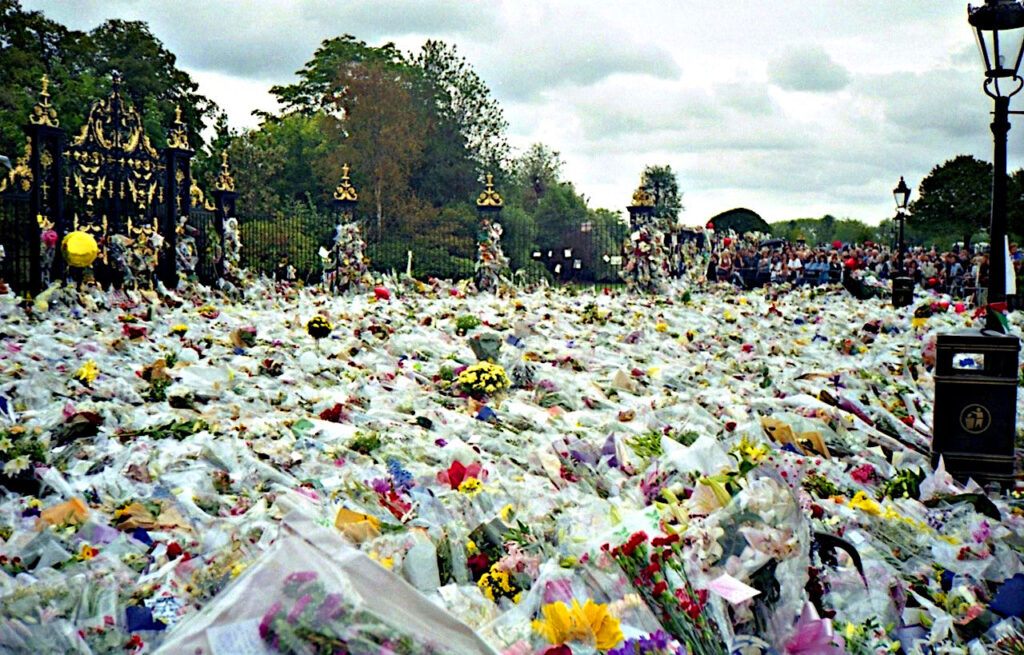
In the days following the death of Princess Diana on August 31, 1997, the gates of Buckingham Palace disappeared beneath an overwhelming tide of flowers. Bouquets and handwritten notes accumulated by the million, transforming a symbol of state authority into an improvised shrine of public grief. The scale was unprecedented in modern British history. Londoners and visitors from around the world brought flowers not only to mourn a young woman’s death, but to express a profound emotional rupture between the people and the institution that represented them.
For several days, the royal family remained out of view, heightening public tension. When they finally emerged, Queen Elizabeth II, Prince Philip, and Diana’s sons, Prince William and Prince Harry, walked among the flowers. The gesture carried immense symbolic weight. Cameras captured a rare reversal: the monarchy, usually distant and elevated, physically descending into the people’s grief. They read notes, paused, bowed their heads. The act did not erase the criticism leveled at the institution, but it acknowledged, quietly and visibly, the emotional authority of the public. Long after the flowers were cleared, composted, or archived, their meaning lingered. They demonstrated how floral rituals can transform spaces of power into spaces of encounter, and how, when shared visibly, mourning can reconfigure national identity.
Flowers are among the oldest cultural instruments through which humans give form to grief, memory, and moral meaning. In locations around the globe, pollen analysis has revealed ritual practices of medicinal plants and funeral flowers at ancient burial sites. Today, across societies, flowers are not only used as decoration and to express sentiment: they are carriers of shared values, social knowledge, and emotional truths that often exceed what language or numbers can express. In moments of crisis, such as pandemics, wars, and periods of political repression, flowers can become a parallel system of communication, translating loss into visible, communal form. Flowers function as cultural signals and ethical gestures, revealing realities that official narratives obscure and enabling collective expression when other channels are constrained or silenced.
In China, the chrysanthemum has long been associated with mourning, funerary rites, remembrance of the dead, and comforting the living. Values that the whole country holds. During the COVID-19 pandemic, this cultural symbolism took on renewed significance as waves of death swept across the country. Official statistics initially reported approximately 73,000 COVID-related deaths, a figure widely regarded as a substantial undercount. For many people, the scale of loss became legible not through government data, but through everyday rituals of grief.
One such indicator was the sudden surge in demand, and corresponding rise in prices, for chrysanthemums. Traditionally purchased to honor recently deceased relatives, particularly around the Lunar New Year, chrysanthemums became scarce as families sought them in large numbers. As Financial Times journalist Kai Waluszewski reported in 2023, florists and wholesalers experienced unprecedented demand, with shortages pointing to a far higher mortality rate than official figures suggested. In this context, the flower market functioned as an informal yet telling index of collective mourning, revealing truths that statistics could not, or did not, fully convey.
In another 2023 case, after a Russian missile struck a residential building in the Ukrainian city of Dnipro, one of the deadliest single attacks since the invasion began, an unexpected and deeply symbolic anti-war ritual emerged in Moscow. In the days that followed, Muscovites began laying flowers at the base of a statue of Lesya Ukrainka (1871–1913), one of Ukraine’s most revered poets, playwrights, and feminist intellectuals, and advocate of national and personal freedom, who spent her final decades living in Moscow. What began as an act of mourning quickly became a public language of dissent.
Flowers, that honored the dead and marked collective grief, took on heightened meaning under conditions where speech itself is policed. Each bouquet functioned as both offering and accusation: a gesture of sorrow for lives lost, and a silent indictment of the violence that caused their deaths. Authorities repeatedly removed the flowers, yet they continued to reappear, transforming the site into a living memorial sustained through repetition. This cycle of removal and return became a wordless confrontation between citizens and the state, a “silent battle” in which remembrance itself served as resistance.
In contemporary Russia, where public protest carries immediate risk of arrest or reprisal, the act of laying flowers became one of the few remaining ways to inhabit public space without overt slogans or banners. The ritual allowed grief to stand in for speech, and memory to function as a political act. What might elsewhere be read as a private expression of condolence became, in this context, one of the earliest large-scale public demonstrations against the war from within Russia.
The practice soon spread beyond Moscow to other cities, as floral memorials appeared in multiple locations. For those who participated, the flowers offered quiet reassurance as well as protest: a sensory reminder that opposition to the war, and to Vladimir Putin’s leadership, persists even in enforced silence. In their fragility and persistence, the flowers embodied a shared moral stance—one that could not be eradicated simply by clearing the pavement.
In Minneapolis this January, at the site where U S citizens Renée Good and Alex Pretti were fatally shot by an Immigration and Customs Enforcement officers, residents and activists left flowers and candles, clustered against the elements as a gesture of mourning and remembrance. These small offerings stood beside handwritten notes and signs calling for justice and accountability, creating a poignant contrast between fragile blossoms and the harsh political and physical climate around them. Local community members, neighbors, and even journalists documented the memorial’s growth as people continued to come and pay their respects.
In other cities, similar scenes emerged. Citizens placed flowers at impromptu shrines as vigils and demonstrations spread across the country. Many of these flowers were gathered alongside candles, pictures, and messages, honoring the sacrifices mourners felt they embodied.
In the midst of protests, chants, and political tension, these floral tributes, laid in the extreme cold and snowy conditions, became places of collective grief and protest in a moment of intense national debate over immigration enforcement, force, and accountability. The flowers offered a quieter language of sorrow, memory, and solidarity, drawing people together across the country and world.
Taken together, these cases show that flowers can operate as cultural evidence and quiet resistance, rendering grief legible when statistics are contested and speech is restricted. Whether marking the scale of loss during the COVID-19 pandemic in China or serving as a wordless protest against war in Russia, or in the UK where flowers functioned as a collective language at a moment when words failed, floral rituals transform private mourning into public meaning. Their power lies precisely in their fragility: flowers wither, are removed, or disappear, yet their repetition sustains memory and insistence.
In this way, flowers carry meaning far beyond their ecological function, beauty, or fragrance. Across cultures and centuries, they serve as messages of condolence and care, bearing witness where words falter. Flowers operate as symbols and rituals, a living language of collective morality, rooted in place, season, and belief. They function as living archives of conscience, preserving shared values, grief, and remembrance. Again and again, flowers speak most clearly in moments when speech is constrained or impossible, offering presence, dignity, and meaning in the face of loss, silence, and oppression.
Gayil Nalls, PhD is an interdisciplinary artist and theorist, and the founder of the World Sensorium / Conservancy.
Sources
Kai Waluszewski, “High demand for chrysanthemums a sign of surging Covid deaths in China,” Financial Times Weekend, January 28–29, 2023.
Valerie Hopkins and Nanna Heitmann,“Protesting War with Flowers at a Poet’s Feet,” The New York Times, January 24, 2023. page A1 and A5.
Julia Naughton, “Diana’s death prompted a sea of flowers we won’t see for the Queen” The Sydney Morning Herald, September 12, 2022. https://www.smh.com.au/world/europe/diana-s-death-prompted-a-sea-of-flowers-we-won-t-see-for-the-queen-20220912-p5bh9q.html
Plantings
Issue 57 – March 2026
Also in this issue:

Jane Colden: Naming the Living World
By John Steele

Why is Old Bay Maryland’s Culinary Anchor?
By Ian Sleat

Ecological Grief: The Work of Mourning Landscapes and Lost Species
By Margherita Gandolfi

Asking Trees to Solve a Roman Conspiracy
By Molly Glick
Attract Pollinators to Your Garden and Other Tips
By WS/C

Eat More Plants Recipes:
Hearty Green Pasta Sauce
By Ian Sleat
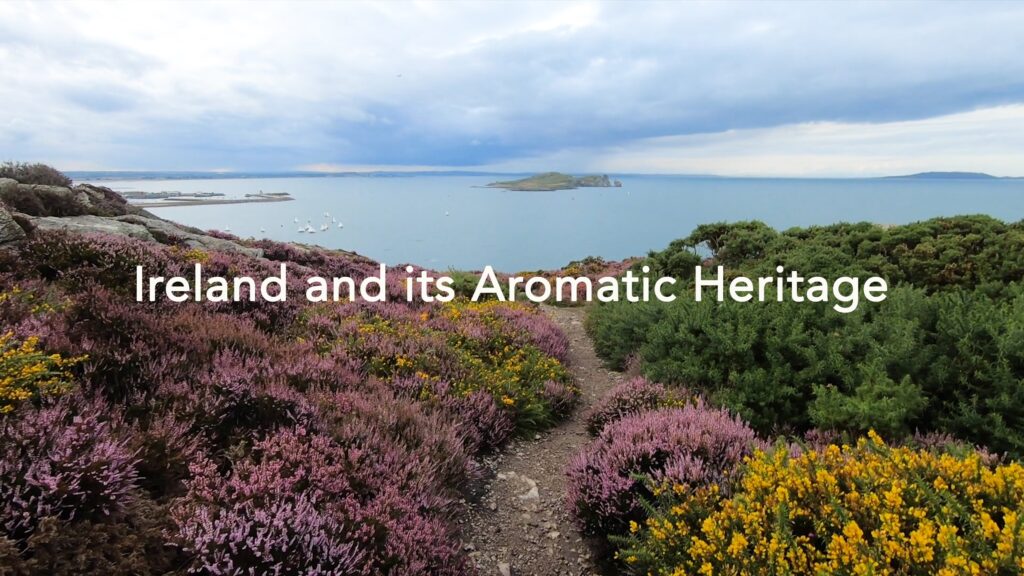
As Ireland transitions from the rich, smoky scent of peat-burning to a more sustainable future, its olfactory heritage is evolving. What will become the next iconic aromatic symbol of Ireland?
Click to watch the documentary trailer.
As Ireland transitions from the rich, smoky scent of peat-burning to a more sustainable future, its olfactory heritage is evolving. What will become the next iconic aromatic symbol of Ireland?