

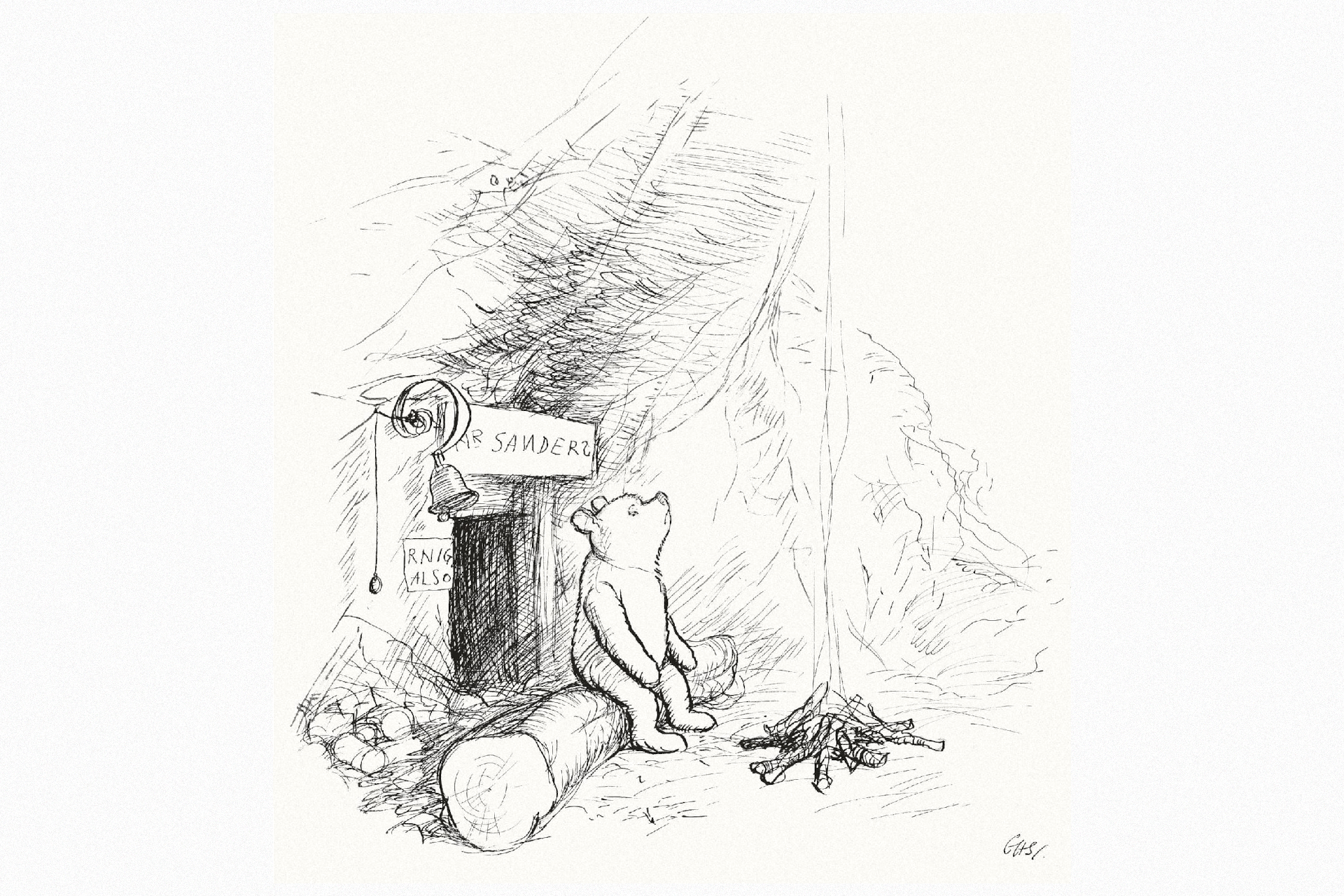
Reflections on the Hundred Acre Wood
By John Steele
Sign up for our monthly newsletter!
Most people are familiar with A.A. Milne’s books or the Disney films or the Kenny Loggins song or Christopher Robin Milne’s small, well-worn stuffed bear that still sits at the New York Public Library with his friends. However they come to him, they know the world Winnie-the-Pooh inhabits, the Hundred Acre Wood, and the gentle adventures he shares there with Christopher Robin.
Childhood does not study nature; it lives it. It does not approach the world as a problem to be solved, but as a presence to be met. In a place like the Hundred Acre Wood, a clearing is not a habitat defined by edge effects and light gradients; it is simply a place where something might happen. A fallen tree is not coarse woody debris returning nutrients to the soil, but a bridge, or a seat, or a beginning. The categories come later. The relationship comes first.
This is not ignorance. It is a different order of knowledge, one that precedes abstraction and, in some ways, exceeds it. When a child walks through a forest, they do not ask what the system produces. They ask, without words, who it is. And the forest answers in textures: in the softness of moss, in the dry whisper of leaves, in the long patience of trunks leaning toward light. It answers in time as well, though not the time of clocks. As one voice in that Wood observes, “Rivers know this: there is no hurry.” Growth follows readiness, not schedule. Change arrives when it is complete, not when it is demanded.
Adulthood, and with it science, introduces a new language. We learn to name, classify, and measure. We come equipped with instruments and intentions. We speak of nutrient cycles, successional stages, competitive advantage. These are not illusions; they are achievements, hard-won and necessary. They allow us to see patterns invisible to intuition alone, to understand processes that unfold over decades or centuries.
And yet something is lost if we mistake this language for the whole of reality. In learning to describe the forest, we risk ceasing to inhabit it. We begin to ask only what can be quantified, and neglect what must be experienced. The forest becomes a system before it is a place.
The Hundred Acre Wood resists this reduction, not by denying ecological truth, but by presenting it in another register. It is not a simplified forest; it is a faithful one, seen through attention rather than analysis. Here, nothing is wasted. Decay is not failure but continuation. A rotting log is not an ending, but a transformation with fungi threading through its fibers, insects carving passageways, new growth taking hold in the softened ground. A child does not mourn this process, they climb it. They understand, without formal instruction, that change is not the opposite of life, but its condition. Children see the world as they and their imagination find it.
What childhood grants is not a lack of knowledge, but a form of belonging. The child does not stand apart from the forest; they are within it, implicated in its rhythms, responsive to its moods. They do not imagine themselves as separate from growth, weather, or time. They participate.
Science, at its best, arrives at the same conclusion by a longer path. It proceeds through doubt, error and revision. It disciplines wonder without extinguishing it. Knowledge, in this sense, is not the accumulation of facts, but the refinement of attention. It is the ability to see more, not less.
The advance of human understanding depends not only on reason, but on imagination, the capacity to enter into other forms of life, to see the world from perspectives not our own. Childhood is our first training in that capacity. We imagine ourselves into the lives of animals, into the stillness of trees, into the quiet persistence of landscapes. We do not yet call this empathy ecological, but that is what it is.
This is why such a Wood endures in memory. Not because it offers escape, but because it recalls a way of encountering the world that we have not entirely lost. The forest of childhood is not simpler than the forest of science; it is prior to it. It contains, in seed form, the curiosity that science later cultivates.
To walk again, as an adult, through such a landscape is to feel the tension between these ways of knowing. One part of the mind names species, notes soil, measures light. Another part simply notices: the path, the light, the stillness. Occasionally, these do not conflict but align.
In such moments, something is restored. Knowledge does not require distance, and precision need not exclude affection. To know a forest fully is not only to analyze its processes, but to experience its character.
There is humility in this recognition. The child possesses it naturally; the scientist must learn it deliberately. It is the understanding that we are not masters of the systems we study, but participants within them. That our measurements, however exact, are partial. That the forest exceeds our descriptions.
This is not a retreat from science, but its fulfillment. The aim of knowledge is not domination, but comprehension, and comprehension includes relationship.
In the end, the lesson of the Hundred Acre Wood is neither nostalgic nor naïve. It does not ask us to abandon what we have learned, but to remember what we once knew. That stillness has value, “Sometimes I sits and thinks, and sometimes I just sits” as Pooh says with characteristic economy. That patience is not passivity, but participation. That life unfolds at its own pace.
And if we listen carefully, beneath the language of data and description, we may hear again a quieter understanding, that the world is not in a hurry, and neither, perhaps, are we meant to be. Or to quote the Tao of Pooh, “Things just happen in the right way, at the right time.”
John Steele is a publisher and the founder of Nautilus Magazine.
Plantings
Issue 58 – April 2026
Also in this issue:

Earth Day: What Is Biodiversity—and Why Does It Matter?
By WS/C
John Burroughs: “The Incense of April”
By Clara Muller

The Science of a Sense of Place
By Gayil Nalls
Antibacterial Herbs: Ancient Remedies, Modern Science
By Gayil Nalls
You probably agree with the animals on which bird calls, frog noises and cricket chirps are most attractive – new research
By Logan S. James

Eat More Plants Recipes:
Vegan Confetti Coleslaw
By Gayil Nalls
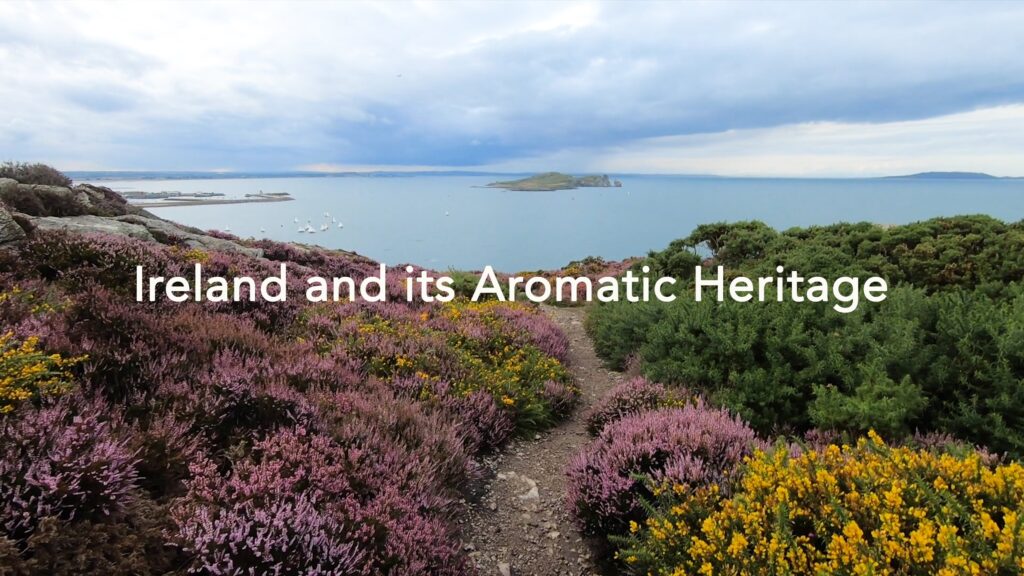
As Ireland transitions from the rich, smoky scent of peat-burning to a more sustainable future, its olfactory heritage is evolving. What will become the next iconic aromatic symbol of Ireland?
Click to watch the documentary trailer.
As Ireland transitions from the rich, smoky scent of peat-burning to a more sustainable future, its olfactory heritage is evolving. What will become the next iconic aromatic symbol of Ireland?