

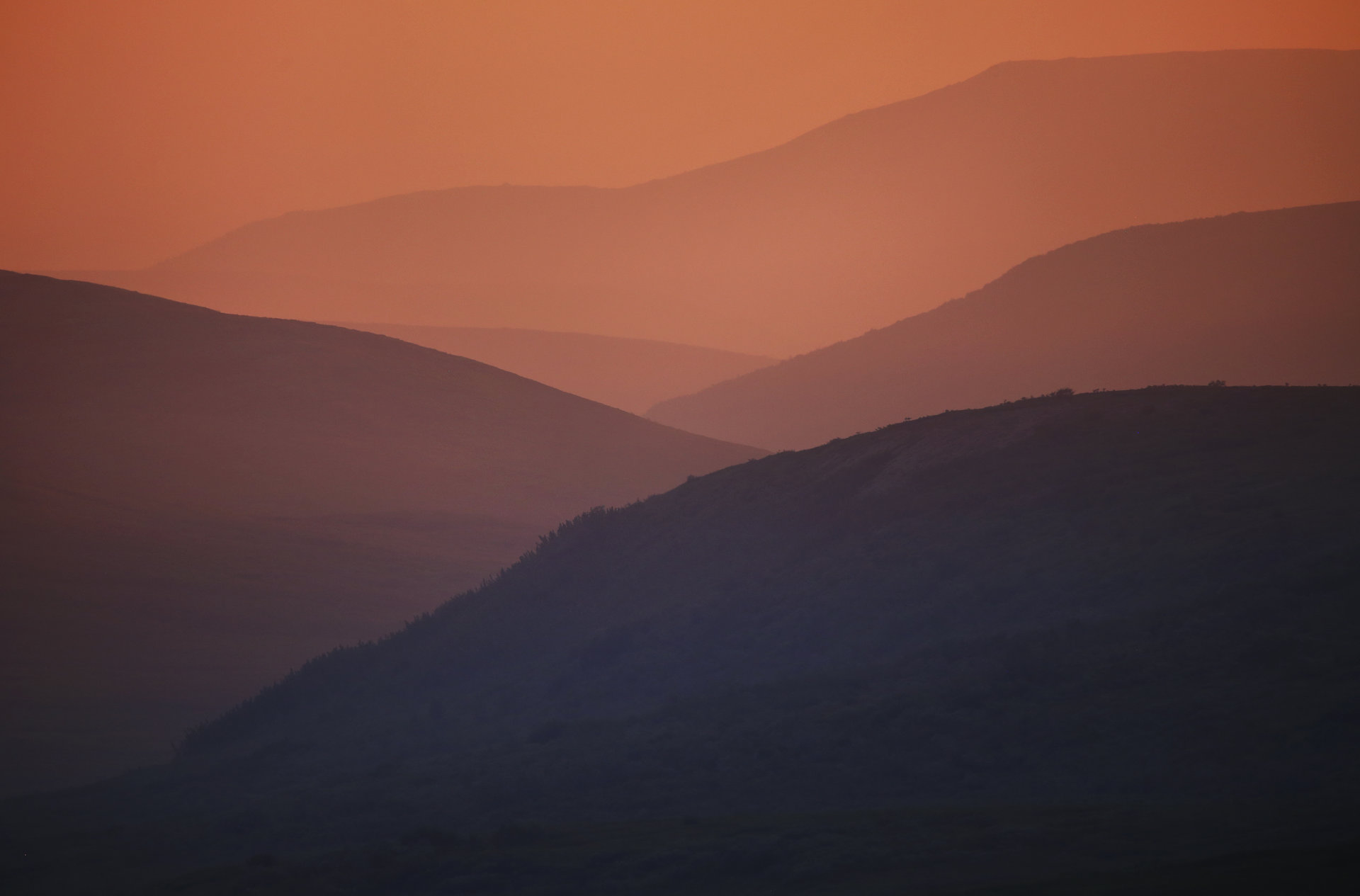
Wildfire haze at sunset over the mountains west of Eielson Visitor Center, Denali National Park and Preserve, Alaska, June 28, 2019. Photograph by Emily Mesner / National Park Service. Public Domain (U.S. federal government work).
Romain Sordello: Sensory Pollution and the Ecology of Odor Landscapes
By Clara Muller
Sign up for our monthly newsletter!
In the Western history of landscape, vision has long been the dominant model: a landscape is something offered to the human gaze, something to be framed, painted, and contemplated from the outside. When the humanities began using the notion of smellscape in the mid-1980s, it was precisely to challenge this visual bias by drawing attention to the olfactory dimension of places. Yet these early approaches remained largely concerned with human experience.1 Ecology invites a further shift in perspective: the question is no longer only how other-than-human beings contribute to the olfactory environments humans perceive, but what a landscape smells like to them, and why it matters to their lives. Research in chemical, landscape, and sensory ecology has indeed shown that environments are more than just spatial configurations: they are perceptual worlds whose contours and significance vary according to the organisms inhabiting them.2
Over the past decade, new questions have arisen in conservation around sensory landscapes, with the long-neglected olfactory dimension receiving increasing attention.3 What happens when human activities alter the chemical environments on which other organisms depend? Atmospheric pollutants can degrade natural odorants; land-use change can remove or transform their sources; agriculture, industry, transport, and everyday human activities introduce new molecules into ecosystems. Odor landscapes can thus be impoverished, masked, or distorted.4 These issues are central to the work of Romain Sordello, an engineer and PhD in ecology at the French Office for Biodiversity’s PatriNat unit.
In his doctoral research and in his recent book Pollutions sensorielles. La face cachée de notre empreinte écologique? (2026), Sordello argues that anthropogenic environmental changes extend beyond their visible and material forms. Roads, dams, sealed soils, and fragmented habitats alter ecosystems physically, but human activities also emit light, noise, and volatile molecules that interfere with the sensory worlds of other living beings. His research asks what this means for conservation and spatial planning, and whether ecological connectivity itself should be understood as sensory as well as physical. In this interview, he discusses the emerging concept of sensory pollution, the still largely unexplored ecological effects of olfactory disturbance, the possibility of protecting “olfactory corridors” within increasingly altered landscapes, and what humans might gain from learning to perceive landscapes as shared, multispecies perceptual environments.
Clara Muller: Your book, Pollutions sensorielles. La face cachée de notre empreinte écologique? [Sensory Pollution: The Hidden Side of Our Ecological Footprint?], is adapted from your doctoral dissertation, which focused on light, noise, and odor pollution, in relation to ecological networks. How did smell — long neglected in this field — enter your work?
Romain Sordello: I came to this question through light pollution, which was my original field of research. In France, light pollution was long approached through the disappearance of the starry sky. But researchers working on multisensory pollution — in particular Dominoni, Halfwerk, and Slabbekoorn — have shown that the framework needed to be broadened. Artificial light at night is not only a problem of disrupted day-night cycles: it also interferes with sensory perception. From that point of view, it has something in common with noise and odor pollution. The aim of my dissertation was therefore to build on the work I had already done on light pollution, and then to broaden the scope. These three forms of pollution are not at all at the same stage in terms of scientific knowledge. On light, there are several thousand articles, a research literature spanning twenty or thirty years. On noise, there is already a substantial body of work. On odors, however, there is almost nothing: barely a dozen articles in ecology on the effects of human activities on the sense of smell of non-human animals.
C.M.: Could this gap be explained by the fact that ecological research itself operates within a modern Western context that has historically devalued the human sense of smell, and has therefore paid less attention to olfaction in non-human species as well?
R.S.: Perhaps. It is paradoxical, because we are diurnal animals and therefore very oriented towards vision, but we are also mammals, and among mammals, smell generally plays a major role. Yet we value it very little. However, if we try to put ourselves in the place of other mammals — or most non-human animals for that matter — smell is often essential for choosing a habitat, detecting a predator, locating a resource, or recognizing a conspecific. In ecology, we still sometimes have a very anthropocentric perspective. In landscape ecology, for example, when we try to identify ecological networks, we often assume that a forest species will choose forest corridors because it “likes” the forest. But we do not really put ourselves in the animal’s position. Why does it choose one path rather than another? What tells it that a passage is favorable or hostile? These are choices guided by different kinds of sensory information. For animals, the landscape is not only a physical structure made up of forests, hedges, roads, or fields. It is also a set of visual, acoustic, chemical, and other kinds of information. If we fail to take those cues into account, we fail to understand what actually makes an environment habitable or usable for a given species.
C.M.: Your work therefore invites us to revisit the very notion of landscape. What does it change, for an ecologist, to think of landscape not only as a spatial or visual reality, but as a multisensory one?
R.S.: I have a particular relationship to this notion, because I originally trained at a school of landscape architecture. It is a concept I am very fond of, but also a highly polysemous one. Landscape can refer to garden design, spatial planning, an aesthetic, cultural, or heritage category, but also to a framework of analysis in ecology. The institutional definition of landscape in Europe comes from the Florence Convention of 2000, which defines it as an area as perceived by people. But the perceivers in that definition are implicitly human. I think that needs to be revisited. A landscape is not simply a territory: it is a portion of territory as perceived by a living being — any living being. In ecology, the landscape scale often provides a framework for observing flows: gene flow, the movement of individuals, dispersal, connections between habitats. But why not also consider flows of sensory cues? That is precisely what I wanted to do: bring together landscape ecology, which deals with space, habitats, and connectivity, and sensory ecology5, which looks at how organisms acquire and use information through their senses. What was missing was a stronger connection between thinking about perception at the scale of the landscape, and thinking about landscape itself as a configuration of sensory signals.
C.M.: In your work, you show that an odor – just as the landscape – does not exist in itself. It depends on an organism that perceives it. What does this imply for the way we think about olfactory landscapes across species?
R.S.: Yes, we need to distinguish between potentially odorant molecules and odors. An odor only arises when an odorant molecule is detected by a biological receptor. The same molecule may produce an odor for one animal and be imperceptible to another. This means that an odor landscape really does not exist independently of an organism that perceives it. For me, the sensory landscape could be defined as the passage between physicochemical space and the reality of an individual. This is where Jakob von Uexküll’s notion of Umwelt, or self-world, becomes very useful (von Uexküll & Kriszat, 1934). Animals may share the same geographical space without inhabiting the same world. They do not perceive the same signals, at the same distances, with the same intensities, and those signals do not have the same importance for them. This is why I also speak of “multiple sensory landscapes” rather than simply of a “multisensory landscape”. There is a visual landscape, a soundscape, an odor landscape, and their contours do not coincide. Sound can travel over long distances, whereas what one can see may be limited by vegetation or darkness. Volatile molecules move differently again: their distribution and detectability vary with wind, humidity, temperature, and concentration. So the sensory landscape is not simply a visual landscape to which sounds and odors have been added. We are dealing with landscapes, in the plural, that overlap without ever fully coinciding.
C.M.: What can we know or map about the olfactory potential of an environment before taking a particular species’ perception into account?
R.S.: In terrestrial ecosystems, the physicochemical environment is shaped primarily by vegetation and soils. Plants emit numerous volatile organic compounds. Soil microorganisms — bacteria, fungi, etc. — and decomposing matter also release molecules into the environment. Animals add their own chemical traces: pheromones, body odors, feces, and signals associated with reproduction, predation, or territoriality. Together, these emissions create chemical and olfactory signatures characteristic of particular environments. In the long term, one could imagine mapping potential odor landscapes on the basis of the composition of a habitat. If we know which plants are present, for example, and which volatile compounds they emit, we can begin to characterize its olfactory potential. But that would still not tell us what a particular animal actually perceives. To reconstruct its experienced olfactory landscape, we would also need to know its receptors, detection thresholds, behaviors, and ecological needs. So we might be able to map an olfactory potential, but not exactly what is perceived at a given moment. Even so, this would already offer another way of describing an ecosystem. In acoustic ecology, many researchers characterize environments through their sounds — the diversity of calls, rhythms, intensities. One could imagine something comparable for odors.
C.M.: How are human activities altering biogenic odor landscapes?
R.S.: There are several mechanisms. One is the destruction or degradation of the sources that naturally produce odors: soils, plant communities, wetlands, forests, meadows, etc. Land conversion, soil sealing, monocultures, deforestation, and the introduction of non-native plants all modify odor landscapes indirectly by altering the very sources of the molecules being emitted. A second mechanism is the production of molecules through our own activities — industry, transport, agriculture, livestock farming, waste treatment. Some of these molecules might already occur in the natural environment, but we emit them in much higher concentrations; others were not previously present in that place, or not in that form. We therefore introduce signals that may be new, overly concentrated, or misleading. Finally, some pollutants are not necessarily odorant themselves but can chemically degrade natural odorant molecules before they are perceived. Certain atmospheric pollutants, for example, reduce the lifetime of floral odorants and the distance over which they can be detected, so that a pollinating insect may no longer be able to locate a flower, or may detect it only at much shorter range. Here again, there are clear parallels with light and noise pollution: artificial light masks the stars used by some animals as navigational cues, anthropogenic noise masks natural sounds, and in much the same way, the molecules we emit can mask, replace, or transform natural odors.
C.M.: What you say about the degradation of natural odor sources brings to mind a passage from Thoreau’s A Week on the Concord and Merrimack Rivers (1849), in which he evokes the disappearance of “odoriferous native plants, sweet-scented grasses and medicinal herbs” that had once perfumed the atmosphere (Thoreau, 1849, pp. 374–375). He associates this loss with grazing, increasingly “artificial” forms of cultivation, and the transformation of the land into a space of production. What strikes me is that he arrives at this observation through close sensory attention, while today we often rely on sophisticated air-sampling technologies to document such changes.
R.S.: That is very interesting, because it connects directly with what we were saying about odor sources. If we destroy soils, plant communities, species-rich meadows, hedges, or wetlands, we are not only changing the physical structure of a habitat: we are also changing what that habitat emits, and therefore what can be perceived by living beings. It also shows that we, as humans, can perceive some of these transformations, provided that we pay attention. But we need to remain cautious: our own perception cannot tell us how other species experience those changes. It can be a point of entry, a warning signal, a way of becoming aware that landscape cannot be reduced to what we see. Ecology can then investigate and substantiate these observations.
C.M.: How are these forms of alteration and pollution managed today, and how might they be better addressed in the future?
R.S.: With light, if you switch it off, it disappears. With an odor, once it is present in the environment, it is much harder to neutralize. I looked, for example, at activated carbon, absorption systems, and other odor-capturing devices designed to remove or neutralize smells. Another approach is to counter an unwanted odor with an additional one. But to me, that is not really a solution, because it introduces a new odor that is not necessarily ecologically appropriate. In my dissertation, I give an almost caricatural example: a duck farmer had been found responsible for creating an olfactory nuisance — for humans, in this case. The solution imposed was to counter the unpleasant odor with a supposedly pleasant one by diffusing a raspberry scent. From a human point of view, the logic is understandable: we would rather smell raspberries than ducks. But from the perspective of another animal, the smell of ducks is information. It signals a presence, a concentration, an activity. The raspberry scent, by contrast, is misleading: there are no raspberry bushes there. We are effectively distorting the olfactory environment of non-human animals in order to make the place more pleasant for ourselves. This is where we need to shift perspective. Birds do not sing for our pleasure, and the odors of an environment are not there for our enjoyment: they carry vital information and are part of ecological relationships.
C.M.: Is there, in France or elsewhere, any regulatory framework that addresses odor pollution from an ecological rather than primarily human perspective?
R.S.: There used to be the French law of August 2, 1961, on atmospheric pollution that explicitly mentioned odors, but it was repealed in 2006 for reasons unrelated to this particular issue. Today, odors still appear in some French legal texts, but mainly in relation to humans: public health, neighborhood disturbance, housing conditions, olfactory nuisance, and so on. From an ecological perspective, however, there is practically nothing. Odor observatories, for example, are generally designed by humans and for humans. They can be very useful for documenting nuisance, but they do not yet amount to an ecological approach to olfaction. There is, however, an interesting opening in the 2021 French law on the sensory heritage of the countryside. It was initially conceived to protect the characteristic sounds and smells of rural life — the crowing of roosters, church bells, the smell of manure, and so on. But the wording introduced into the Environmental Code also refers to natural spaces, resources, and environments, to daytime and nighttime landscapes, and to the sounds and odors that characterize them.6 This could therefore be interpreted as going beyond the protection of human or cultural heritage alone: it could potentially encompass the odors of plants, soils, ecosystems, and habitats. For the moment, however, that possibility has not really been explored.
C.M.: In your work, you propose the idea of preserved “olfactory corridors” — trames olfactives in French. How would you define it simply?
R.S.: The idea comes from the French framework of ecological networks: the trame verte for creating continuities in terrestrial environments, the trame bleue for aquatic environments. The trame noire later emerged to preserve darkness and reduce light pollution along ecological corridors, followed by the trame blanche, concerned with acoustic quiet.7 This notion of a trame — a network of ecological continuities — is quite specific to France. At the European level, one would more commonly speak of green infrastructure. But the idea of extending these ecological networks to sensory dimensions has developed particularly in France. Of course the aim is not to create a few protected areas and corridors and then assume that anything is acceptable outside them. A trame is a tool for preserving or restoring ecological continuity. But it cannot replace broader policies aimed at reducing pollution at the source. An olfactory corridor would therefore mean taking both odor continuity and olfactory disturbance into account in spatial planning. But I remain cautious, because we do not yet have the same tools for odors as we do for light. With light, we know fairly well what can be done: switch it off, reduce intensity, adjust color temperature, restrict operating hours. Odors are much more difficult to manage.
C.M.: How could olfactory corridors actually be maintained in practice, and what could managers of natural areas do to protect them?
R.S.: We can imagine technical solutions such as capture or absorption systems, activated carbon, or physical barriers designed to contain odors, but these all have limitations. Physical barriers are problematic because they introduce additional obstacles into the landscape, whereas landscape ecology is precisely concerned with maintaining the permeability of environments. Vegetated barriers may seem more promising, but they can also expose plants themselves to pollutants — almost as though we were sacrificing vegetation to protect the rest of the ecosystem. The most coherent approach is therefore to reduce emissions at the source: rethink certain industrial processes, reduce the use of combustion-engine vehicles, limit agricultural inputs, and preserve soils, hedgerows, and diverse vegetation. At the scale of protected or managed natural areas, one could also imagine more targeted measures. For sound, some managers already establish quiet zones through signage, restrictions on certain recreational activities, or regulations on outdoor concerts. I have seen nothing comparable for odors. Yet one could imagine recommendations such as not wearing perfume in particularly sensitive environments, avoiding strongly scented laundry products, limiting the use of combustion engines, or restricting dogs in certain areas, since they leave strong olfactory traces. These measures would need to be tested, documented, and evaluated. More broadly, reducing the artificialization of environments does not only reduce our physical footprint; it also reduces our sensory footprint. Ultimately, this is a question of how we choose to inhabit the world…
C.M.: Most people don’t think that a perfume worn while walking in a forest — even if it is made from natural materials — can become a form of pollution…
R.S.: The issue is not only whether a molecule is “natural” or “artificial.” If you enter a forest wearing a strong smell of rose, jasmine, or patchouli, when there are no roses, jasmine, or patchouli in that environment, you are introducing an odor source that is not characteristic of that environment. You are modifying the olfactory composition of the place and possibly disrupting important chemical communications. At an individual scale, this may seem anecdotal compared with industrial, agricultural, or road-traffic emissions. But it clearly shows the cultural shift that is needed. We do not spontaneously think that, when we enter an environment, it is already permeated by olfactory information that matters to other living beings.
C.M.: Could odors themselves become tools for conservation — for instance, to guide animals toward safe crossings or away from dangerous areas?
R.S.: Yes, it is an interesting possibility, but it needs to be approached with great caution. Acoustic and olfactory signals are already used to scare animals away, to protect crops, or reduce collision risks. But these interventions are generally designed from a human perspective. A more ecological approach would ask how we might restore or reinforce signals that are useful to the animals themselves. One could, for instance, place deer droppings on a wildlife crossing to encourage animals to use it, broadcast amphibian calls to guide them toward a wildlife tunnel, or use olfactory cues to facilitate the recolonization of a restored habitat. At the same time, we have to remember that an odor intended to benefit one species may disturb another. In a complex ecosystem, non-target effects are very difficult to predict. So I would rather describe this as a field of research and experimentation than propose ready-made solutions.
C.M.: What research priorities seem most urgent to you today?
R.S.: First, we need a better understanding of olfaction in non-human animals. Insects are relatively well studied, especially in the context of plant-insect interactions. But when it comes to birds, for instance, we still know remarkably little. For a long time, they were thought to have almost no sense of smell, even though some seabirds and nocturnal raptors actually use it extensively. We also need to understand the mechanisms of sensory disruption more precisely: masking, saturation, chemical degradation, olfactory decoys, disorientation, and so on. And we need to work on thresholds: at what concentration does a particular molecule begin to disrupt an animal’s behavior? Those thresholds are probably highly variable depending on species, individuals, and contexts. Finally, we need to develop mapping tools. We could begin by mapping odor sources — vegetation, soils, infrastructure, emission zones — and then cross-reference those data with what we know about the species present and their sensory capacities. For now, all of this remains highly exploratory.
C.M.: Many biologists believe that olfactory landscapes are likely to change profoundly in the coming decades, because of pollution and climate change in particular. In your view, what other factors could affect future smellscapes?
R.S.: The difficulty is that we do not have a baseline. As we mentioned earlier, changes have been underway at least since the Industrial Revolution. In France, for example, the road network is already very dense and the transformations linked to traffic go back several decades. They will probably continue to intensify, but the major shift began a long time ago… As far as odors are concerned, I think landscape simplification and soil sealing are central: urbanization is still ongoing; agricultural intensification is reaching areas that had remained relatively intact; hedges are being uprooted; meadows are being plowed up; monocultures are spreading; etc. As long as we alter soils and plant communities, we will continue to impoverish odor landscapes. Everything else is linked to industry, transport, and agriculture. As long as we do not profoundly question these three activities, it will remain difficult to slow or reverse changes.
C.M.: How can these issues be made understandable to the general public? Can artistic practices play a role?
R.S.: Yes, I am convinced they can. About ten years ago, I created a dance performance about light pollution. It was a hybrid format: danced solos of about twenty minutes, interspersed with a voice-over giving factual elements, followed by a short scientific talk of fifteen minutes. In the solos, I addressed light pollution through the body: the origin of night, the arrival of artificial light, its effects on living beings. I “spoke” through dance, through the choice of gestures, through light, through rhythm. Only afterwards did the scientific data come in. I really believe in the power of this format. Once people have been engaged emotionally and through their senses, scientific information is received much more readily. In my work, I give many lectures, but I can see that this is not always enough. You can overwhelm people with figures; if they have not felt something themselves, it does not necessarily lead to change. Art reaches people differently, more viscerally. Of course, this does not mean that we should abandon science. Science is indispensable. But it is not enough. Many researchers in ecology feel this: we accumulate data, we sound the alarm, and yet we sometimes feel that we are not being heard. On sensory issues, it seems especially relevant to also work through sensory forms, because the question itself concerns the way living beings perceive their world.
C.M.: Do you think that if we, as humans, revalued smell as a mode of perception — as a way of knowing and navigating the world — we might better understand the importance of non-human olfactory worlds, and therefore be more inclined to imagine solutions?
R.S.: Yes, provided we do not assume that our own perception is enough to imagine that of other species. We do not have the same olfactory world as an insect, a dog, a seabird, or an amphibian. But educating our attention and our sense of smell can definitely help us understand that landscape is not only what we see but a space full of invisible signals that other living beings read, follow, avoid, or seek out. So that may be a first step: realizing that when we enter a forest, a meadow, or a riverbank, we are not entering a silent, neutral setting. We are entering an environment full of multispecies messages. Our presence and activities can thus scramble them, mask them, or erase them. And this, too, is part of our ecological footprint.
Clara Muller is a French art historian and art critic conducting research on olfaction in art, design, and literature. She has been a writer for the olfactory magazine and publishing house Nez since 2016. She contributes to the collection “The Naturals Notebooks” for which she studies the place of aromatic plants in the history of visual and decorative arts. She has curated several exhibitions dedicated to olfactory art and design. https://www.claramuller.fr/
Footnotes
1The notion of smellscape was introduced in geography by Daniel W. Gade (1984) and J. Douglas Porteous (1985), who used it to describe the olfactory dimension of places and of human landscape experience. Paul Rodaway (1994) later helped consolidate this approach within sensory geography by situating smell among the embodied and spatial ways through which humans perceive and make sense of their environments. Since then, the concept has been widely used — and critically discussed — in geography, urban studies, landscape studies, tourism studies, and heritage studies. It has nevertheless remained largely centered on human perception. A recent synthesis by Morenets (2025), for instance, defines smellscape as “a unified theoretical framework for understanding how humans perceive and interpret olfactory environments within specific contexts and periods” (p. s107). While she draws on geography, cultural history, urban studies, psychology, cultural studies, and anthropology, she does not engage with the ways smellscapes have been approached in ethology, ecology, or the natural sciences more broadly.
2From an ecological perspective, an odor landscape is approached through the interaction between an objective chemical reality — whose components, within a given environment, can be identified, measured, and described — and an organism-specific perceptual system, in this case chemical sensitivity, which takes many forms across kingdoms and species. It also depends on species-specific ways of being alive, which determine what within the perceived environment is salient or meaningful, and in what way. In this sense, the odor landscapes mobilized by ecological sciences can be understood as species-specific “odor worlds” (Atema, 1996, p. 129). See also Finnerty et al. (2022).
3Terminology partly reflects different disciplinary traditions. In the humanities and social sciences, smellscape has commonly been used. In the life sciences, researchers more often use terms such as odor landscape to describe the spatial distribution of chemical cues available to organisms (Atema, 1996; Finnerty et al., 2022). The distinction is not absolute, but it is useful here: smellscape could refer primarily to the human-centered conceptual tradition, whereas odor landscape might be used when discussing ecological and multispecies perspectives.
4Atmospheric pollutants can transform natural odorant molecules, shorten their lifetime, or reduce the distance over which they can be detected, thereby disrupting olfactory communication between organisms (Jürgens & Bischoff, 2017). Monocultures, soil sealing, deforestation, the introduction of non-native plants, and climate change can also modify the volatile emissions of ecosystems. An odor landscape may therefore be impoverished, saturated, scrambled, or increasingly shaped by anthropogenic inputs — sometimes without the human nose registering any change. Such alterations can be understood within the broader framework of sensory pollution, in which anthropogenic stimuli mask, distract from, or provide misleading sensory information (Dominoni et al., 2020). In response to these pressures, researchers have increasingly emphasized the need to understand — and potentially protect — the olfactory landscapes on which other organisms depend (Finnerty et al., 2022; Sordello, 2024).
5Sensory ecology became formalized as a discipline rather recently, in the 1990s, with reference works such as David Dusenbery’s Sensory Ecology (1992).
6“Terrestrial and marine spaces, resources, and natural environments — along with the sounds and odors that characterize them, sites, day and night landscapes, air and water quality, living organisms, and biodiversity — form part of the nation’s common heritage. This heritage generates ecosystem services and use values. Biological processes, soils, and geodiversity contribute to the makeup of this heritage. […]” Code de l’environnement [French Environmental Code], art. L110-1(I), wording in force since August 25, 2021. The reference to “the sounds and odors that characterize” natural environments was introduced by Law No. 2021-85 of January 29, 2021, aimed at defining and protecting the sensory heritage of the French countryside, art. 1; the article was subsequently amended by Law No. 2021-1104 of August 22, 2021, art. 48. English translation by the author.
7The French term trame has no exact equivalent in English. In conservation and landscape ecology, it refers to an ecological network: a connected system of habitat patches or core areas (réservoirs de biodiversité) linked by ecological corridors. Such networks developed in response to habitat loss and fragmentation, which isolate populations and impede the movement of individuals between suitable habitats. By maintaining or restoring landscape connectivity, trames are intended to facilitate dispersal and migration, allow individuals to move between habitat patches during their life cycles, maintain gene flow between populations, and thereby support species persistence and ecological functions. France’s Trame verte et bleue (“Green and Blue Network”), launched in 2007, applies this principle to terrestrial and aquatic environments. In international and European contexts, related approaches are more commonly discussed under the broader terms ecological networks or green infrastructure (Sordello, 2024).
References
Atema, J. (1996). Eddy chemotaxis and odor landscapes: Exploration of nature with animal sensors. The Biological Bulletin, 191(1), 129–138. https://doi.org/10.2307/1543074
Dominoni, D. M., Halfwerk, W., Baird, E., Buxton, R. T., Fernández-Juricic, E., Fristrup, K. M., McKenna, M. F., Mennitt, D. J., Perkin, E. K., Seymoure, B. M., Stoner, D. C., Tennessen, J. B., Toth, C. A., Tyrrell, L. P., Wilson, A., Francis, C. D., Carter, N. H., & Barber, J. R. (2020). Why conservation biology can benefit from sensory ecology. Nature Ecology & Evolution, 4(4), 502–511. https://doi.org/10.1038/s41559-020-1135-4
Dusenbery, D. B. (1992). Sensory ecology: How organisms acquire and respond to information. W. H. Freeman.
Finnerty, P. B., McArthur, C., Banks, P., Price, C., & Shrader, A. M. (2022). The olfactory landscape concept: A key source of past, present, and future information driving animal movement and decision-making. BioScience, 72(8), 745–752. https://doi.org/10.1093/biosci/biac039
Gade, D. W. (1984). Redolence and land use on Nosy Be, Madagascar. Journal of Cultural Geography, 4(2), 29–40. https://doi.org/10.1080/08873638409478572
Jürgens, A., & Bischoff, M. (2017). Changing odour landscapes: The effect of anthropogenic volatile pollutants on plant–pollinator olfactory communication. Functional Ecology, 31(1), 56–64. https://doi.org/10.1111/1365-2435.12774
Morenets, O. (2025). Reconsidering the origins of smellscapes: Insights from late medieval and early modern travel narratives (Mandeville, Moryson, and Hakluyt). European Journal of Geography, 16(1), s101–s113. https://doi.org/10.48088/ejg.si.spat.hum.o.mor.101.113
Porteous, J. D. (1985). Smellscape. Progress in Human Geography, 9(3), 356–378. https://doi.org/10.1177/030913258500900303
Rodaway, P. (1994). Sensuous geographies: Body, sense and place. Routledge.
Sordello, R. (2024). Écologie du paysage et écologie sensorielle : Prendre en compte les pollutions lumineuses, sonores et olfactives dans les trames écologiques. De la connaissance à l’action [Doctoral dissertation, Muséum national d’Histoire naturelle]. HAL. https://hal.science/tel-04645145
Sordello, R. (2026). Pollutions sensorielles : La face cachée de notre empreinte écologique ? Éditions Quæ. https://doi.org/10.35690/978-2-7592-4200-9
Thoreau, H. D. (1849). A week on the Concord and Merrimack Rivers. James Munroe and Company.
von Uexküll, J., & Kriszat, G. (1934). Streifzüge durch die Umwelten von Tieren und Menschen: Ein Bilderbuch unsichtbarer Welten. Springer. https://doi.org/10.1007/978-3-642-98976-6
Plantings
Issue 64 – October 2026
Also in this issue:

Beyond GDP: Tenzin Seldon’s Vision for an Economy That Regenerates Life
Gayil Nalls

Lessons for the 21st century from a 200‑year‑old book by Frankenstein author Mary Shelley
Eileen Hunt

The Land Within Us
Gayil Nalls
Hucked and Shucked
Lewis H. Ziska
The Olive Tree
John Steele
Eat More Plants Recipes:
Maple Oat Baked Apples
Gayil Nalls
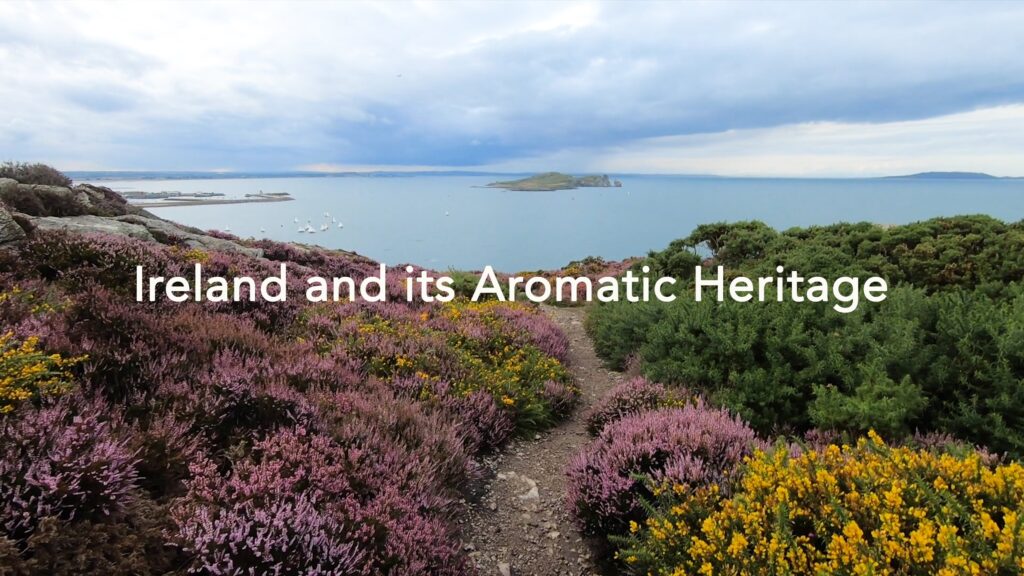
As Ireland transitions from the rich, smoky scent of peat-burning to a more sustainable future, its olfactory heritage is evolving. What will become the next iconic aromatic symbol of Ireland?
Click to watch the documentary trailer.
As Ireland transitions from the rich, smoky scent of peat-burning to a more sustainable future, its olfactory heritage is evolving. What will become the next iconic aromatic symbol of Ireland?