

By Stuart Firestein
Sign up for our monthly newsletter!
Artificial intelligence has already worked its way through most of the common senses. It identifies faces and produces images, transcribes speech and composes music, modulates the grip of a robotic arm by touch, and has recently produced new leads for sweet and umami tastes. Now it is coming for the nose.
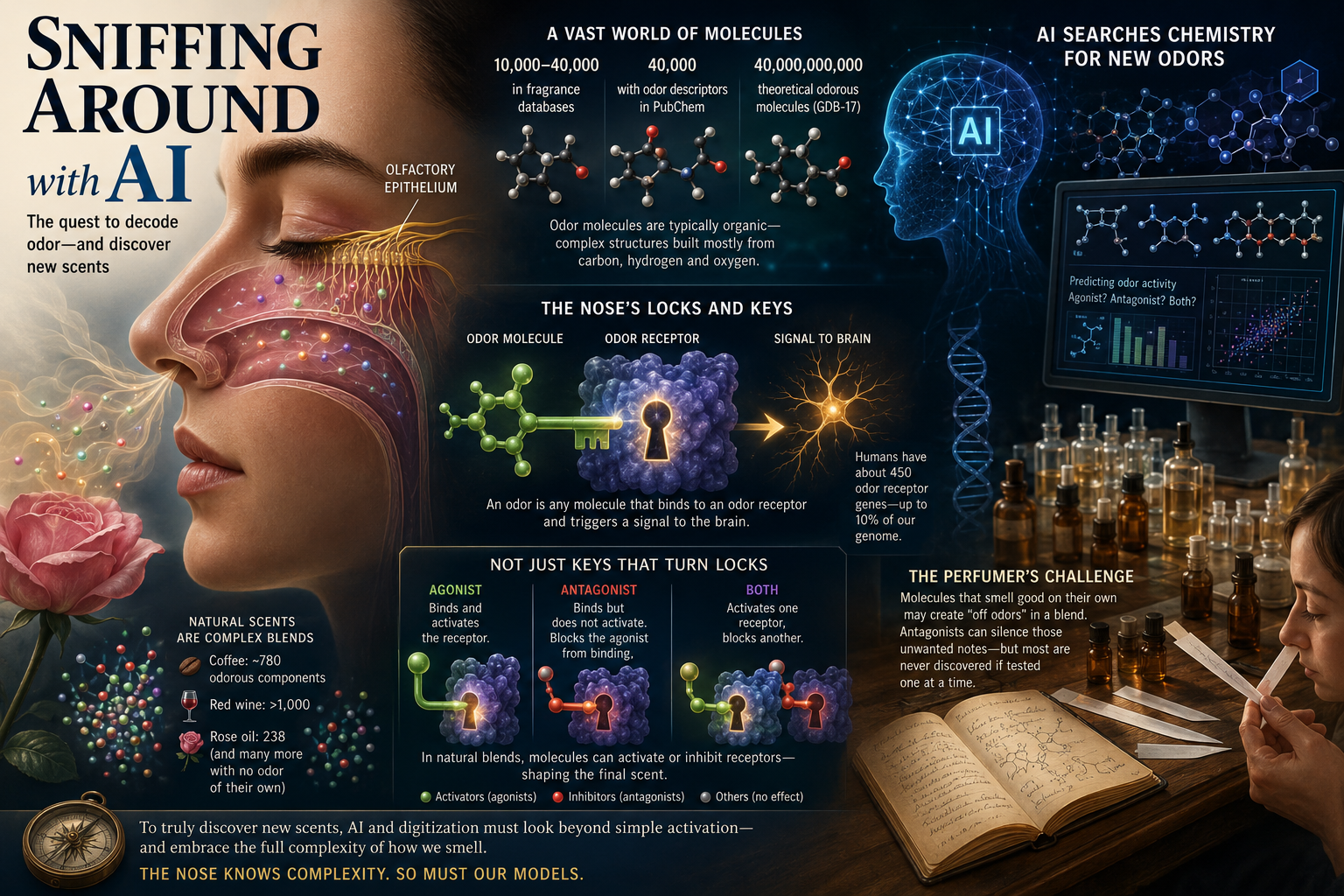
The vertebrate nose is arguably the best chemical detector on the face of the planet – and even the one on your face, which has been unreasonably discounted as being inferior to that of other animals. It is capable of detecting and distinguishing among a vast number of chemical compounds that we commonly call odors. Humans too have relatively good olfactory systems and the data place us in the middle of the pack for olfactory abilities. That said, it is worth asking a seemingly simple question. What is this marvelous detector detecting? What exactly is an odor? Chemically, we can say that odor molecules are typically organic molecules. That is, they are based on carbon atoms making bonds with mostly oxygen and hydrogen atoms and forming an unexpectedly and incredibly vast number of complex structures. Estimates of the number of odor molecules range from 10,000 which is the number that can be found in the several curated fragrance databases, to 40,000 found in the PubChem chemical catalogue that have vague odor descriptors (citrusy, woody, grassy, etc.) associated with them, to 40,000,000,000 which is the theoretical number of possible odorous molecules out of the more than 160 billion molecules catalogued in a database known as GDB-17. That estimate is based largely on the physical qualities of a molecule (volatility, solubility, etc.) as determined from known odors. It is almost surely an overestimate.
All of these numbers are based on chemical descriptions of odors, but as that last estimate shows, there are 40 billion molecules out there that have most of the properties that would be consistent with them being odorous, and which likely do not have an odor (given that the identified number of odor molecules through centuries of perfumery is a mere 10,000 – 40,000). It may be that chemistry is not the best way to define an odor. Rather a biological, operational definition may be more accurate. Simply put, that would be: An odor is any molecule that binds to an odor receptor in your nose. An odor receptor is a protein that resides in the membranes of the olfactory neurons that populate a thin tissue in the higher reaches of your nasal cavity. In a Nobel prize-winning discovery in 1991, Linda Buck and Richard Axel cloned the genes for these receptors and found that there is a shocking number of them – 450 in our genome and as many as 2000 in that of an elephant. Given that there are about 20,000 genes in the typical mammalian genome (ours included), the genes for odor receptors comprise between 2% and 10% of the entire genome. No other family of genes comes close. Certainly, for receptors of this type, which also include those for many brain transmitters such as dopamine or adrenaline, they are typically found in families numbering between 4 and 15.
Let us say then that an odor is a molecule that can bind one of these receptors and activate a cascade of events that eventually results in a signal being carried back to the brain. One can imagine it roughly to be like a lock and key. The lock is the receptor protein, and the key is the odor molecule. If it fits and turns (i.e., activates) the lock, then a door opens – or a signal is generated and sent to the brain, which must figure out which lock was activated – that is, which odor fit into the receptor.
This would at first seem to make the whole system easier to understand. Any given odor molecule may be able to bind to 1 to 10 receptors, and any given receptor may be able to bind from 1-10 similar molecules. All the brain has to do is recognize which particular receptors are activated (signaling), and that configuration of receptors can be associated with a particular odor. A simple code for odor recognition seemed to be within reach.
The natural world, however, is rarely that simple, and this is where digitization of olfaction and AI for odor discovery runs into problems. Almost all naturally occurring fragrances are complex blends of a few to hundreds of molecules. Coffee has 780 odorous components, red wine may have more than a thousand, and rose oil has 238. And those are the molecules that have an odor quality. Several laboratories, including my own, have recently shown that complex blends of odors may contain molecules that both activate and inactivate receptors. Going back to the lock and key analogy, an inhibitor, or as it is known in pharmacology and drug development, an antagonist, is like a key that fits into the lock but won’t turn it. Thus, this molecule binds to the receptor, does not activate it, but can prevent the odor molecule that activates it from binding. This means that molecules that have no odor themselves can nonetheless be an important contributor to the perception of a blend by cancelling some receptors out of the pattern. To complicate things a bit further (because why not?) some molecules can act as an activator (called an agonist) at one receptor and an antagonist at another. This should actually not be surprising as among the other 450 receptors of this class (dopamine, serotonin, adrenaline, etc.) there are more known antagonists than agonists, and many drugs are antagonists (for example beta-blockers are so called because they bind beta adrenaline receptors and prevent naturally occurring adrenaline from activating those receptors, preventing blood vessels from contracting around the heart). To understand a blend then requires knowing about antagonists as well as agonists. The difficulty is finding something that does nothing.
Curiously, this is the exact same problem that has plagued the perfume industry for centuries. The major fragrance producers employ thousands of chemists who cook up hundreds of new molecules each year in the hopes of discovering new scents or creating synthetic versions of existing fragrances that are cheaper to produce or withstand heat and other environmental factors that weaken their potency. All of these new molecules are funneled to the “Noses”, the perfumers who will use them to make new fragrances. The problem is that these perfumers test the new molecules one at a time, judging each to be sufficiently strong or good-smelling or representative of their class (green woody, citrusy, floral, etc.). But if they never smell an odor in a blend, or at least paired with a few other odors, they will never know if it is actually an antagonist and potentially useful.
Why would antagonists be useful in a blend of odors? Because receptors are not perfect locks, an odor can activate more than one receptor if it can fit into it. The problem then is that the odor of interest carries along with it some “off odor” because of these secondarily activated receptors. So, it is common for floral odors to carry a green odor (like grass) with it and that is often unwanted in a mixture designed to be light and flowery. Antagonists could inhibit these unwanted receptors and get rid of the off odor. There are numerous examples of this in perfumery (and flavor, which is mostly olfaction) that have been discovered “accidentally” by perfumers.
AI searches for new odors using current odors as models and then some other knowledge of chemistry to concoct new molecules that should have some smell. But do they look for antagonists? And even if they did, how would one train the AI to look for antagonists without opening the floodgates of possible molecules (as many as 160 billion at least)? These are not insoluble problems, but until AI and odor digitization efforts include antagonists and complex odor interactions in their calculations and knowledge bases, they will be hunting down new molecules in the same way as has been done for centuries – just faster.
Stuart Firestein is Professor of Neurobiology at Columbia University, where his laboratory has investigated the vertebrate olfactory system for more than three decades. He is also a member of the Fractal Faculty at the Santa Fe Institute and serves on the Board of Advisors of the World Sensorium Conservancy. Firestein is the author of several acclaimed books exploring the nature of scientific inquiry, including his latest, It Could Be Otherwise: Science in the Age of Uncertainty, now available.
Plantings
Issue 61 – July 2026
Also in this issue:

Artificial Olfaction or Olfactory Intelligence?
By Andreas Keller

AI and Scent: Creating an Ethics of Synthetic Smell
By Gayil Nalls

Multispecies Meanings: Merle Bergers on Plant Communication, Natural Perfumery, and Ecological Attention
By Clara Muller

How to Meet an Alien
By Willow Gatewood

The Language of Living Air
By Gayil Nalls
Eat More Plants Recipes:
Uncertainty Salad
By Daria Dorosh

As Ireland transitions from the rich, smoky scent of peat-burning to a more sustainable future, its olfactory heritage is evolving. What will become the next iconic aromatic symbol of Ireland?
Click to watch the documentary trailer.
As Ireland transitions from the rich, smoky scent of peat-burning to a more sustainable future, its olfactory heritage is evolving. What will become the next iconic aromatic symbol of Ireland?