

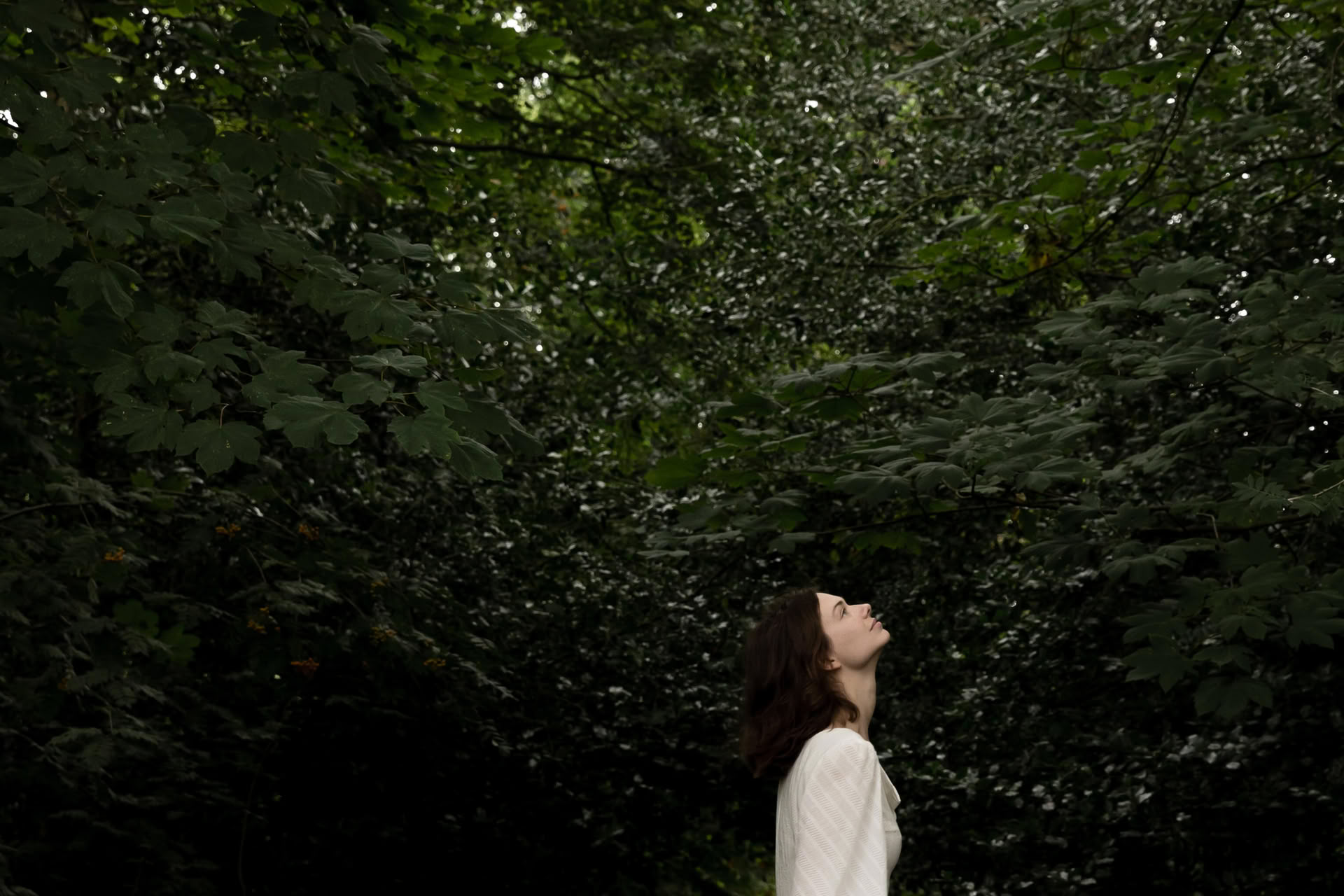
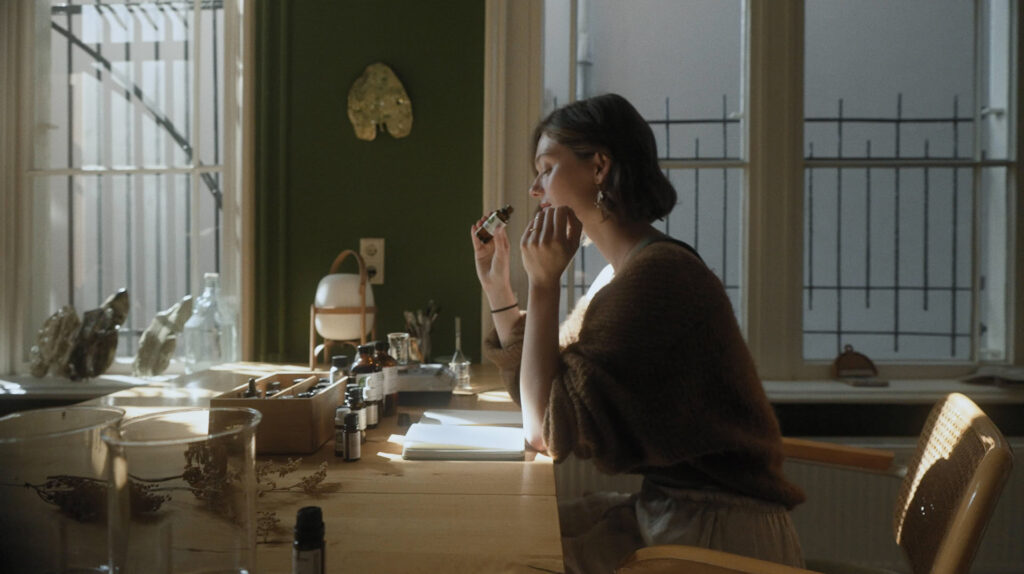
Marieke Verdenius, Portrait of Lingua Planta founder Merle Bergers, 2021. Courtesy of Lingua Planta.
Multispecies Meanings: Merle Bergers on Plant Communication, Natural Perfumery, and Ecological Attention
By Clara Muller
Sign up for our monthly newsletter!
Dutch conceptual designer, perfumer, and founder of Lingua Planta, Merle Bergers grew up in a small forest in the east of the Netherlands, where the living world first appeared to her as animated and relational. Later, reading across plant science and more-than-human thought — from Peter Wohlleben and Paco Calvo to Robin Wall Kimmerer, David G. Haskell, and Suzanne Simard — she became fascinated by the possibility that plant smells could be approached not simply as aromas, but as a “scent language”: a mode of communication to which humans might learn to become attentive.
While studying at Design Academy Eindhoven, Bergers imagined a multisensory installation that would make this chemical communication more accessible to human experience. At its core were three olfactory compositions — Attract, Repel, and Defend — each evoking one of many functions that volatile compounds can play in the lives of plants: luring pollinators, deterring herbivores, or responding to injury and attack. Chemical ecology, which emerged as a scientific discipline in the 1960s, has indeed taught us that biogenic odors are not merely a backdrop to human life, nor simply raw materials for human use, but key mediators within the biotic community. Volatile compounds act as signals or cues, indicating that something is happening within or between living beings. Many of their names — linalool, indole, pinene, cis-3-hexenol, geosmin… — may be familiar to perfumers and aromatherapists, yet these molecules first play a role in the lives of countless organisms.
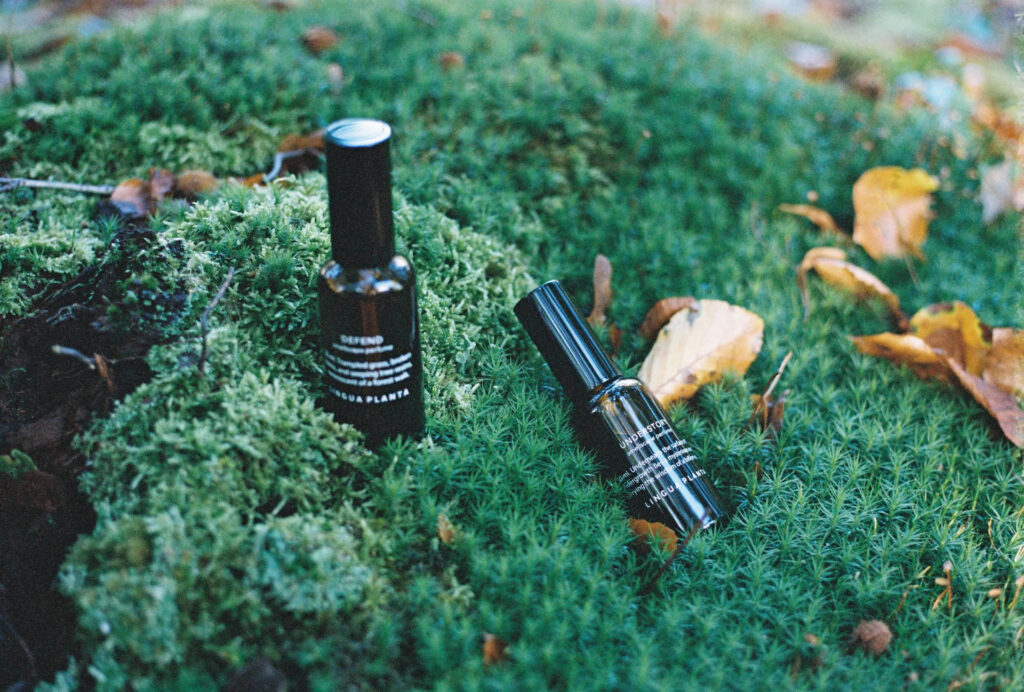
In 2019, wishing to bring this research into everyday life, Bergers launched Lingua Planta, a line of artisanal natural perfumes inspired by ecological knowledge, ethnobotany, and personal experience. The collection now includes the floral radiance of Attract, Nightflowers, and Sacred Sun, the green, fresh accords of Defend and Repel, and the woody, earthy, smoky atmospheres of Understory and Henosis. Without asking us to forego the human pleasure of fragrance, these creations use that pleasure as a bridge toward more-than-human considerations: What if a fragrance were not only a personal signature, but an encounter with otherness? A glimpse into ecological dynamics and relationships? What if the scent of a rose were not only considered a romantic emblem, but as a call to pollinators; the green sharpness of leaves not merely a “fresh” note, but part of a plant’s response to injury? From this perspective, Merler Bergers’s perfumes can be approached as bouquets of multispecies meanings — olfactory choruses that bring forward the voices of the other-than-human beings contributing to our fragrances, and to the odor landscapes of the world.
In this conversation, Bergers discusses the origins of Lingua Planta, plant sentience and intelligence, her ambitions as a natural perfumer, ecological grief, and the possibility of re-enchanting our relationship to Nature through smell.
Clara Muller: What kinds of experiences of Nature did you have growing up? How did your perception of plants and your interactions with them develop and perhaps change over time?
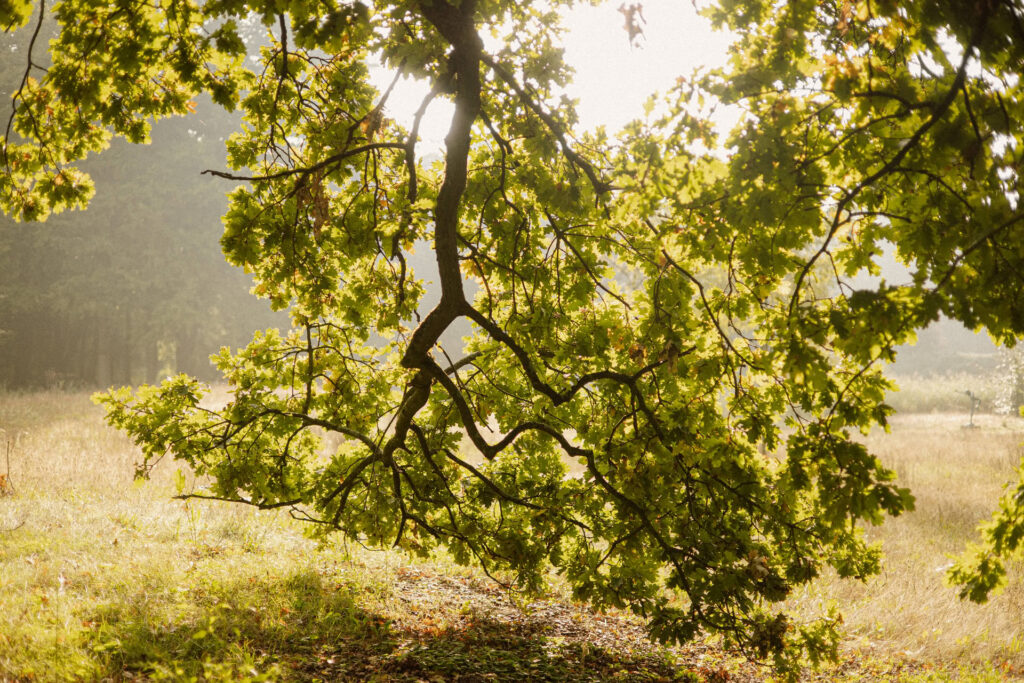
Merle Bergers: As a child growing up in the east of the Netherlands, I was really enchanted by the living world around me. I felt a strong connection to trees, plants, and insects. That world felt very animated and alive to me. I could spend hours alone, looking at leaves, at the earth, watching things move, observing insects in the one-hectare forest where we lived. I spent a lot of time in and under my favorite trees. When I was a little older, I also became interested in making medicine with plants. My grandmother, who lived next to us, had an herbal garden. She would talk to me about the plants and what they did. She helped me think about what plants can mean for us and how they can help us. That added another layer to my curiosity: plants were not just decorative, they had an influence on us.
C.M.: How did that early connection develop into a more specific interest in plant communication?
M.B.: When I moved abroad and lived in cities, I somehow forgot how spending time with non-human beings made me feel. When I came back to the Netherlands, I wanted the natural world to become more meaningful in my life again, so I started reading about plants. That was about ten years ago, when many popular science books were coming out about plants as active and adaptive beings. I became a little obsessed with all the different ways plants show intelligence and sentience. While I was studying at Design Academy Eindhoven, I wanted to do something with this information, which at the time seemed to exist almost only in written form. I wanted to sensorialize the way this research was communicated because I thought it would be interesting to actually see the science, to touch it, hear it, and smell it. So I began exploring different forms of expression. I worked with Arduino coding, for example, translating plant electrical signals into sound waves. At the time, I called my project Planta Sentiens, after an article by Paco Calvo. Then, for my graduation project, I decided to explore volatile communication more deeply, because it felt like an undervalued part of this whole field of research. I thought that if we could learn to understand plants’ “scent language,” maybe it could become an entry point for empathy and connection. That was when the project became Lingua Planta.
C.M.: For your graduation project, Lingua Planta took the form of a multisensory installation involving a glass and ceramic sculpture, three scents, a film, as well as audio and textual material. How did these different elements work together to make plant volatile communication accessible to human experience and understanding?
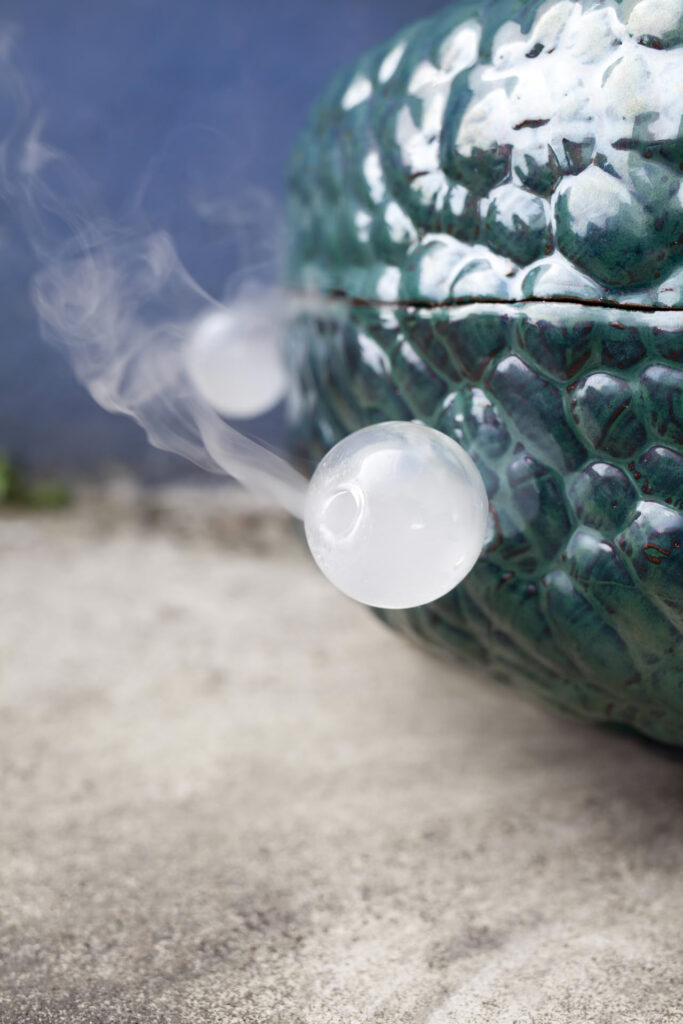
M.B.: I really wanted to draw people in, to trigger curiosity about plants through something a bit mysterious. I created this organic shape in earthenware from which scented mist slowly emerged. I also filmed the surface of a tomato leaf under a microscope to show the trichomes and stomata. It was like traveling through an almost surreal landscape, as I moved very slowly through different depths of field. It was meant to be an entry point to talk about where communication and perception happen in plants, and how different that is from our own ways of sensing and exchanging information. With human beings, we know that language comes out of the mouth, and we identify the nose and ears as sensory organs. With plants, sensory systems are distributed differently. There was also audio in the installation: people could put on headphones and listen to my voice talking about plants and language. If they were really interested, people could also dive deeper thanks to a small booklet with more information, but they could also stay on the purely sensory level. I think Lingua Planta still works that way: people may first relate to the aesthetics of what they see or smell, then they can choose to go deeper, to read more, and really understand what is behind the project. I always want to bring people in through the experience first.
C.M.: What were the scents in the installation like? Were they similar to Attract, Defend, and Repel from Lingua Planta’s current perfume line?
M.B.: They were very rudimentary, because I mostly worked with pure molecules. Repel contained limonene, which can be found in many citrus fruits, and caryophyllene, which is present in black pepper, for instance. Defend had camphor notes, which you can find in eucalyptus, and alpha‑pinene, a component of pine essential oil. A few months after the graduation presentation, there was a larger public presentation, and I started looking into natural isolates and essential oils. However, at that time, they were not yet meant to be worn on the skin.
C.M.: How did the project move from a design installation about plant communication into a line of natural perfumes?
M.B.: After graduation, I was looking forward to making something for people’s daily lives. I felt a bit constrained by the design presentation setting, which is more artistic. I wanted to create something that could be connected to everyday life. What really helped was that a curator asked me to take part in her yearly design exhibition, but she wanted the scents to be available for people. I had only six months to make them wearable on the skin. At that point, however, we presented them as “smellscapes,” not perfumes. That came a couple of years later, after I learned more about natural perfumery techniques.
C.M.: Your work as a perfumer goes beyond the “health and wellness” frame often associated with natural perfumery — and even with discussions around the smells of Nature, which tend to focus on human benefits such as stress reduction, cardiovascular health, or memory stimulation. You bring an ecological perspective to the human-centered appreciation of biogenic scents. Could we say that your perfumes are not just inspired by plants, but by the relationships – mutualistic or antagonistic – that plants maintain with pollinators, herbivores, fungi, and microorganisms?
M.B.: Yes. I understand this wellness frame, but it can make us forget that plants are entities in their own right. Sometimes, when we work with plants, there is a very extractive way of thinking: we grow and pick them because they are good for us. But they don’t exist simply for our sake, even if we can benefit from them. In my work, I try to bring in the plant perspective as well. Often the scent is about the plant’s relationship with other beings because the volatile organic compounds they emit are mostly to protect themselves or to interact with other species.
C.M.: Your perfumes thus ask us to consider the ecological dimension, but they are also born out of your personal experience and your own creative inspiration. How do you hold together ecological meaning and artistic freedom?
M.B.: Although I am inspired by plant messages and relationships, I give myself the freedom not to be as exact as a scientist. I think my work can be considered a poetic interpretation of plant messages. Additionally, as a maker, you always bring your own feelings into the perfumes you create. Last year, I released Nightflowers, a scent about nocturnal flowers blooming and attracting night pollinators. But for me, it was also about beauty and femininity. It was a celebration of finally allowing flowers to have a role in my own life. For a long time, I had been very practical, working very hard, perhaps not giving beauty much space. Suddenly there were flowers, appreciation, making time to make my own life beautiful, being outside, going to the vegetable garden, bringing flowers into my home, celebrating life, dance, love, fertility… With the release of that perfume, I wanted to anchor those things in my life. So it was something very personal, but also something that speaks to a collective experience.
C.M.: You describe Attract, Repel, and Defend, the first three perfumes in the line, as three core plant “strategies.” How do you translate these ecological functions into perfume notes, accords, textures, or atmospheres?
M.B.: Attract is based on the ways flowers attract pollinators they have co-evolved with, such as bees and butterflies. It is centered around the Bulgarian Rosa damascena and evokes a warm floral garden under the sun. Repel is built around molecules emitted to prevent herbivores from eating various parts of a plant by making it less appealing, less tasty or digestible. Limonene in citrus peel, for example, makes the fruit less edible, preventing attacks. I therefore used clementine, grapefruit, and lemon, but also plants with a lot of linalool such as bergamot, ho wood, clary sage and lavender. With lavender, which is also rich in caryophyllene, I was also inspired by the way gardeners use it to repel certain insects. Defend evokes more of a forest environment. It is inspired by the ways herbaceous plants or trees defend or repair themselves when they are under attack, when they have already been damaged. It’s built around green notes suggesting green leaf volatiles, as well as resinous notes such as benzoin, frankincense, cedarwood, cypress, and copaiba.
C.M.: The active verbs in the names of these scents can suggest a form of plant intentionality, of purpose. Yet most biologists tend to avoid suggesting any form of conscious intention in plants. How do you navigate between the poetic power of these verbs and the risk of anthropomorphizing plants?
M.B.: I love this question so much. It feels a bit like a keurslijf — a Dutch word for a kind of restrictive frame, something that holds you in very tightly. I think it is a funny rule, this idea that we cannot anthropomorphize plants. It is difficult because we do not have specific words to describe what plants are doing. Yet they are doing things that are, in some ways, similar to what human beings do. I think we have to let go a little bit of the idea that anthropomorphizing is something we absolutely cannot do. If the goal is to empathize with plants, and if we lack the words to describe what they are actually doing, then we can make use of words we usually use for humans and for how humans act in the world. Some scientists, such as Monica Gagliano, Daniel Chamovitz, or Paco Calvo, actually give themselves more freedom in how they express themselves.
C.M.: Isn’t there a risk that, once semiochemical compounds synthesized by plants become ingredients in a perfume, their ecological meanings are completely overshadowed by their aestheticization for human pleasure?
M.B.: I think the aestheticization of plant messages is not necessarily a bad thing if it can prompt a form of re-enchantment and help people reconnect with the living world. I hope people will go outside, smell my perfumes, and realize that plants are doing this all around us: attracting multispecies partners, repelling aggressors, defending themselves… I once asked a biologist: “If I make a perfume with some molecules flowering plants use to attract pollinators, will I be haunted by bees?” Of course, he told me that insects are more intelligent than that. They might check you out, they might be curious, but they will not mistake you for a flower. Insects do not rely only on smell to find the pollen or nectar they depend on. So I feel I can play with these compounds without disrupting the whole ecosystem, and hopefully in a way that brings people to pay more attention to the plant kingdom.
C.M.: How do you respond to the paradox that these perfumes may reconnect people to plants, while perfumery itself depends on extraction, trade, and transformation of plants considered as raw materials?
M.B.: When I started thinking about plants and plant intelligence, I was really empathizing with them, especially when I was working with sound waves. I became a fruitarian for a while because I was thinking so much about how we live with plants, and how we have been using and exploiting them for such a long time. At some point, I felt blocked — blocked from working with plants, or even eating plants. I think I had perhaps fallen into over-anthropomorphization. Plants do not experience pain as animals do. They can lose parts of their bodies and sometimes even do better for it. Fruits, for example, have easily breakable stems because they are meant to fall or be taken. Michael Pollan’s books helped me understand this, because he writes about these questions in relation to gardening. In Braiding Sweetgrass, Robin Wall Kimmerer also explains that, at one point, the U.S. government forbade sweetgrass harvesting in certain places, while Indigenous communities were still allowed to harvest it in their areas. Where harvesting was forbidden, sweetgrass declined. Where people continued to engage with it and harvest it, it did better. So I learned that we do not have to completely disengage from working with plants, but we have to do it with awareness. This is particularly important to me when sourcing materials. It requires a lot of reverence. In perfumery, going “natural” is not automatically better if you are not careful about where everything comes from and how it is grown.
C.M.: “Natural” can easily become a marketing word today, especially when there is little transparency. On your website, you list the ingredients you use, along with their origins and certifications. That seems like an important way of allowing people to make more informed choices. How do you define naturalness in your own practice?
M.B.: I work almost exclusively with essential oils and absolutes. When I can avoid fractionated distillation, I do. One exception is cis-3-hexenol, which has this fresh-cut grass note that I cannot find anywhere else. But I know it is made from mint, I know where it comes from, so it is an informed choice. I also try to use as many organic-certified materials as possible, although that is not always an option. For ingredients like citrus oils, it is especially important, because they are made by pressing the peel, and you do not want pesticides in your essential oil. But oakmoss, for example, cannot be certified organic because it grows in the wild. With trees, like pines, organic certification is not always the best option either, because a certification might mean that the plant is grown in a large-scale production system. There are many surface-level sustainable options. You always have to follow your curiosity and dig deeper. Sometimes something may appear to be a “less bad” option, but that does not make it sustainable.
C.M.: French perfumer Marc-Antoine Corticchiato has said that, to appreciate all-natural perfumes, people often have to shift their expectations, because we tend to like what we already know — and what many people know best is mainstream perfumery, built from both natural and synthetic materials. Natural perfumes also do not smell exactly like living plants, because extraction transforms their olfactory profiles. Do you agree that natural perfumery requires a form of re-education of the nose?
M.B.: Natural perfume wears differently. It changes a lot from one person to another, in the way it unfolds and in the nuances that come forward. It is a different experience, but there is an intrinsic beauty to that difference. And the opposite is also true: many people who wear my perfumes tell me they thought they did not like perfume at all. Natural perfumery resonates more with some people. And not everybody has to love my perfumes. I never try to make something everybody will like. The goal is for the right people to find the perfumes that fit them. It is a bit like music or art: it becomes more interesting when it is not made to please everybody, or to be obviously beautiful.
C.M.: I wanted to talk about Henosis, because it feels very different from the other perfumes in the line. With its smoky, resinous, birch-tar accord, it does not directly evoke plant communication, but rather wildfires, damaged ecosystems, and a form of ecological grief. What role did this scent play for you in holding or transforming that grief?
M.B.: I made Henosis at the beginning of the COVID-19 pandemic, when the forests in Australia were on fire. In a way, it felt as though the whole world was on fire. I had this sudden anxiety and grief, and I felt very strongly that I had to do something with it — to let it move through me and process it by making a project. There were many things happening in me while creating this perfume. I was feeling the tension between human beings, trees, and fire. Then relief came in the form of different resins, which felt deeply soothing to me. I started reading about frankincense and the Catholic Church, and about the way frankincense can affect people — making them feel rooted, safe, and comforted. So Henosis is quite a holistic perfume. It seems to reduce anxiety, but it also speaks about human relationships with trees, with fire, while leading back to the very origins of perfume: per fumum, “through smoke.”
C.M.: There is an ambiguity in the smell of smoke. Evolutionarily speaking, it can signal danger, but culturally it can be comforting because it evokes fireplaces, bonfires, or rituals. Fire ecology adds another layer to this ambivalence: wildfires can be destructive, but fire can also regenerate ecosystems that have evolved with it. Many pyrophile plants need fire to complete their reproductive cycle, either to release their seeds or to stimulate germination. In some cases, research has shown that it is not the heat that triggers germination, but a chemical cue in cellulose-derived smoke. In Henosis, the sharp green note in the middle of all the smokiness reminds me of that. Was that something you had in mind?
M.B.: I did not have that specific narrative in mind, but I love it, because there is definitely a notion of relief in Henosis. The perfume holds both things at once: the darkness and the soothing quality, grief and relief. Smoke can be frightening, but it can also be comforting. Fire can be destructive, but it can also be part of a cycle. It is not necessarily only an ending; it can also be renewal, opening a new possibility for life.
C.M.: Does the Field Notes series give you a different kind of freedom than the permanent collection? How do you approach these limited editions?
M.B.: I do work differently with Field Notes, and it gives me freedom because I do not have to keep the scent in stock for years to come. I now have quite a few different fragrances. Keeping them all in stock, especially when working with rare materials, can be challenging. With Oak, for instance, I worked with an eleven-year-aged Italian oak absolute, made from chips from the barrel industry. There is a good chance Oak may come back, but perhaps the aged oak will no longer be available, and there may be a different oak instead. Every year it can be different, the way every autumn is different. I enjoy the idea of seasonality. There is seasonality in my perfumes anyway, because the batches I receive are never exactly the same, the materials change. I try to communicate about that.
C.M.: What directions would you like to explore next?
M.B.: At the moment, I am working on a tomato plant fragrance. The film for the original Lingua Planta installation was actually made with a tomato plant! It is such an intelligent communicator. When you stroke it or when it becomes stressed, it smells more strongly almost immediately. I have a tomato plant at home, and every time I smell it, it smells different. Tomato plants have different characters. The fragrance I’m working on is a positive, vibrant, green, sparkling fragrance that reminds me of long summers in Italy and the generosity of the fruit of the plant. So it will speak about our relationship with the tomato plant, but it also links back to the very beginning of the research, about the intelligence of plants.
C.M.: In a time of climate change and biodiversity loss, what smells from the living world do you think humans most urgently need to attune themselves to? And what do you hope to achieve with Lingua Planta?
M.B.: I think we most urgently need to notice Nature and plants in general. That is an ongoing task: to unblind ourselves to plants, to see them for what they are, and to realize how special, wonderful, and necessary they are — how alive they are. Smell is a great tool for that. When I started learning about scent and about the different molecules involved, I began to smell differently in the wild. Before that, it was just one general “forest smell” or “summer forest.” By learning what I was actually smelling, it became clearer. I think a lot of information is perceived through the nose, but we do not always have the words for it. Overall, I feel that my role as a natural perfumer, working with the natural world and inspired by plants and plant science, is about re-enchanting — about making people fall in love with plants again.on — which might make some plants more resilient to climate change.
Clara Muller is a French art historian and art critic conducting research on olfaction in art, design, and literature. She has been a writer for the olfactory magazine and publishing house Nez since 2016. She contributes to the collection “The Naturals Notebooks” for which she studies the place of aromatic plants in the history of visual and decorative arts. She has curated several exhibitions dedicated to olfactory art and design. https://www.claramuller.fr/
Plantings
Issue 61 – July 2026
Also in this issue:

Sniffing around with AI
By Stuart Firestein
Artificial Olfaction or Olfactory Intelligence?
By Andreas Keller
AI and Scent: Creating an Ethics of Synthetic Smell
By Gayil Nalls

How to Meet an Alien
By Willow Gatewood
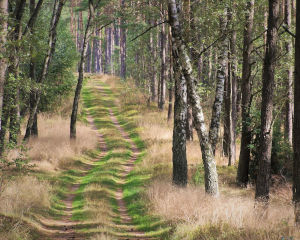
The Language of Living Air
By Gayil Nalls
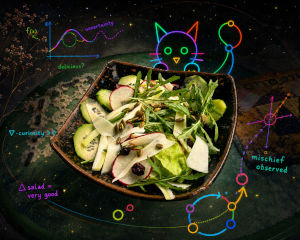
Eat More Plants Recipes:
Uncertainty Salad
By Daria Dorosh
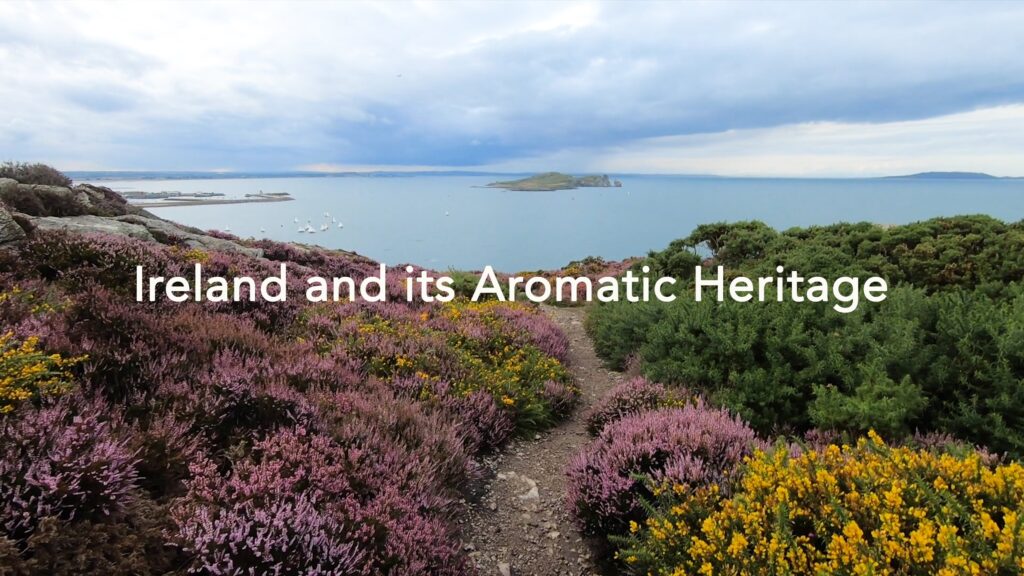
As Ireland transitions from the rich, smoky scent of peat-burning to a more sustainable future, its olfactory heritage is evolving. What will become the next iconic aromatic symbol of Ireland?
Click to watch the documentary trailer.
As Ireland transitions from the rich, smoky scent of peat-burning to a more sustainable future, its olfactory heritage is evolving. What will become the next iconic aromatic symbol of Ireland?