
Artificial Olfaction or Olfactory Intelligence?
By Andreas Keller
Sign up for our monthly newsletter!
Since ChatGPT was made publicly available in late 2022, reaching 100 million monthly users only two months later, media, politics, and financial markets have anticipated the arrival of Artificial General Intelligence (AGI), a hypothetical system able to do most economically valuable work as well as humans. Whether current approaches can be scaled and fine-tuned to develop AGI is unclear, but there is wide agreement that AGI would be a world-changing technology (although there is little agreement whether the post-AGI world would be dystopian or utopian).
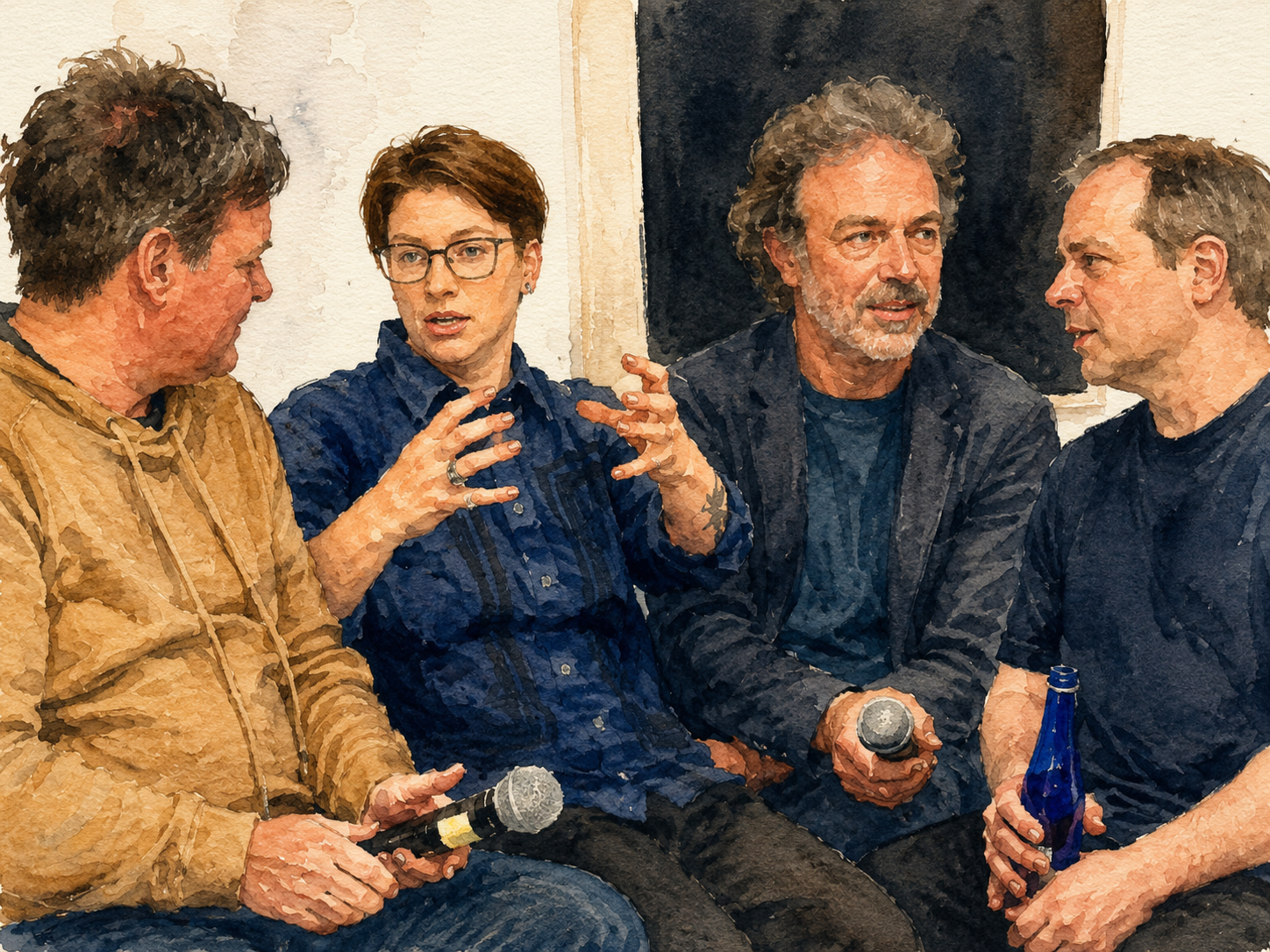
While we wait and see, the world is being changed in less dramatic ways by narrow AI, which is focused on a specific domain such as radiology, autonomous driving, weather forecasting, or targeted online advertising. In the fragrance world, AI has started to receive more attention since Osmo, a start-up with a diverse portfolio of projects that apply AI to olfaction, spun out of Google Brain in 2022. On May 14th, I hosted a panel at Friedrichs Pontone, a contemporary art gallery in Tribeca, to discuss the current state and possible futures of olfactory AI The panel was organized by 1014, a New York-based not-for-profit organization that brings people together from both sides of the Atlantic to creatively engage with today’s global topics.
The conversation that inspired this text brought together three remarkable practitioners working at the forefront of scent, technology, and creative inquiry. M Dougherty, a nonbinary scent artist, researcher, and creative technologist, explores how emerging technologies can expand our understanding of olfaction, perception, and multisensory experience, often blurring the boundaries between art, science, and speculative futures. Pablo Meyer Royas, manager of the Biological Analytics and Modeling group at IBM Research, brings expertise in computational modeling, machine learning, and biological systems, investigating how artificial intelligence can help reveal patterns hidden within the immense complexity of chemical and sensory data. Sean Raspet, an artist whose work has long examined scent, molecular structure, and the material foundations of perception, is also co-founder of Patina, a start-up focused on designing novel scent molecules. His practice bridges contemporary art, chemistry, and fragrance innovation, challenging conventional distinctions between natural and synthetic odors while exploring new possibilities for olfactory creation. Together, their perspectives illuminated how advances in artificial intelligence are transforming our ability to analyze, model, and create scent, while raising deeper questions about creativity, perception, and the future relationship between humans, molecules, and machines. This article has been inspired by themes and ideas that emerged during that conversation.
AI is used in electronic noses, which can sniff out explosives or drugs, or diagnose a variety of diseases based on the volatile molecules associated with them. It can also help determine the toxicity of scent molecules and allergic reactions. However, the biggest question facing those working with fragrance is: How do we predict what a molecule, or a mixture of molecules, smells like?
It may be surprising that we cannot predict the smell of olfactory stimuli. Predicting perception from physical features is a routine task in vision and audition, where well-established technologies (microphone/speaker; camera/screen) efficiently and accurately translate between the physical, digital, and mental. The lack of understanding structure-odor relationships makes perfumery (and fragrance chemistry) an art form in which experience is highly valued. There are rules of thumb, but there is no way to know what the mixture of a few ingredients at certain ratios will smell like, so time-consuming iteration guided by intuition and trial and error is the only strategy to achieve a desired result. AI may change that, thereby deemphasizing skill in the creation of novel scents. It is not there yet (at least judging by the models that are in the public domain). However, the speed of progress is dramatic. The first models that can be applied to all possible olfactory stimuli were introduced less than a decade ago.
Despite the progress over the last decade, it is uncertain whether olfactory AI will ever get “there”. Smell is more variable than other ways of perceiving the world. It is very common for people to have one or more specific anosmias — conditions, often caused by genetic variability in odorant receptors, that make it impossible to smell certain notes, such as musk. The reverse condition, an increased sensitivity to notes such as the soapy smell of cilantro, is also common. Smell perception is also heavily influenced by prior experiences and cultural context, which often differ dramatically between individuals. There may be no correct answer to the question of how something smells. The right question to ask may instead be how something smells to a specific individual with their genetically unique set of odorant receptors and particular experiences and background. Of course, perfumers working without AI assistance also face these challenges, but addressing them requires more than a model to map physical features of molecules onto verbal scent descriptors (which introduce a further level of complexity through the ambiguity of language).
Olfactory AI is already used as a tool by synthetic chemists aiming to create fragrance molecules with novel scent profiles and by perfumers creating perfumes based on verbal briefs. The usefulness of these tools is likely to improve. How this will change the fragrance industry and perfumery remains to be seen. In radiology, AI already outperforms humans in most tasks and in 2016 the Nobel Prize-winning AI researcher Geoffrey Hinton warned that we “should stop training radiologists now”. Despite the very mature AI in their field (about three-fourths of the FDA-approved AI applications are in radiology), radiologists are still in high demand. On the other hand, unemployment of new Computer Science graduates is rising and projections for the future demand for software developers are dire. Is perfumery in this context more similar to radiology or to software development? We will see, but my money is on radiology.
The concerns about intellectual property, that AI uses creative work of others as training data without acknowledgement or remuneration, ironically, are less pressing in perfumery because of the absence of legal protection for olfactory intellectual property. Since any perfume formula found online can freely be used for any commercial project, it does not seem outrageous that it can also be used to train an AI system to create new perfumes. Other concerns, such as the environmental footprint of AI, apply to olfactory AI in much the same way as to AI in other domains, though the massive volume of visual digital content created (close to one million hours of video are uploaded every single day) dwarfs the expected effect of perfumes being created with AI.
In summary, olfactory AI is expected to improve, especially if companies increase their efforts to collect large sets of training data. This will make perfume creation cheaper and faster, leading to a further acceleration of perfume launches, reinforcing a trend that predates AI (around 100 perfumes were released annually in the early 1980s, compared to over 3,000 in a recent year). The perfume experience will become more individualized but whether we will drown in olfactory slop, or encounter exciting olfactory novelty, or a little bit of both, remains to be seen
Andreas Keller is a neuroscientist and leading researcher in the science of smell, holding PhDs in both neuroscience and philosophy. His research focuses on olfaction, sensory perception, and the relationship between molecular structure and odor. Widely recognized for his contributions to odor classification, olfactory genetics, and artificial olfaction, Keller has helped advance understanding of one of humanity’s oldest and least understood senses. He is also the author of The Philosophy of Olfactory Perception and formerly ran Olfactory Art Keller, a New York gallery dedicated to exploring scent as a creative medium.and voices of those at the margins. While there is a lot to learn, perhaps a shift in perspective is one of the first places to start.
Plantings
Issue 61 – July 2026
Also in this issue:
Sniffing around with AI
By Stuart Firestein
AI and Scent: Creating an Ethics of Synthetic Smell
By Gayil Nalls

Multispecies Meanings: Merle Bergers on Plant Communication, Natural Perfumery, and Ecological Attention
By Clara Muller
How to Meet an Alien
By Willow Gatewood

The Language of Living Air
By Gayil Nalls
Eat More Plants Recipes:
Uncertainty Salad
By Daria Dorosh

As Ireland transitions from the rich, smoky scent of peat-burning to a more sustainable future, its olfactory heritage is evolving. What will become the next iconic aromatic symbol of Ireland?
Click to watch the documentary trailer.
As Ireland transitions from the rich, smoky scent of peat-burning to a more sustainable future, its olfactory heritage is evolving. What will become the next iconic aromatic symbol of Ireland?