

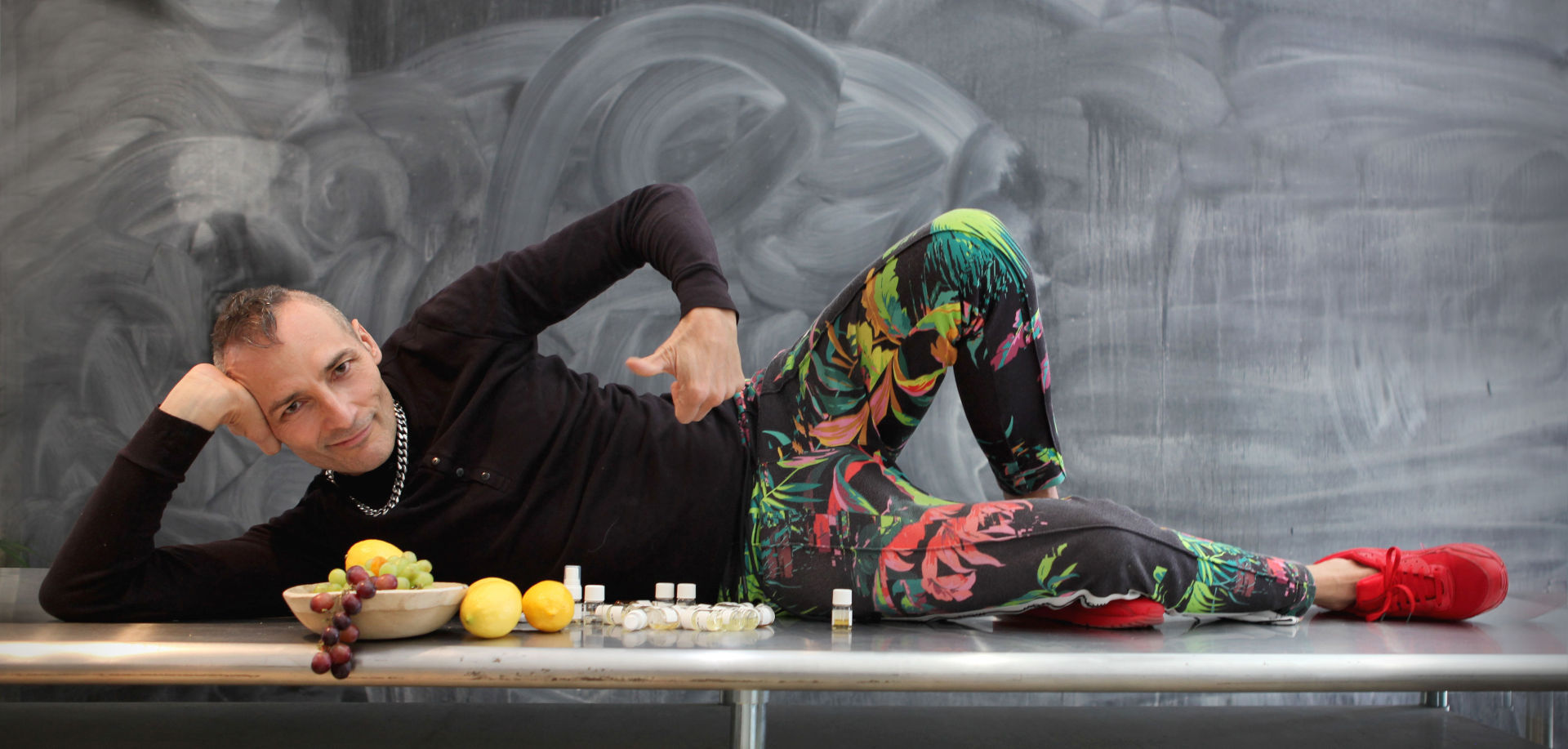
Photo: IAO Los Angeles
Christophe Laudamiel: Planted Memory, Cultivated Ethics, and More Blossoming for Perfumery
By Gayil Nalls
Sign up for our monthly newsletter!
Scent is among humanity’s oldest forms of knowledge. Long before experience was routinely recorded in writing, the aromas of plants, foods, bodies, landscapes, ritual, and crafted perfumes carried information about place, season, culture, and memory. Yet despite smell’s extraordinary ability to summon emotion and recover the past, olfactory experience remains one of the least preserved dimensions of cultural history.
Few contemporary perfumers have challenged that omission as forcefully as Christophe Laudamiel. A French master perfumer, trained engineer, inventor, and avant-garde scent artist working between Manhattan and Tokyo, Laudamiel has spent his career pushing perfumery beyond conventional ideas of fragrance. His work ranges from widely recognized commercial perfumes to experimental scent installations, museum projects, scent-tracks, and collaborations that treat smell as an artistic and intellectual medium in its own right.
Laudamiel describes smell as capable of creating “entire emotional worlds,” recalling how, early in his career, he experimented with tubing, vials, natural bergamot, and other materials to build atmospheric scent installations. That understanding places olfaction alongside visual art, music, dance, and performance as a powerful means of communicating human experience.
In this expansive and provocative interview, Laudamiel asks us to think about perfumery as a meeting place of botany, chemistry, agriculture, ecology, art, memory, economics, and ethics.
Gayil Nalls: For decades, you have worked simultaneously as a perfumer, inventor, artist, and scent engineer. Looking back across your career, what first convinced you that scent could be more than a commercial product—that it could function as a cultural, artistic, and even historical medium?
Christophe Laudamiel: Smell has been linked to duality since I was born. It always felt obvious—far more reliable than vision. I grew up surrounded by the cooking and aromas of French cuisine from Lyon and Nantua (my father’s side—Lyon having long been considered the epicenter of French gastronomy), Italian cuisine from Bologna (my mother and her family—a greater temple of cuisine than Tuscany, as Italians in the know will tell you), and the tropical smells and foods of New Caledonia, as well as Thai (the market stalls and my nanou there) and Moroccan cuisines. I don’t remember Morocco myself, as I was 1 year old, but my parents remember it vividly and talk about the country and its flavors all the time. Another key feature of my childhood is foraging in the mountains, probably of Morocco for nuts, and certainly of Auvergne volcanoes, the Alps and Jura summits, prairies and forests for flowers, berries, herbs or branches, logs and …manure, and the well-known heights, lushly covered of New Caledonia when I was 6 and Hawaii when I was 26.
I have also always loved performances. Song shows on television (waaaaay more exciting to me than soap operas—I have never liked those and have never watched one from beginning to end), ballet, dance of every kind—from ballroom to tap to flamenco to pop and house—to sports and Broadway. They take your heart, and the energy is irreplaceable.
As soon as I entered perfumery at P&G, I began noticing how profoundly fragrances I would bring, or discuss as part of my job, moved people, whether in casual encounters, where you glimpse someone’s true self through a visceral reaction, or at the most polite, formal dinners.
As an “engineer” helping the “artist” who wants to communicate excitement, I very quickly started building installations in my bedroom, using tubing, needles, IV systems and vials borrowed from my boyfriend, who was a medical doctor, to recreate atmospheres: bubbling pure and natural bergamot, or a floral-woody-spicy scent blown gently through the air. I already knew that laundry and skin alone were not enough. Scent could create entire emotional worlds. Which is now what I am doing at BélAir Lab Tokyo with scents containing 30% of natural Ginger, loads of bergamot, or at multimedia Arte Museums with scents containing seaweeds or real vetivers from three different countries.
GN: The World Sensorium/Conservancy is deeply concerned with the conservation of aromatic plants and the cultural memories they carry. In your view, what is humanity at risk of losing when native aromatic species disappear from landscapes and ecosystems?
CL: First unusual consideration: unlike the animal world, where we have discovered most of the larger animals on this planet (let’s say, hamster-sized and above), we still discover bacteria and insects regularly, but only once in a blue moon do we surprise a new deer species.) In Vietnam, the world of plants remains very much unexplored. Kew Gardens in London names 100-200 of previously unknown plants every year, about 10% of what is discovered every year. This without counting mushroom species. Even more compelling: there must be many, many more plants with potential for perfumery. We currently extract perhaps 500 plants out of the millions and millions that are known. There are so many that perfumery has never extracted, or even routinely accessed and just smelt in the wild. I think this field is about to explode. Foraging has vastly entered haute cuisine in the past 20 years. How many new algae are eaten in Denmark alone? I’m using three algae in perfumery. I’m still hearing from certain factories: do we really need three?
Second consideration: if a perfumery plant disappears, it is usually because we have completely stopped using it in perfumery—not because it has been overharvested. More often than not, that happens because of regulation. Yes, there are exceptions such as oud and sandalwood. But guess what? Very good ouds and sandalwoods are back. Perhaps they are a little less rich than they once were, although that may simply be a matter of aging or waiting for improved cultivation techniques. They have not disappeared like the dodo. In fact, people are now trying to resurrect the dodo—and the mammoth. So, in terms of smells themselves, I am not too worried.
What worries me more is that, under the often incorrect—and very fearmongering—banner of sustainability (which sometimes seems to support the balance sheet more than the human or environmental balance sheets), cultivation may disappear from certain countries. That means noble agricultural work becomes scarcer compared to whatever other work or boring cultivation is available in those regions. Fields and landscapes disappear, and with them the birds, pollinating insects, mammals, and entire ecological communities that depended on them. Tourism can also reshape these landscapes. So can politics. Positively or negatively. All of these forces alter where and how aromatic plants are cultivated. We live that daily in perfumery.
GN: You have created fragrances, scent installations, scent-tracks, and olfactory experiences for museums, films, and public spaces around the world. What artistic possibilities does scent offer that cannot be achieved through visual or auditory media alone?
CL: First, smells open drawers in your brain that words simply cannot. You can talk for hours about oranges or a temple, but present their scent, and suddenly you trigger different emotions, different memories. The “job” of artists is to plunder emotions, feelings, beliefs, and thoughts.
Second, some people are much more auditory, some more visual, some more olfactory, some more tactile—or a combination of two or three of those four. Remove one of those channels, and you become less communicative with a great many people. I am going to ask a friend with a PhD in math to calculate how many people would be let down statistically. I guess a lot among seven billion terrestrials.
Third, before education became widespread—say, 100 years ago—most people could not read well. Scent was therefore more communicative than it is now. Yet when we study the past or attempt to recreate it, this entire dimension is almost always obliterated. So weird and deceiving.
GN: You have been a vocal advocate for the ethical use of natural ingredients and founded the Perfume Code of Ethics. What ethical challenges concern you most today, and what changes would you like to see within the fragrance industry?
CL: No later than two months ago, I quietly launched some artwork named Fuck the Fluff and Augmented Reality, and I am now preparing the third piece in that series. Beyond presenting Ethical Hacking and Good Hacking, and opening a debate about excellence, plain fun and artistic frontiers in perfumery, the use of natural ingredients is also at the center of this initiative.
I have explained at length—in BeautyMatter, Essencional magazines, and through my Instagram and LinkedIn posts, all public and widely read—how the industry benefits from keeping the public in ignorance, and how many brands capitalize on the confusion between the smell of jasmine and actual jasmine from Egypt, or vanillin and vanilla from Madagascar. Those are two of the biggest scandals.
For example, based on three different GC analyses, including two from reputable fragrance houses, I calculated that a fragrance such as Baccarat Rouge EdP generates $50 million in sales from the purchase of just one kilogram of Egyptian jasmine absolute by the brand. Natural jasmine sells extremely well. Yet the farmers and harvesters receive about $1,500, and the extraction factory another $1,500. Something is clearly not right.
The recently released film about Baccarat Rouge EdP and Elixir also employs a familiar tactic, called amalgam, well documented in the literature: it blurs the distinction between which fragrance actually contains natural ambergris and which one contains a meaningful quantity of natural jasmine. This confusion needs to be addressed through a Code of Practice that protects the use of natural ingredients in significant quantities, so brands can no longer simply cash in on the plant, farmers, and the country’s reputation. The ISPC and Francis Kurkdjian have disagreed with this principle.
I spend a great deal of time promoting natural ingredients, helping farmers and producing countries revive or strengthen their perfumery traditions, cross-checking industry claims, and making their materials more relevant for genuine applications—not by making them cheaper, or by extracting what remains after the primary extraction to create lower-grade products that brands then market as though they contained the real beautiful thing. Mathilde Laurent, the French in-house perfumer behind Cartier’s fragrances, has also spoken very openly about this in her book The Sense of Scent and how she avoids this practice at Cartier.\
There are also some extremely interesting developments happening in India. I have loved and followed, modestly, this country and its farmers for a while. They have helped me a lot in creating great scents. Five scents of mine are archived very academically at Harvard University, along with the PhD thesis by James McHugh on ancient India.
Artists are here to open the eyes, the ears, and the nostrils of the public, journalists, celebrities, and scientists. Perfumers, for the most part, are tamed and docile artists—or controlled designers. They are afraid, for many understandable reasons. They are already filtered at the entrance to perfume schools, something that is a rare occurrence in the broader art world. That is not healthy for the growth of an industry.
I think we already have proof, from every other artistic discipline—and from sport—that this kind of filtering limits both emotional expression and the business. Our industry is growing because the public is finally realizing that the power of scent is real, and social media is amplifying that realization because it thrives on what is spectacular. But in our olfactory case, the spectacle is something much more fundamental. If we allow it to grow, and if we allow artists to be artists, perfumery will become bigger than music and architecture. Like Phase II of growth.
GN: Climate change is altering ecosystems, flowering cycles, and the chemistry of plants themselves. Are you already seeing these changes affect the materials available to perfumers, and how might they reshape the scents of the future?
CL: Whether it is climate or politics, we see these effects in perfumery all the time. This is nothing new. Whether it is a short-term climate event or long-term climate change, or political shifts, they all reshape the supply of natural ingredients.
Take pistachios. Why has California become the world’s largest producer? Politics and economics, even though, in experts’ opinion, Iranian pistachios are still better. Or saffron, now planted almost everywhere—sometimes successfully, sometimes… less so, “thanks” in part to the troubles in Iran and Kashmir.
The same is true for perfume ingredients. Consider why Australian spicatum sandalwood suddenly became fashionable. It was not because of its smell, despite what brands would like consumers to believe and what perfumers are sometimes expected to explain to clients. It happened because the Indian album Sandalwood finally became sustainable—but sustainable also meant expensive. Brands were perfectly happy to use Indian sandalwood when it was dirt cheap, and forests were being destroyed just as cheaply. They knew. I was a member of WWF, and this was communicated over and over again. Now, sustainably harvested Australian spicatum, often produced by Aboriginal communities, has become more expensive as well, so I have heard the first brands starting to find justification why not to use it any longer. When I hear all this—and I am far from being an NGO fanatic—I am simply enraged.
Why did vanilla suddenly start coming from Indonesia? Because the Madagascan government wanted fairer compensation for its farmers—who, even then, remained veeeeery inexpensive. Some major brands simply shifted production to Indonesia or embraced the next joke: vanilla tincture. Instead of focusing their investigations on struggling farmers, the public, television journalists, and NGOs should look downstream, at the brands and luxury retailers. That is where the real scandal lies, to the best of my knowledge.
Brands such as Guerlain and Chanel, which truly understand the relationship between an exceptional natural material, its effect within a fragrance, and the difference that exists from farm to formula, are very rare. Many perfumers remain confined to their catalogs, for all sorts of reasons. Others simply do not experiment nearly enough. I think this will give rise to another kind of niche perfumery.
I will not say more—rather like a chef who wants to protect the sources of ingredients until everything is firmly established.
GN: You have worked extensively with both natural materials and synthetic molecules. How do you view the relationship between the two, and what misconceptions do you think the public often has about natural versus synthetic ingredients?
CL: The first part of the question has been well covered already, including in an award-nominated article by Keap Candles and me. The second part of the question is the subject of a crusade. The public has to stop taking brands at face value. Learn about natural ingredients and molecules. Train your nose to recognize quality in different scenarios. Then spend your Euros and Dollars on what is genuinely worth it, not on clever bluffing.
This is not about preferring one style of perfumery over another—elegant versus kitsch. It is about developing discernment. It is about recognizing the ingredients that truly make a difference, understanding the distinction between genuine elegance and faked elegance, and knowing the difference between kitsch, which can be intentional and expressive, and something that is simply cheesy—or worse, a mockery in its smell or its presentation. AI is going to swamp the market with new scents of all types of qualities. One more reason for the public to educate itself to navigate perfumery like it knows how to navigate music, at least in the easy waters.
GN: The Osmothèque serves as a repository of olfactory history, preserving fragrances that might otherwise disappear. As an osmocurator, what have you learned about the importance of safeguarding scent heritage, and what role should institutions play in preserving humanity’s olfactory memory?
CL: As I mentioned above about scent and means of communication, if we truly want to feel what people of the past felt—people who often could not read or write, or could do so only poorly—we need scent. It was one of their primary languages and signals. From smells to finished perfumes.
Second, thanks to the Osmothèque, we can smell fragrances that are no longer available on the market. You will not find the disco era, the ragtime era, the tap dance era, the marching band era, or the fragrances once worn by nobility and diplomats in today’s perfume counters. The Osmothèque preserves those lost olfactory worlds and allows us to experience history through the nose, not just through words. Some scents, including those from plants such as Spikenard and non-purified Oakmoss tinctures, or those reminiscent of certain plants and animals, need to be sourced somehow to recreate those scents of the past and feel a little bit like the sniffers of the past did.
Christophe Laudamiel is a French master perfumer living and creating in Manhattan and Tokyo, fully trained as an engineer and avant-garde scent artist. He co-founded Dream Air in 2010 and has most recently worked with Google, Osmo, BélAirLab Japan, and Arte Museums. He is renowned for co-creating major commercial hits like Abercrombie & Fitch Fierce and Ralph Lauren Polo Blue, as well as artistic scent installations in art galleries and museums. @christophelaudamiel
Gayil Nalls, Ph.D., is a pioneer in olfactory art and science, creator of World Sensorium, founder of the World Sensorium Conservancy, and Editor of its journal, Plantings.
Plantings
Issue 63 – September 2026
Also in this issue:
When Flowers Keep Time: How Circadian Rhythms Shape the World of Scent
By Gayil Nalls
Bioluminescence and Living Earth
By Gayil Nalls
Ancient forests took 100,000 years to recover from the last global warming period similar to today – Wyoming fossils reveal what happened
By Regan E. Dunn
A Calendar of Smells
By John Steele
How to Nurture Plants and Your Kid’s Curiosity
By WS/C
Eat More Plants Recipes:
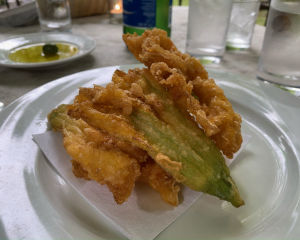
Fried Zucchini Blossoms: A Roman Celebration of Cucina Povera
By Alexandru Kovacs
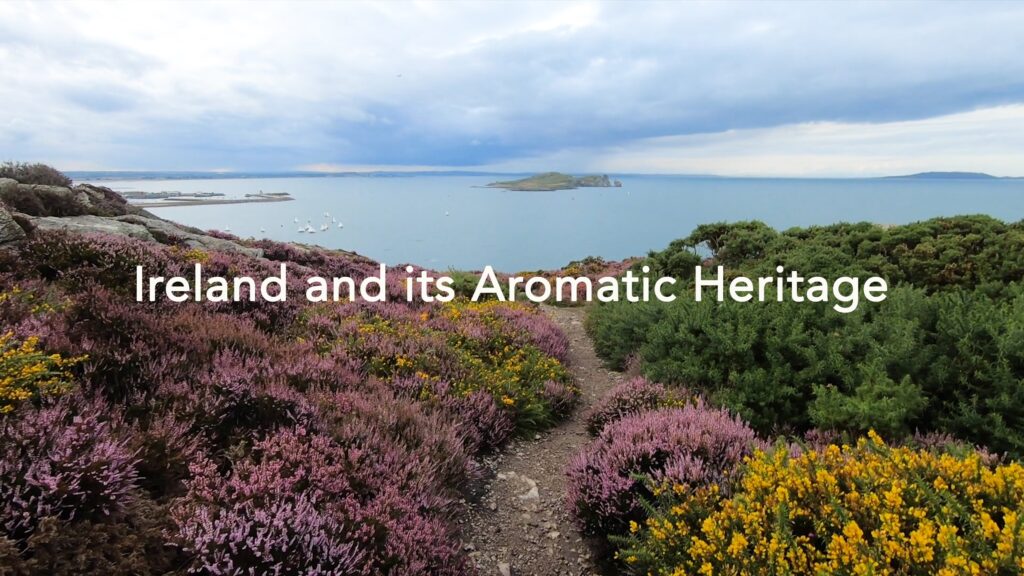
As Ireland transitions from the rich, smoky scent of peat-burning to a more sustainable future, its olfactory heritage is evolving. What will become the next iconic aromatic symbol of Ireland?
Click to watch the documentary trailer.
As Ireland transitions from the rich, smoky scent of peat-burning to a more sustainable future, its olfactory heritage is evolving. What will become the next iconic aromatic symbol of Ireland?