

AI and Scent: Creating an Ethics of Synthetic Smell
By Gayil Nalls
Sign up for our monthly newsletter!
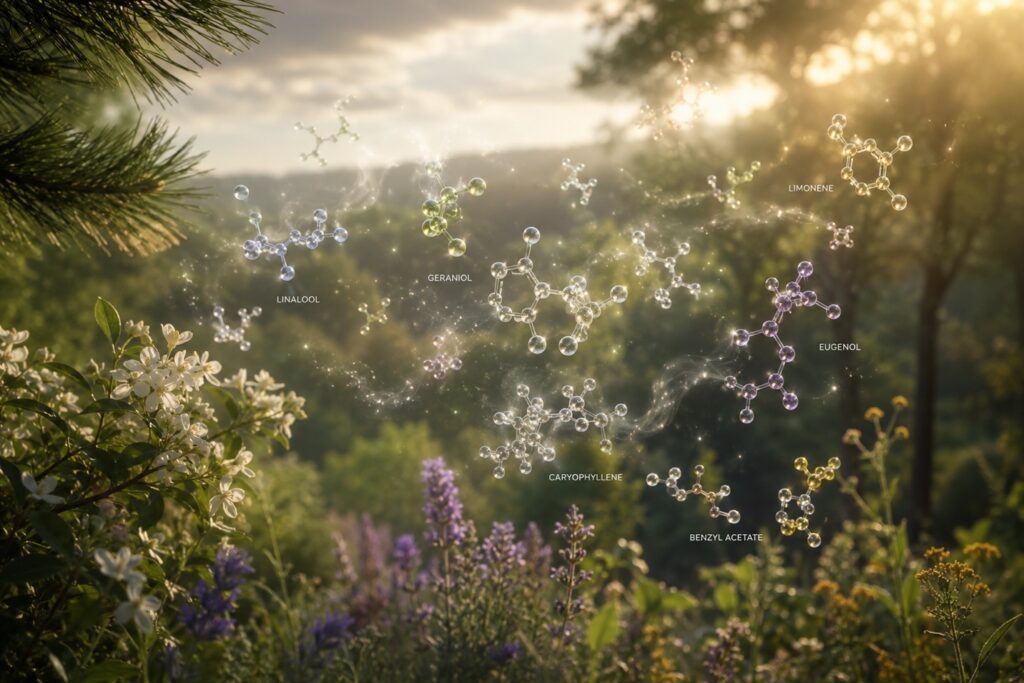
The emergence of artificial intelligence in olfaction and perfumery marks a profound turning point in the human relationship with scent. Deep learning systems trained on massive datasets of molecular structures, odor descriptors, receptor interactions, and human sensory responses can now make informed predictions about how a novel molecule might smell before it is ever synthesized. While these predictions are not perfect, they have become accurate enough to substantially accelerate fragrance research, flavor development, and odor discovery. These AI systems are opening a vast, previously inaccessible sensory frontier, generating entirely novel fragrance molecules that have never existed in nature and have never been encountered by human olfactory systems.
This landmark breakthrough came in 2023 when researchers from Google Research, including Alexander Wiltschko and collaborators, developed an “odor map” in which molecules with similar perceived smells cluster together, even when their chemical structures differ substantially. Their model successfully predicted odor qualities for many molecules it had never encountered before, suggesting that odor perception follows hidden mathematical relationships that AI can uncover.
This work led to the founding of Osmo, which uses AI to design entirely new fragrance molecules, identify substitutes for scarce natural ingredients, and search vast regions of chemical space that perfumers could never explore manually. Rather than screening millions of compounds experimentally, researchers can ask AI to propose molecules likely to smell “jasmine-like,” “green,” “woody,” or “fruity,” then synthesize only the most promising candidates.
Current models can often predict whether a molecule is likely to have an odor, its general odor families (floral, woody, citrus, sulfurous, earthy, musky, etc.), and add multiple odor descriptors simultaneously.
However, some perfumers are reporting that AI still struggles with predicting odor intensity and longevity, modeling complex perfume accords in which dozens or hundreds of molecules interact, and accounting for individual variation arising from differences in olfactory receptor genes. Additionally, it makes no evaluation of emotional, cultural, and autobiographical associations with odors. Some researchers and perfumers have begun informally referring to the flood of computationally generated scents as the perfume equivalent of ‘AI slop. However, this development is both exhilarating for some and deeply consequential.
For centuries, perfumery evolved largely through botanical extraction, fermentation, distillation, and chemical modification of naturally occurring compounds. Even synthetic perfumery of the twentieth century, from aldehydes to modern aroma chemicals, generally remained within a relatively limited chemical and sensory landscape. AI-generated fragrance design changes this fundamentally. It introduces the possibility of exploring millions, even billions, of hypothetical odor-active molecules beyond evolutionary precedent.
The implications extend far beyond perfume.
Because olfaction is directly linked to the limbic system, the brain regions associated with memory, emotion, endocrine response, and survival, novel fragrance molecules, which are biologically active atmospheric agents, enter human nervous systems and ecosystems in ways we do not yet fully understand.
The greatest risks of novel AI-generated fragrance molecules lie in the unknown toxicological effects. The creation of molecules that may smell pleasant or not be recognized at all by human perception, while simultaneously having biological effects that are poorly understood or entirely unknown. Already, some synthetic fragrance molecules disrupt endocrine function, accumulate in fatty tissue, irritate respiratory pathways, alter neurological signaling, sensitize immune responses, and interact unpredictably with other chemicals. And do this to all life forms. These possibilities underscore why rigorous, transparent pre-market toxicological evaluation remains essential.”
Traditional toxicology often evaluates substances one at a time, yet real-world fragrance exposure involves complex mixtures that interact continuously with human biology and indoor environments. Novel molecules generated through AI may fall outside existing toxicological databases, meaning regulators and manufacturers may have little historical evidence regarding chronic exposure, developmental impacts, neurotoxicity, epigenetic effects, or synergistic chemical interactions.
This is especially concerning because olfactory exposure bypasses some of the protective filtering mechanisms associated with ingestion.
Inhaled volatile compounds rapidly enter circulation through the lungs and bloodstream, while odor signals are transmitted almost immediately through the olfactory nervous system to brain regions involved in emotion and memory.”
Another danger is unknown ecological persistence and atmospheric effects. Many synthetic fragrance compounds already persist in waterways, soils, and organisms. Some bioaccumulate in aquatic life and resist degradation.
In addition to some of the synthetic fragrance molecules, now AI-generated molecules could unintentionally persist for decades, transform into toxic secondary compounds, interfere with microbial ecologies, disrupt insect communication systems, or alter atmospheric chemistry.
Plants, fungi, insects, and animals rely extensively on volatile organic compounds (VOCs) for communication. Pollinators locate flowers through scent, forests exchange stress signals chemically, predators track prey olfactorily, and soil organisms coordinate through molecular emissions. Introducing large quantities of novel anthropogenic odorants into ecosystems already creates forms of “chemical noise” that interfere with evolved ecological signaling systems. This will increase the compounds, and the atmosphere itself could become increasingly saturated with synthetic molecular information not shaped by evolutionary feedback. This possibility remains largely unexplored.
In time, AI systems may eventually become highly effective at predicting emotional and behavioral responses to scent. This raises profound ethical concerns about neuropsychological and behavioral manipulation.
Many retailers, hotels, casinos, and other commercial environments intentionally use ambient scent to influence customer experience and behavior. Scents are used to prolong consumer attention, stimulate purchasing behavior, reduce anxiety in commercial settings, manipulate appetite, or influence mood at subconscious levels.
The hospitality and gaming industries have long recognized that scent influences human behavior, but artificial intelligence could dramatically amplify these practices. Imagine that behind the scenes in casinos, hotels, stores, and malls, AI has analyzed millions of data points from consumer studies, wearable devices, eye-tracking, biometric sensors, and purchasing histories to determine precisely which scent profile keeps someone browsing longest, lowers stress, and increases the likelihood of making an unplanned purchase or keeps them at a gaming table.
Because olfactory processing operates largely below conscious awareness, scent-based persuasion can be more covert than visual advertising. The possibility of hyper-personalized algorithmic scent environments introduces questions about autonomy, consent, and sensory sovereignty.
There is also a profound biocultural risk: the erosion of botanical diversity and the cultural traditions rooted in it. As AI-designed aroma molecules become less expensive, more stable, more sustainable, and virtually infinitely customizable, industries may accelerate their shift away from naturally derived aromatic materials. While this transition offers clear environmental and economic advantages in some cases, it could also reduce demand for traditionally cultivated aromatic plants, threatening the livelihoods, agricultural knowledge, and cultural practices that have evolved around them over centuries. Without thoughtful stewardship, the rise of AI-generated scent molecules may contribute to the decline of aromatic agriculture, diminish incentives to conserve culturally significant plant species, and weaken the living relationship between people, plants, and place that natural fragrances embody.
It is a plausible future concern that the risk is not only economic but civilizational.
Beyond their essential role in sustaining ecosystems, aromatic plants are living repositories of culture. They embody intricate ecological relationships, centuries of medicinal wisdom, ceremonial traditions, place-based identities, and the sensory memories through which communities remember, celebrate, and understand the world.
Replacing living aromatic biodiversity with endlessly generated synthetic alternatives may deepen humanity’s estrangement from ecological systems and erode aromatic heritage—the sensory dimension of cultural memory embedded in plants and landscapes.
The important question is–How can AI protect human and ecological health?
Paradoxically, the same predictive powers creating novel molecules can become our best defense against their dangers. AI could help establish a new era of anticipatory toxicology and ecological forecasting.
The first way is through predictive toxicology. Machine learning systems can already model receptor binding, mutagenicity, carcinogenic potential, endocrine disruption, and metabolic breakdown pathway
All future AI safety systems should evaluate fragrance molecules before synthesis by predicting inhalation toxicity, skin sensitization, neurological impacts, hormonal interactions, reproductive risks, and long-term accumulation tendencies. This would shift toxicology from a reactive model to a preventive one.
Instead of waiting years for harm to emerge epidemiologically, unsafe compounds could be filtered out computationally during the design phase.
Another way predictive AI can help is through environmental fate modeling. AI can simulate how molecules behave after release into ecosystems. This includes predicting biodegradability, atmospheric transformation, aquatic persistence, bioaccumulation, soil interactions, and impacts on microbial communities.
Future fragrance development could require environmental simulations analogous to climate modeling. A molecule might smell extraordinary yet be rejected because predictive systems identify potential pollinator disruption, persistence in waterways, ozone interactions, or ecological toxicity
Rather than maximizing novelty alone, AI systems could design safer molecules by constraint, optimizing for low persistence, rapid biodegradation, minimal endocrine activity, non-bioaccumulative structures, and low ecological disruption.
This represents an important philosophical shift. The goal should not simply be “Can we invent a new smell?” but: “What kinds of smells should exist in a healthy planetary future?”
AI could help create fragrance chemistry aligned with ecological intelligence rather than industrial extraction alone.
It is exciting to think of the ways responsible use of AI could expand human olfactory knowledge and deepen scientific understanding of olfaction itself. Smell remains one of the least understood senses. We still do not fully understand how odor perception emerges, why molecules smell the way they do, how scent interacts with memory, or how atmospheric chemistry shapes cognition and emotion.
AI-driven olfactory research may illuminate receptor activation patterns, emotional scent mapping, cross-cultural odor perception, and links between scent and mental health.
This could benefit medicine, environmental monitoring, and conservation.
For example, disease biomarkers may be detected through smell, including volatile biomarkers associated with cancers, metabolic disorders, and infectious diseases. Forest stress could be monitored through VOC analysis, and endangered ecosystems might be tracked through atmospheric scent signatures.
The creation of unprecedented fragrance molecules requires more than technological capability. It requires a new ethical framework.
Such a framework should include mandatory predictive toxicology, ecological impact assessment, transparency of fragrance chemistry, independent long-term testing, atmospheric monitoring, and protection for aromatic biodiversity.
Most importantly, it requires recognizing that scent is not trivial; a smell is ecological information. It is one of the oldest communication systems on Earth, linking microbes, forests, insects, animals, weather, memory, emotion, and culture through invisible molecular exchange.
As AI expands humanity’s ability to write new olfactory languages into the atmosphere, we are assuming unprecedented responsibility for the chemistry of perception itself.
The future of fragrance cannot just pursue novelty or market advantage. It must ask whether the scents we create deepen human and ecological flourishing or further separate us from the living systems that gave rise to smell in the first place.
Lead image by Gayil Nalls and AI
Gayil Nalls, PhD, is an interdisciplinary artist and theorist and the founder of the World Sensorium / Conservancy.
Plantings
Issue 61 – July 2026
Also in this issue:

A Corner on a Country Road
By John Steele

The Ecology of Memory: Scent, Culture, and the Brain
By Gayil Nalls

Three New Plant Research Findings Everyone Can Apply
By WS/C

Heat and the Voices Most Unheard
By Willow Gatewood

Hildegard of Bingen: The Living Green World
By Gayil Nalls
Eat More Plants Recipes:
Magnolia, White Chocolate Vinnaigrette for Foraged Greens
By Mary Munroe

As Ireland transitions from the rich, smoky scent of peat-burning to a more sustainable future, its olfactory heritage is evolving. What will become the next iconic aromatic symbol of Ireland?
Click to watch the documentary trailer.
As Ireland transitions from the rich, smoky scent of peat-burning to a more sustainable future, its olfactory heritage is evolving. What will become the next iconic aromatic symbol of Ireland?