

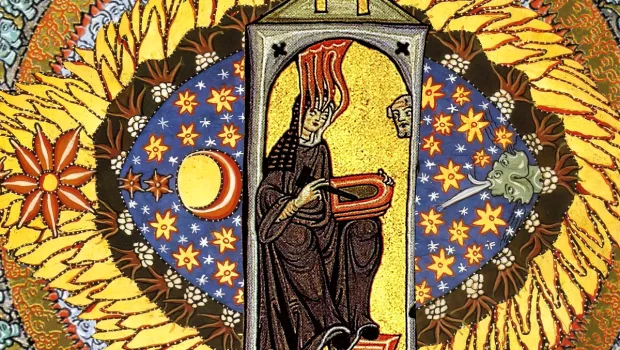
Hildegard von Bingen receives a divine inspiration and passes it on to her scribe. Public Domain | Collage by Aleteia
Hildegard of Bingen: The Living Green World
By Gayil Nalls
Sign up for our monthly newsletter!
I thought it was interesting when I read that for the Museum Director Hans Ulrich Obrist, who has met a big slice of the important living artists in the world, Hildegard of Bingen is the one artist he would time-travel to meet. I have to say, I agree.
Born in the 12th century, long before the language of ecology emerged, Hildegard of Bingen was already articulating a vision of the Earth as a living, breathing whole. A German Benedictine abbess, composer, physician, mystic, and natural philosopher, Hildegard understood the world not as a collection of resources, but as an interwoven vitality, a dynamic field of relationships between plants, bodies, elements, and spirit. Her work offers a remarkably prescient framework for what we might now call ecological consciousness, rooted in observation, reverence, and an ethic of care.
At the heart of Hildegard’s thinking is the concept of viriditas, often translated as “greenness,” but more accurately understood as a life-generating force that animates all living beings. It is the sap rising in plants, the vitality in the human body, the fecundity of the Earth itself. In her theological and scientific writings, particularly in Scivias and Physica, this greening power becomes both a biological and spiritual principle. Health, for Hildegard, is the flourishing of viriditas; illness, its diminishment.
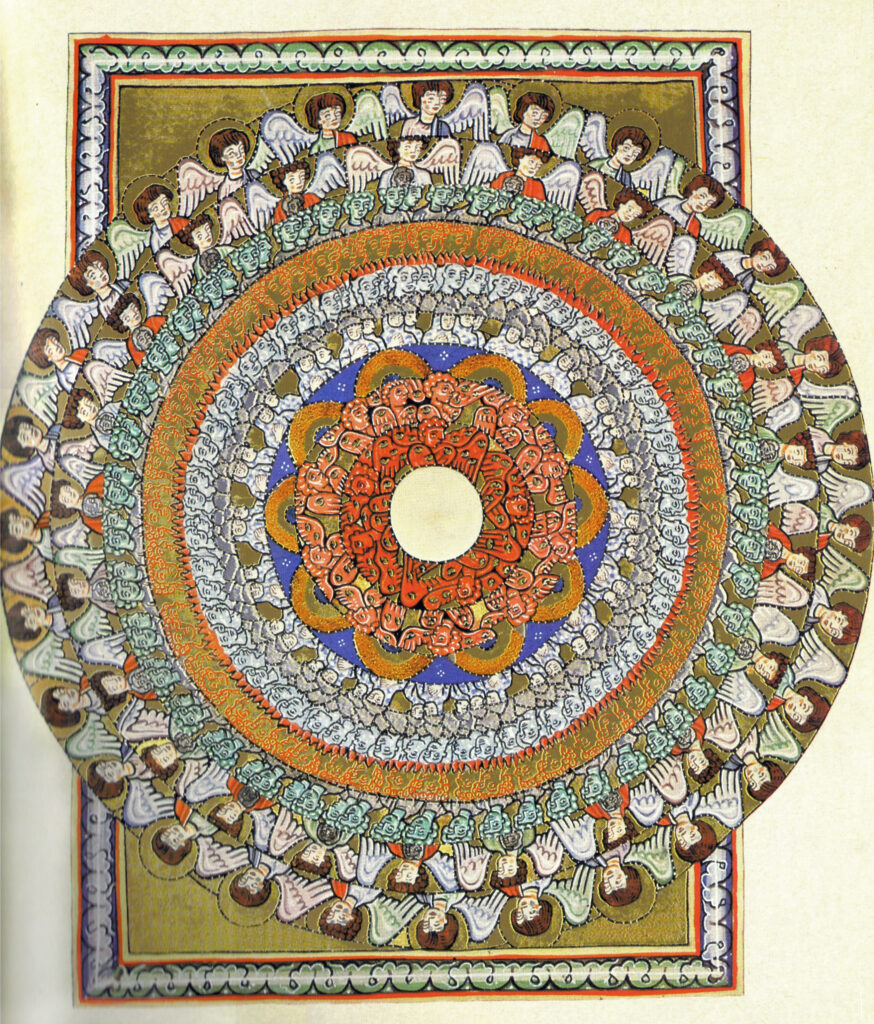
Scivias I.6: The Choirs of Angels. From the Rupertsberg manuscript, folio 38r.
Her medical texts, including Causae et Curae, draw extensively on the properties of plants, minerals, and animals, but always within a broader cosmology. Plants are not inert substances to be extracted and consumed; they are expressions of Earth’s intelligence, each with its own temperament, affinities, and role within a larger harmony. Fennel, she writes, “makes a person cheerful,” while sage is “more warm than cold” and restores strength. These relational insights were early gestures toward what we now understand as phytochemistry, energetics, and the ecological embeddedness of healing.
Hildegard’s worldview resonates strikingly with contemporary movements in plant science and environmental philosophy. Today, researchers study plant signaling, volatile organic compounds (VOCs), and symbiotic networks—phenomena that reveal plants as communicative, responsive beings within complex ecosystems. While Hildegard did not have access to microscopes or gas chromatography, her intuitive grasp of interconnected vitality anticipates these discoveries. Her language is poetic, but her observations are grounded in careful attention to the living world.
Equally significant is her ethical stance. Hildegard warned against excess, imbalance, and the disruption of natural order. She saw human well-being as inseparable from environmental health, writing that when the elements are “disturbed and polluted,” the human body suffers in turn. This principle, now central to frameworks like One Health and planetary health, positions her as an early voice in environmental ethics. Her warnings feel uncannily contemporary in an age of climate instability, biodiversity loss, and ecological fragmentation.
Yet Hildegard’s legacy is not only cautionary; it is also deeply restorative. She offers a vision of re-attunement, a way of returning to balance through attention, humility, and care. To engage with plants, in her view, is to enter into a relationship with the generative forces of life itself. This is not unlike the ethos emerging today in biocultural conservation, where the preservation of plant species is inseparable from the cultural knowledge and sensory practices that give them meaning.
Hildegard of Bingen invites us to reconsider the sensory dimensions of ecology. Her writings are filled with texture, taste, scent, color, and vitality. The greenness she describes is embodied, perceptual, and immediate. It calls to mind the sharp brightness of crushed fennel, the resinous depth of sage, the subtle sweetness of flowering herbs carried on warm air. In this sense, Hildegard’s work aligns closely with the mission of the World Sensorium Conservancy: to recognize plants not only as biological entities, but as carriers of memory, culture, and meaning.
In an era increasingly defined by data and distance, Hildegard reminds us that knowledge can also arise through intimacy, with land, with plants, with the subtle shifts of season and body. Her viriditas is not a metaphor to be admired from afar; it is a force to be encountered, protected, and sustained.
To read Hildegard today is to encounter an older, slower science, one that does not separate observation from reverence, nor utility from relationship. It is to be reminded that the green world is not simply around us, but within us, sustaining and shaping the conditions of life. And it is to recognize that the work of conservation is, at its core, the work of keeping that greenness alive.
Gayil Nalls, PhD is an interdisciplinary artist and theorist, and the founder of the World Sensorium / Conservancy.
Plantings
Issue 60 – June 2026
Also in this issue:
Sensing Floral Futures: A Conversation with Eliza Collin
By Clara Muller
A Corner on a Country Road
By John Steele
The Ecology of Memory: Scent, Culture, and the Brain
By Gayil Nalls
Three New Plant Research Findings Everyone Can Apply
By WS/C
Heat and the Voices Most Unheard
By Willow Gatewood
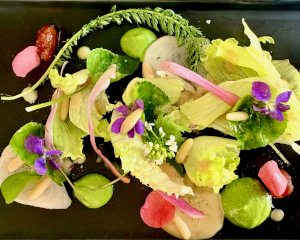
Eat More Plants Recipes:
Magnolia, White Chocolate Vinnaigrette for Foraged Greens
By Mary Munroe
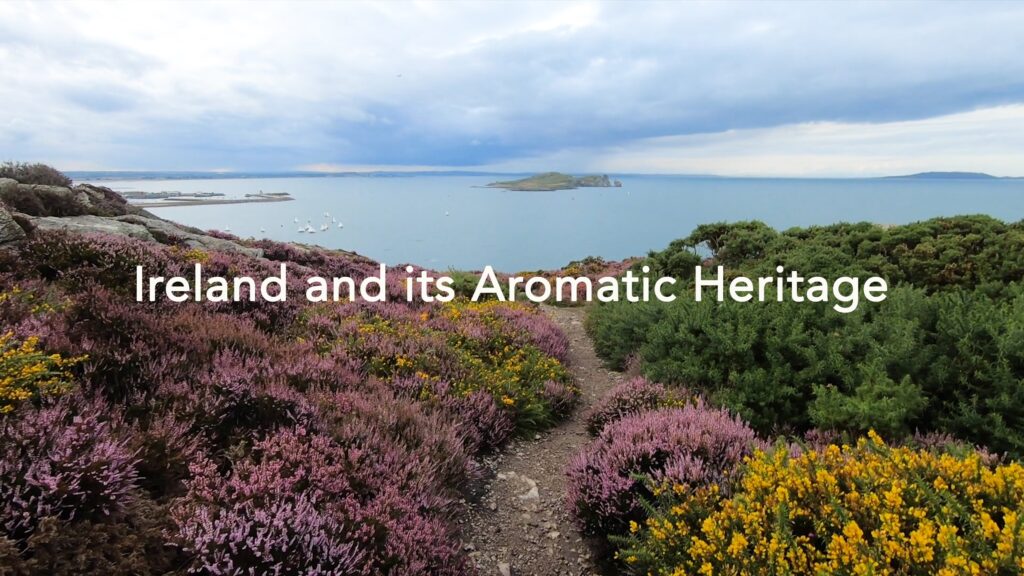
As Ireland transitions from the rich, smoky scent of peat-burning to a more sustainable future, its olfactory heritage is evolving. What will become the next iconic aromatic symbol of Ireland?
Click to watch the documentary trailer.
As Ireland transitions from the rich, smoky scent of peat-burning to a more sustainable future, its olfactory heritage is evolving. What will become the next iconic aromatic symbol of Ireland?