

© archibio.it
Bioenergetic Landscapes: Rethinking Our Relationship with Trees
By Octavia Overholser and Gayil Nalls
Sign up for our monthly newsletter!
Long before cities, roads, and buildings reshaped the human experience, our ancestors lived among trees. For hundreds of thousands of years, forests and wooded savannas provided shelter, food, protection, and the ecological conditions under which human perception and physiology evolved. Today, although most people spend the majority of their lives indoors or in-built environments, our attraction to trees remains remarkably strong.
Scientists increasingly recognize that this attraction is more than aesthetic. Research in environmental psychology, neuroscience, and public health suggests that spending time in natural settings can reduce stress, restore attention, improve mood, and support physical health. These findings have inspired new approaches to landscape design that seek not only to beautify places but also to improve human well-being.
Among the most intriguing and most debated of these approaches is Bioenergetic Landscapes, developed by Italian researcher and landscape designer Marco Nieri.
The idea begins with a simple observation: humans evolved in close relationship with living landscapes. This evolutionary history forms the basis of the concept of biophilia, introduced by biologist Edward O. Wilson, which proposes that people possess an innate affinity for other living organisms.
Over the past several decades, researchers have shown that even relatively brief exposure to forests, gardens, or green spaces can produce measurable physiological benefits. Two influential theories have helped explain these effects.
Stress Recovery Theory, developed by Roger Ulrich, suggests that natural environments rapidly reduce physiological stress and promote emotional recovery.
Attention Restoration Theory, developed by Rachel and Stephen Kaplan, proposes that nature restores the brain’s capacity for focused attention after mental fatigue.
Together, these theories have helped establish what many people experience intuitively– that landscapes can function as places of healing as well as beauty.
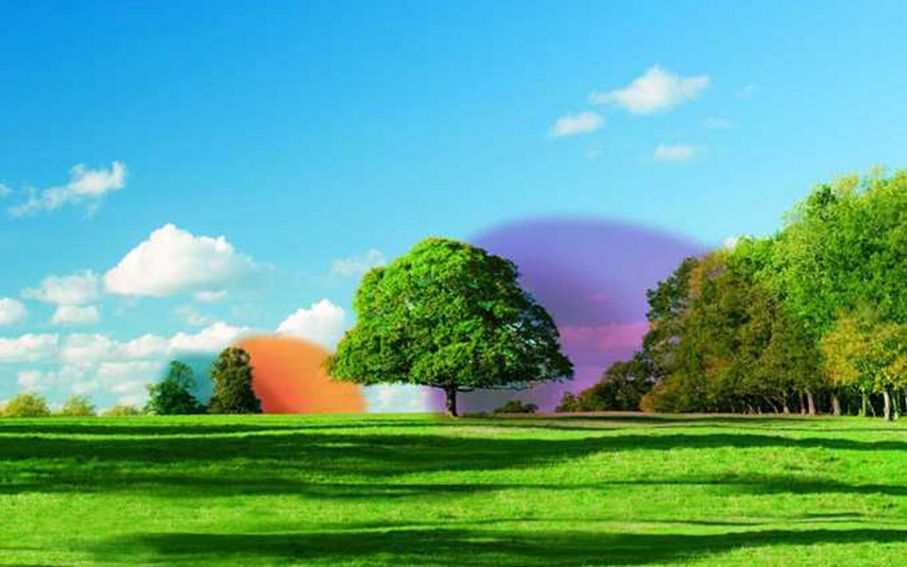
Beyond Forest Bathing,Bioenergetic Landscapes builds upon these established ideas but proposes an additional dimension.
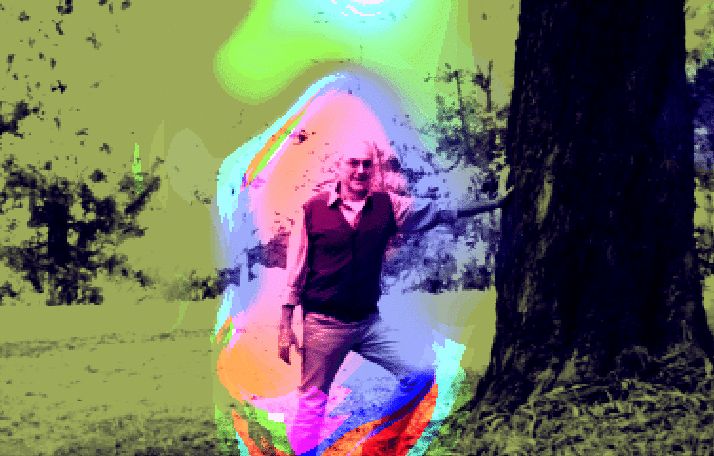
According to Nieri, trees emit weak bioelectromagnetic fields that interact with the human body. He suggests that under certain environmental conditions these fields may extend outward from individual trees, creating “bioenergetic areas” where people may experience enhanced relaxation, reduced stress, or support for particular physiological systems.
The concept proposes that different tree species generate distinct energetic characteristics and that these can be identified, mapped, and incorporated into landscape design. Rather than simply encouraging people to spend time in nature, Bioenergetic Landscapes seeks to identify locations around specific trees where these proposed effects are strongest.
Nieri’s work incorporates several technologies intended to visualize or measure biological responses associated with tree contact. These include Gas Discharge Visualization (GDV) imaging, multispectral imaging, hyperspectral imaging, and other bioelectromagnetic measurement systems that are presented as tools for assessing changes in human energetic patterns before and after time spent near selected trees. Images here are examples of thermal and spectral imaging used to visualize energy flow associated with trees.
The interpretation of these measurements remains an active area of discussion. While the broader scientific community widely accepts the health benefits of spending time in forests and green spaces, the specific claims that tree-generated electromagnetic fields directly influence particular human organs have not yet achieved broad scientific consensus.
This distinction is important. Bioenergetic Landscapes should be understood as an emerging hypothesis that seeks to explain why some natural environments may feel especially restorative, rather than as an established medical model.
Whether or not every proposed mechanism is ultimately confirmed, the practical applications are compelling for designing landscapes for well-being
Nieri has designed Bioenergetic Parks and therapeutic landscapes throughout Italy, including installations in Bolzano, Perugia, and the Tenuta de L’Annunziata Natural Relais near Lake Como. These landscapes invite visitors to slow down, spend extended time with particular trees, and experience nature through deliberate observation and quiet presence. Interpretive signs identify tree species and describe their proposed restorative qualities, creating spaces intended for reflection as much as recreation.
These projects represent a broader shift occurring in landscape architecture and urban design: parks are increasingly viewed not only as ecological infrastructure but also as public health infrastructure.
Perhaps the greatest contribution of Bioenergetic Landscapes is not whether every energetic hypothesis proves correct, but that it asks us to reconsider our relationship with trees.
Modern science continues to reveal extraordinary forms of plant communication, electrical signaling, volatile chemical exchange, and underground fungal networks that were unimaginable only decades ago. At the same time, technologies capable of measuring increasingly subtle biological and environmental interactions continue to advance.
Bioenergetic Landscapes occupies this frontier between ecology, landscape design, human physiology, and emerging environmental research. It invites questions that deserve careful investigation: How do different landscapes influence human biology? Can certain trees produce measurably different restorative experiences? And how might future technologies deepen our understanding of the invisible relationships that connect people and the living world?
Whether viewed as an innovative design philosophy, an emerging research program, or an invitation to pay closer attention to the living landscapes around us, Bioenergetic Landscapes reminds us that trees may offer far more than shade, oxygen, and beauty. They may also offer new ways of thinking about health, place, and the profound connections between human beings and the forests from which we came.
Octavia Overholser is a Strategic Advisor on Business Management and Sustainability and an Educator. She is on the WS/C Board.
Gayil Nalls, PhD, is an interdisciplinary artist and theorist and the founder of the World Sensorium / Conservancy.
Plantings
Issue 62 – August 2026
Also in this issue:

David Shaw: Health for a Living Planet
By Gayil Nalls
Vertical Farming: Reimagining Agriculture in an Urban Age
By Gayil Nalls
Using Evolution to Better Your Neighborhood
By WS/C
What a Village Knows That a City’s Forgotten
By Willow Gatewood
The New Extractivism
By Nuri McBride

Eat More Plants Recipes:
Cold Veggie Peanut Noodles
By Ian Sleat
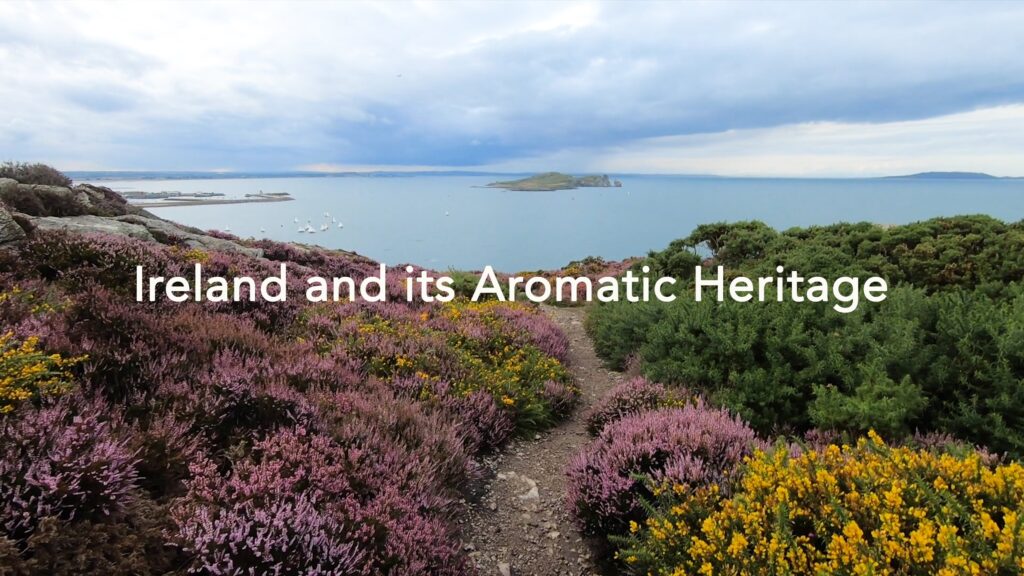
As Ireland transitions from the rich, smoky scent of peat-burning to a more sustainable future, its olfactory heritage is evolving. What will become the next iconic aromatic symbol of Ireland?
Click to watch the documentary trailer.
As Ireland transitions from the rich, smoky scent of peat-burning to a more sustainable future, its olfactory heritage is evolving. What will become the next iconic aromatic symbol of Ireland?