

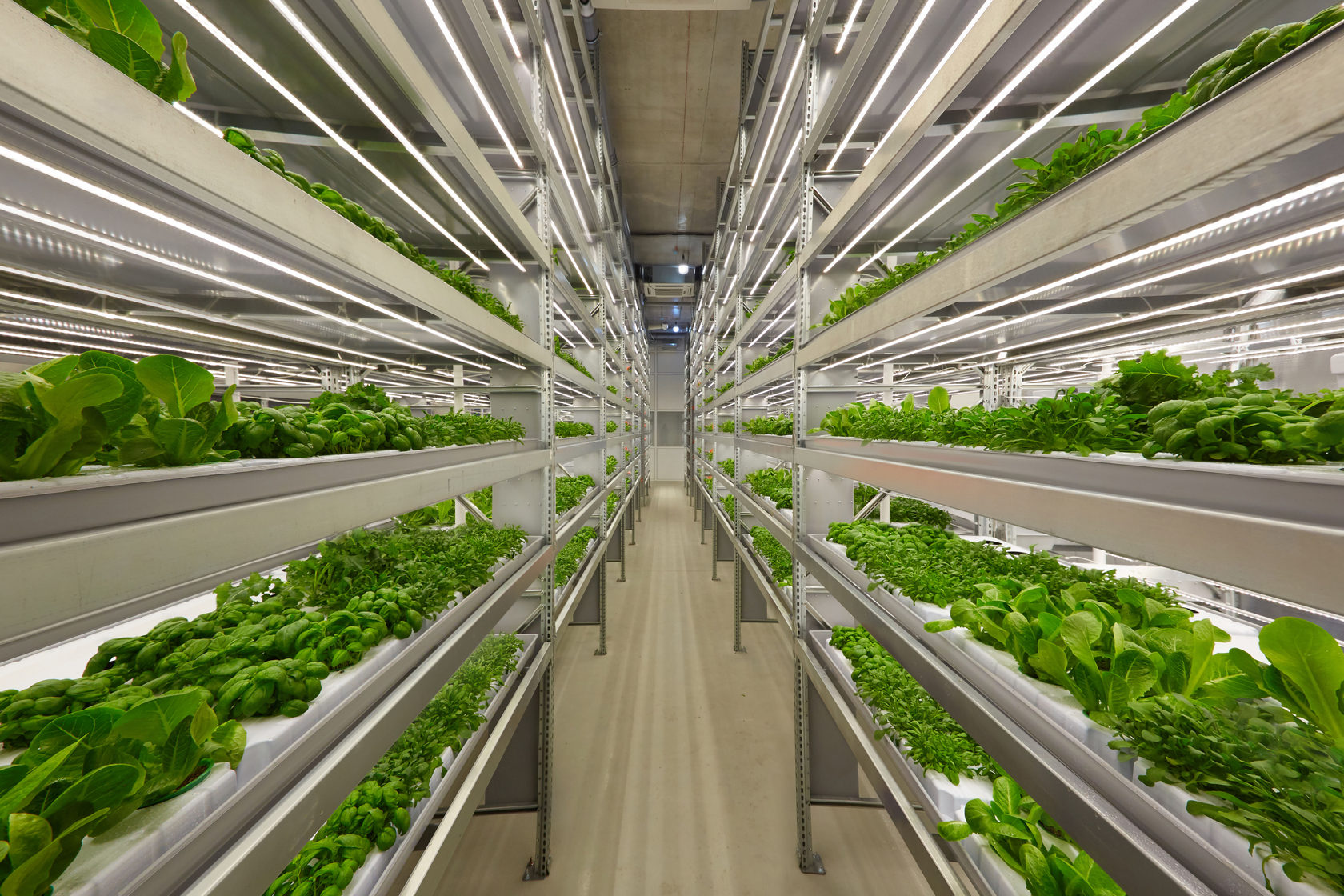
ifarm.fi, CC BY-SA 4.0, via Wikimedia Commons
Vertical Farming: Reimagining Agriculture in an Urban Age
By Gayil Nalls
Sign up for our monthly newsletter!
As climate instability, soil degradation, water scarcity, and expanding urbanization place increasing pressure on conventional agriculture, vertical farming has emerged as one of the most compelling experiments in the future of food production. What began for many as a few herbs growing in pots on a sunny kitchen shelf has evolved into a sophisticated agricultural movement that rethinks where and how plants can grow.
Once viewed as a futuristic experiment, vertical framing is increasingly becoming part of a global search for resilient food systems in a warming, urbanizing world and already encompasses a wide spectrum of cultivation practices. At its simplest, it may involve growing edible plants in containers along apartment windowsills, balconies, rooftops, or indoor shelves illuminated by natural sunlight. At its most technologically advanced, it can mean hydroponic systems in which roots grow directly in nutrient-rich water, or aeroponic systems where roots hang suspended in air and are misted with precisely calibrated nutrients inside carefully controlled indoor environments. In these highly engineered spaces, plants may grow without soil, without weather, and sometimes without sunlight itself, nourished instead by LED grow lights designed to mimic the spectral qualities needed for photosynthesis.
What unites these diverse practices is a profound shift in agricultural thinking. Rather than expanding outward across ever more land, vertical farming grows upward. Plants are cultivated in stacked layers or vertically integrated systems that maximize spatial efficiency while reducing the need for large tracts of farmland. In dense urban environments where land is scarce and expensive, this transformation is especially significant. One no longer needs to own acres of arable soil to participate in food production. Agriculture can exist inside repurposed warehouses, shipping containers, office buildings, greenhouses atop skyscrapers, schools, restaurants, and homes.
This shift carries profound ecological implications. Traditional industrial agriculture consumes enormous amounts of freshwater, depletes soils, contributes to deforestation, and depends heavily on long-distance transportation networks. Vertical farming systems, by contrast, often dramatically use less water through recirculating irrigation systems that minimize waste. Hydroponic and aeroponic systems can reduce water consumption by as much as 70–95% compared to conventional farming methods. Because these systems are enclosed, they also reduce exposure to pests, lowering or eliminating the need for pesticides and herbicides that contaminate ecosystems and waterways.
The environmental benefits extend further. Locating food production within or near cities shortens supply chains and reduces transportation emissions. Lettuce grown a few blocks away does not require refrigerated trucking across continents. Herbs harvested moments before reaching a kitchen retain more nutrients, aroma, and vitality than produce shipped over thousands of miles. This sensory dimension is especially important. Freshly harvested aromatic plants contain volatile organic compounds at their peak expression. Basil, mint, rosemary, cilantro, and edible flowers reveal fuller olfactory complexity when consumed close to the moment of harvest. Vertical farming therefore not only changes logistics: it changes sensory experience and potentially restores intimacy between people and living plants.
Vertical farming also raises profound sensory and cultural questions. Agriculture is not only a system of production; it is a relationship between humans, land, weather, smell, memory, and biodiversity. Traditional farming landscapes carry the scent signatures of place: sun-warmed tomato vines, damp soil after rain, basil in summer heat, apple orchards in bloom, or the mineral aroma of peat-rich fields. These atmospheric and olfactory experiences shape cultural identity and ecological memory.
This reconnection may become increasingly important as younger generations grow up in highly urbanized environments with limited direct contact with nature. Indoor cultivation systems can function not merely as food technologies, but as educational and sensory tools. Children watching strawberries ripen indoors or inhaling the scent of tomato vines under grow lights experience firsthand that food is not a manufactured product, but a living process dependent on light, water, minerals, microorganisms, and care.
Yet, there is also something psychologically transformative about bringing cultivation back into daily urban life. For much of human history, agriculture shaped seasonal rhythms, cultural rituals, and communal identity. Industrialization and globalization distanced many people from the sources of their food. Vertical farming partially reverses this separation. A shelf of greens under soft grow lights in a city apartment, or a community hydroponic installation in a neighborhood school, reconnects individuals with the act of nurturing living systems. It invites observation of germination, leaf emergence, root development, moisture cycles, and plant behavior. Even small-scale cultivation can restore awareness of biological processes that modern life often obscures.
At larger scales, vertical farming is beginning to intersect with questions of resilience and food sovereignty. Extreme weather events, droughts, floods, wildfires, and geopolitical disruptions increasingly threaten global food systems. Indoor vertical farms can buffer some of these vulnerabilities by stabilizing production conditions and decentralizing cultivation. Countries with limited arable land, harsh climates, or rapidly growing urban populations are investing heavily in controlled-environment agriculture as part of long-term food security strategies.
Yet vertical farming is not without challenges or contradictions. Large indoor facilities can consume significant amounts of energy, particularly for lighting and climate control. The sustainability of these systems depends heavily on whether they are powered by renewable energy sources. Critics also note that many staple crops such as wheat, rice, and corn remain difficult and economically impractical to grow vertically at scale. For now, vertical farming is best suited to leafy greens, herbs, microgreens, strawberries, medicinal plants, and specialty crops with high nutritional or economic value.
There are also deeper philosophical questions. What happens when agriculture becomes increasingly separated from soil, seasons, insects, and weather? Can fully artificial growing environments preserve the ecological complexity and microbial richness that have long shaped plant chemistry, nutrition, and flavor? Will future generations understand the smell of rain on soil, or the seasonal fragrance of flowering orchards, if much of their food emerges from climate-controlled interiors? These questions are not arguments against vertical farming, but reminders that technological innovation must remain in dialogue with ecological wisdom.
The future of agriculture will likely not be singular, but plural. Regenerative soil farming, agroforestry, seed conservation, urban gardens, rooftop cultivation, Indigenous ecological knowledge, and vertical farming may all become complementary strategies within a more resilient food system. Vertical farming should not be seen simply as a replacement for traditional agriculture, but as one evolving response to the environmental and spatial realities of the twenty-first century.
Perhaps most importantly, vertical farming challenges us to reconsider what agriculture can be. It transforms cultivation from a distant rural industry into something embedded within daily life, architecture, education, and culture. It suggests that even in dense cities, amid concrete and glass, humans still carry an instinctive desire to nurture green life. Beneath the glow of LED lights or beside a sunlit kitchen window, the ancient relationship between people and plants continues to adapt, seeking new forms through which to survive and flourish.
The future of farming may ultimately be hybrid rather than singular: regenerative outdoor agriculture restoring soil and biodiversity; community gardens strengthening local resilience; agroforestry rebuilding ecological complexity; and vertical farming providing efficient supplemental food production where land and climate constraints intensify.
As humanity moves deeper into the twenty-first century, one question becomes increasingly urgent: how can we feed growing populations without severing ourselves from the living systems that sustain both biological and cultural life?
Vertical farming offers one possible answer, not simply by growing upward, but by challenging us to rethink what agriculture means in an era of ecological instability. The task ahead is not merely technological innovation but ensuring that efficiency does not come at the cost of our sensory, ecological, and emotional relationship with the Earth itself.ions between human beings and the forests from which we came.
Gayil Nalls, PhD, is an interdisciplinary artist and theorist and the founder of the World Sensorium / Conservancy.
Plantings
Issue 62 – August 2026
Also in this issue:

David Shaw: Health for a Living Planet
By Gayil Nalls
Using Evolution to Better Your Neighborhood
By WS/C

Bioenergetic Landscapes: Rethinking Our Relationship with Trees
By Octavia Overholser and Gayil Nalls
What a Village Knows That a City’s Forgotten
By Willow Gatewood
The New Extractivism
By Nuri McBride

Eat More Plants Recipes:
Cold Veggie Peanut Noodles
By Ian Sleat

As Ireland transitions from the rich, smoky scent of peat-burning to a more sustainable future, its olfactory heritage is evolving. What will become the next iconic aromatic symbol of Ireland?
Click to watch the documentary trailer.
As Ireland transitions from the rich, smoky scent of peat-burning to a more sustainable future, its olfactory heritage is evolving. What will become the next iconic aromatic symbol of Ireland?