

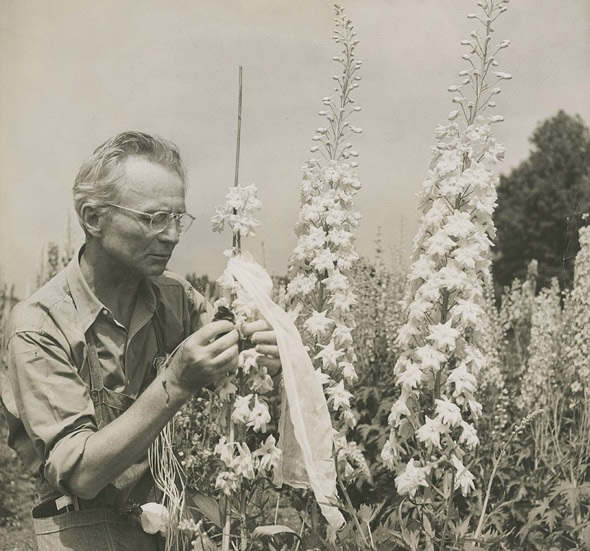
Edward Steichen: Delphiniums on Umpawaug Farm
By Gayil Nalls
Sign up for our monthly newsletter!
One truth emerges again and again across disciplines: the cultivation of a garden and the practice of photography share a common sensibility. Both depend on patience, attention, and a deep responsiveness to light, form, and time. Few embodied this convergence more fully than Edward Steichen (1879-1973).
Widely recognized as one of the most influential photographers of the 20th century, shaping fashion, portraiture, and later curating the landmark exhibition The Family of Man, Steichen was equally devoted to horticulture. Beginning in 1905, he undertook an ambitious and highly disciplined program of hybridizing delphiniums, driven by a singular aesthetic goal: the creation of a “deep, pure blue,” a color he pursued with the same rigor he brought to photographic tonal range and composition. During the years 1906-1914, when he lived and worked in France, the French Horticultural Society awarded him its gold medal in 1913, and he served as president of the American Delphinium Society from 1935 to 1939.
In 1937, Steichen left his position as chief photographer for Condé Nast and relocated to his farm in Redding, Connecticut. There, at Umpawaug Farm, he developed an extraordinary cultivated landscape, over 400 acres supporting approximately 50,000 delphinium plants. The scale was both agricultural and artistic, a living studio in which color, structure, and seasonal rhythm could be observed, refined, and ultimately translated into photographic form.
Delphiniums, often called larkspur, rise in early summer as tall, luminous spires, their densely clustered blossoms unfolding in gradients of blue, violet, white, and occasional pink. Belonging to the genus Delphinium, these plants have long been cultivated for both their architectural elegance and their elusive, almost electric blue tones that have drawn gardeners and artists into a quiet pursuit of intensity and purity. Edward Steichen was the most devoted. At his Connecticut farm, he hybridized tens of thousands of delphiniums in search of a “deep pure blue,” treating the flower as both living subject and aesthetic experiment. Artists across traditions have likewise been drawn to the flower’s vertical rhythm and saturated color, from the close, sensuous enlargements of Georgia O’Keeffe to the atmospheric gardens of Impressionist painters such as Claude Monet, where spires of bloom punctuate fields of shifting light. Each delphinium flower, with its delicate backward-reaching spur, serves as both an intricate landing structure for pollinators and a sculptural form in its own right. Native to the temperate regions of the Northern Hemisphere, delphiniums thrive in cool climates and well-tended soils, yet their beauty carries a certain fragility. They are sensitive to heat, wind, and disturbance, and all parts of the plant are toxic if ingested. Perhaps for this reason, they have come to symbolize both openness and ardent attachment. The plant’s vertical gesture in the garden has invited both cultivation and sustained artistic attention.
During peak bloom, Steichen would walk among his towering spires of delphiniums, many reaching four to six feet in height, carefully selecting specimens with what he described as having “beautiful architecture.” His eye was sculptural as much as botanical: he sought clarity of line, density of florets, and a chromatic intensity that could hold its own against the camera’s demanding gaze. These selections became subjects for images such as Delphiniums on Unpawaug Farm (1939), in which the plants are rendered as vertical compositions, architectural forms articulated through light and shadow.
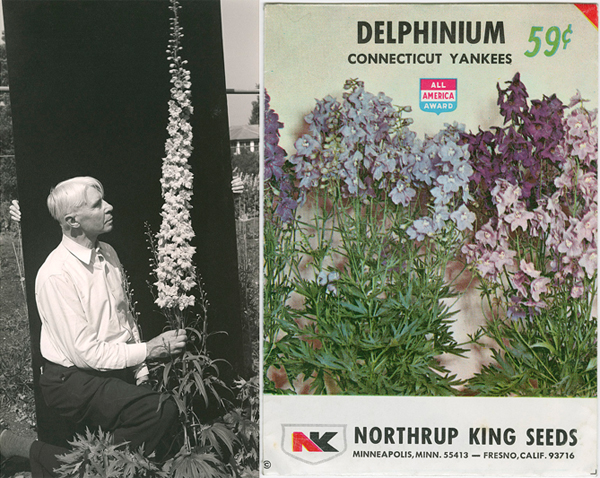
From left: Carl Sandburg with the “Carl Sandburg” delphinium (c. 1938), Umpawaug House (Redding, Connecticut). Photo by Edward Steichen. Gelatin silver print. Seed packet of “Delphinium Connecticut Yankees,” bred by Edward Steichen (c. 1973). Offset, printed in color. Both images Edward Steichen Archive, VII. The Museum of Modern Art Archives. CC-BY
Among the many delphinium varieties Edward Steichen developed were cultivars that reflected both his artistic sensibility and his personal circle. One, “Carl Sandburg,” honored his brother-in-law, close friend, and the Nobel Prize-winning poet. Another, the “Connecticut Yankees,” was later introduced to the public through seed packets released by Northrup King Seeds in the 1960s, extending Steichen’s horticultural legacy into home gardens across America. His devotion to these flowers reached a remarkable public expression in June 1936, when the Museum of Modern Art presented its first—and only—dedicated flower exhibition, Edward Steichen’s Delphiniums. For a single week, the galleries were transformed by towering blooms that Steichen had cultivated himself and personally transported to the museum, blurring the boundaries between fine art, horticulture, and lived aesthetic experience.
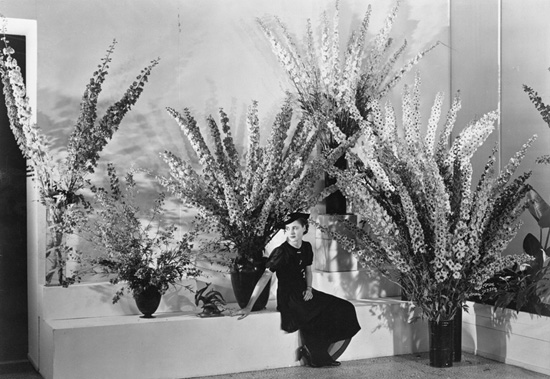
Installation view of the exhibition, Edward Steichen’s Delphiniums. June 24, 1936, through July 1, 1936. The Museum of Modern Art, New York. Photograph by Edward Steichen. CC-BY
Steichen’s dual practice reveals a profound continuity between cultivation and image-making, extending his artistic inquiry. In the delphinium fields, he explored the same questions that animated his photography: how to frame beauty, distill form, and capture the ephemeral moment when nature achieves a kind of visual perfection.
A recent exhibition at the George Eastman Museum in Rochester draws on the museum’s rich archive to illuminate this lesser-known dimension of Steichen’s life and work. Through photographs, documents, and horticultural records, the exhibition traces his lifelong engagement with the garden, revealing how deeply intertwined his botanical and photographic practices truly were. On view through September 6, it offers a rare glimpse into an artist who understood that cultivating beauty and capturing it are, at their core, the same act.
The exhibition Edward Steichen and The Garden
is at the George Eastman Museum
900 East Ave, Rochester, NY 14607
March 27, 2026-September 6, 2026
Gayil Nalls, PhD is an interdisciplinary artist and theorist, and the founder of the World Sensorium / Conservancy.
Plantings
Issue 59 – May 2026
Also in this issue:
The Green Bloom: Chlorophyll, Light, and Renewal
By WS/C
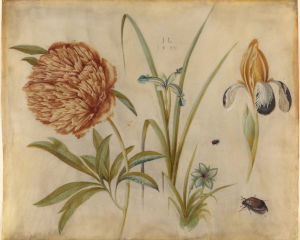
Environmental Generational Amnesia and the Smell of Maybugs
By Clara Muller
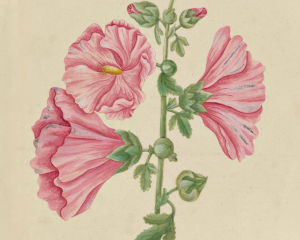
Elizabeth Blackwell: The Courage of Attention
By John Steele
The Importance of Embodied Joy
By Gayil Nalls
Seeds, Time, and the Human Psyche
By Margherita Gandolfi
Eat More Plants Recipes:
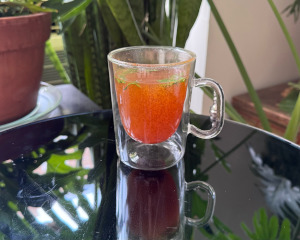
Spring Dandelion & Burdock Broth
By Gayil Nalls
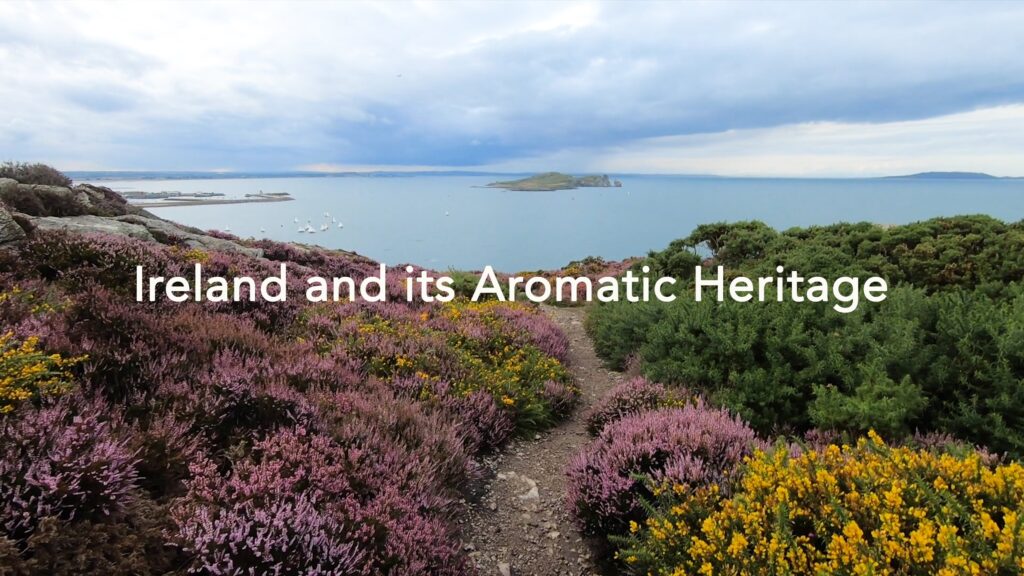
As Ireland transitions from the rich, smoky scent of peat-burning to a more sustainable future, its olfactory heritage is evolving. What will become the next iconic aromatic symbol of Ireland?
Click to watch the documentary trailer.
As Ireland transitions from the rich, smoky scent of peat-burning to a more sustainable future, its olfactory heritage is evolving. What will become the next iconic aromatic symbol of Ireland?