

Environmental Generational Amnesia and the Smell of Maybugs
By Clara Muller
Sign up for our monthly newsletter!
Maybugs used to be the messengers of spring.i In late April and early May, every three to four years, the adults emerged from the ground where they had lived as larvae and pupae, filling the evening air with the loud buzz of their wings and, if literary and historical accounts are to be trusted, a distinctive smell.
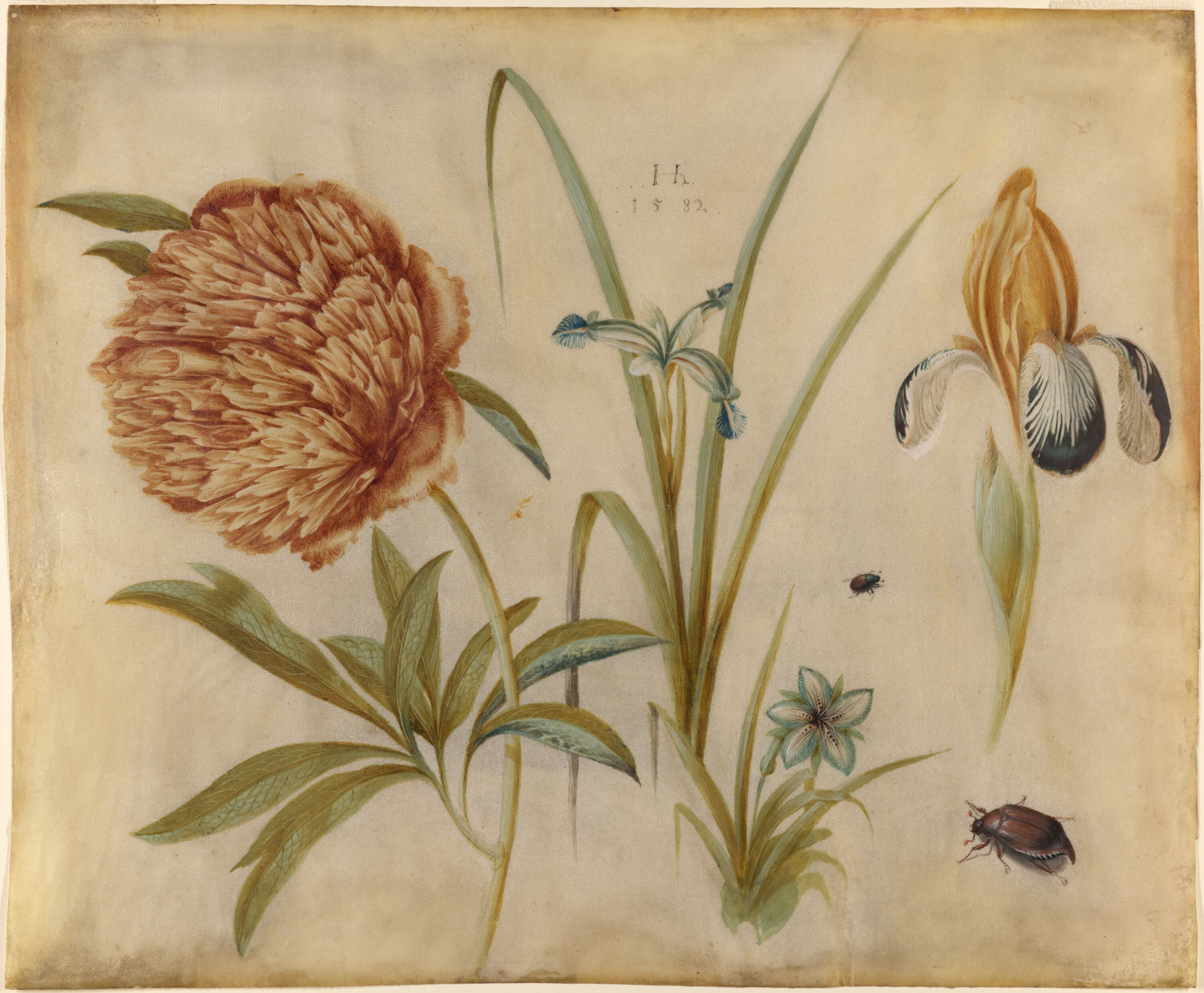
The first time I came across a mention of that smell was in Colette’s Pour un herbier (1947). In one of her most striking descriptions of a floral scent, she writes: “Peonies smell like peonies, that is to say, like cockchafers.”ii Although she may in fact have been referring to Cetonia aurata, the rose chafer,iii rather than the common cockchafer (Melolontha melolontha), the remark stayed with me. It led me to a simple but disquieting question: What do maybugs smell like—and why do I not know?
The “Acrid” Smell of Maybugs
The common cockchafer is easily recognized by its chestnut-brown wing cases, black eyes, furry body, fan-shaped antennae—an extraordinary olfactory organiv–and its awkward, erratic flight, which earned it a reputation for stupidity, clumsiness, and comic ineptitude. To this distinctive appearance must be added a characteristic humming sound and a peculiar odor. One mid-nineteenth-century account notes that they “make their appearance at sunset with a disagreeable buzzing noise, and most unpleasant smell.”v Elsewhere, this odor was described by nosewitnesses as “foul,”vi “acrid,”vii “fetid,”viii “pungent”ix—in short, unmistakable and generally unpleasant.x
Yet what surprised me most was not simply discovering that maybugs stink—countless arthropods possess a more or less pleasant odorxi—but how often that smell was mentioned in literature, scientific writing, and the press of the nineteenth and early twentieth centuries.xii This “unbearable”xiii stench was said to drift through the evening air when maybugs swarmed, but also to cling to whatever they had touched. The French poet Carlos Larronde suggests as much in a brief, vernal quatrain from 1931: “The cuckoo seems to be playing hide and seek / You eat a sprout / And your fingers have kept / The smell of a maybug.”xiv
Writers of the time plainly assumed a shared sensory knowledge—one that has now largely disappeared. The smell of cockchafers, in fact, was once familiar and specific enough to function not only as a literary image but also as an olfactory comparison in botanical description. Besides Colette’s peony, Midland hawthorn (Crataegus laevigata), for instance, was often said to smell of cockchafer.xv In 1903, a local French newspaper evoked the first signs of spring in these poetic terms: “Here are the tender, silky caterpillars of the hazel trees, the cottony pendants of the willows, and the tender budding that appears on the hawthorns with the scent of cockchafers and summer evenings.”xvi
This comparison may have had a chemical basis. The flowers of Crataegus laevigata are known to emit trimethylamine (TMA), a compound associated with the smell of rotting fish, urine, and even corpses. If cockchafers also produce TMA—as far as I know, no one has investigated the question—it could explain both the revulsion their smell provoked and the analogy with the mayflower.xvii The blossoms of Pyrus communis and some poplars were also sometimes said to smell of maybug, likely for similar chemical reasons.xviiiToday, however, the usual comparison for the smell of these plants is no longer the maybug but cat urine. This shift in olfactory reference testifies to the extent to which cockchafers—and therefore their smell—have receded from common experience as populations declined over the course of the twentieth century.
Cockchafer Hunting: Le Hannetonage
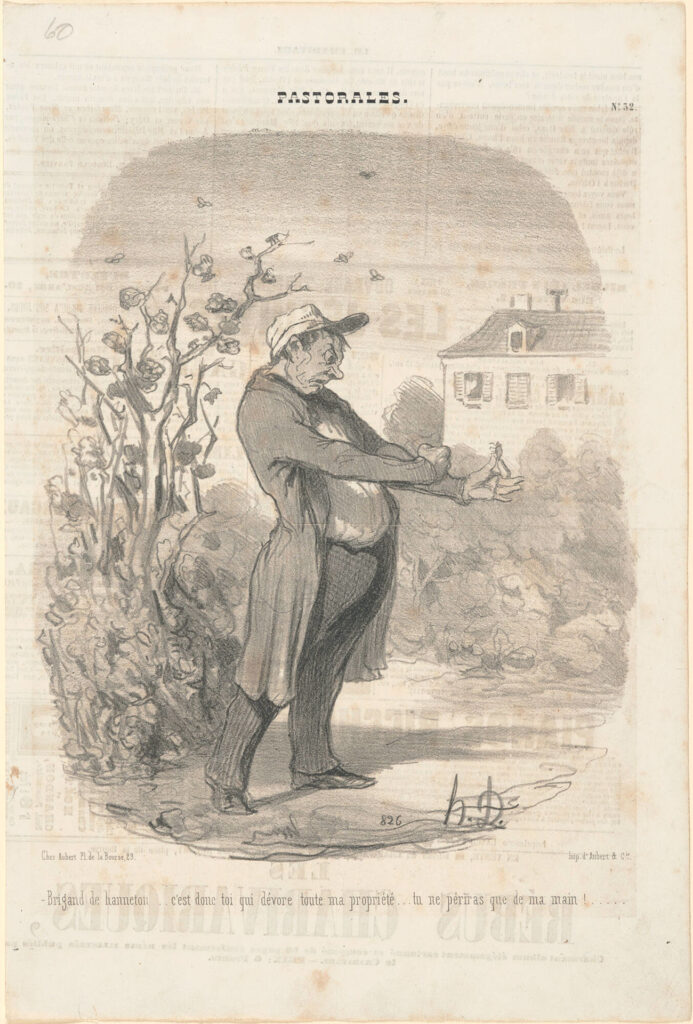
For centuries, cockchafers were dreaded as one of the great scourges of agriculture.xix The voracious larvae, known as “white grubs,” feed on the roots of many cultivated plants,xx while the adults devour leaves, sometimes causing complete defoliation. Unsurprisingly, they were widely detested and exterminated for these reasons. The violence of the language used against them in nineteenth‑century press and literature is enough to make any modern reader shudder.xxi
In the pre-industrial period, the principal means of reducing cockchafer populations was simply to collect and kill the adults, thereby interrupting their reproductive cycle. In French, this practice had a name: le hannetonage. Encouraged by public authorities, and sometimes made compulsory,xxii it mobilized rural communities across France, Switzerland, Germany, Austria, Great Britain, and likely elsewhere in Central and Western Europe. Elderly people, women, and children often took part eagerly, especially when local administrations offered bounties for each liter or kilogram collected.
The hunt relied on the insect’s peculiar habits. Cockchafers are active for only a few hours each day, usually at dusk. The rest of the time, they remain torpid, clinging motionless to the undersides of leaves. They could therefore be gathered, as one nineteenth-century account explains, “by violently shaking the branches of the trees on which they doze during the day,”xxiii making them fall to the ground or onto cloths spread below. French texts sometimes describe this spectacle with expressions such as “faire pleuvoir les hannetons”—“making it rain cockchafers.”
Once gathered from trees and hedges, the insects were destroyed in various ways: crushed under millstones, poisoned with naphthalene, or boiled for a few minutes—a process many described as producing a horrid stench. They were then sometimes used as fertilizer: rich in nitrogen, they were considered a valuable manure when mixed with lime.xxiv They were also fed to pigs and poultry,xxv although it was widely said that hens fed on cockchafers or white grubs laid eggs with a markedly unpleasant taste.xxvi So many insects were killed in these campaigns—literally hundreds of tons—that they were carted away in bulk and, in some towns, brought to the town hall in such quantities that “the air was filled with stench.”xxvii
In some regions, hannetonage survived into the 1960s. But from the 1880s onward, these collective hunts were supplemented—and eventually overtaken—by more industrial methods: light traps, then chemical pesticides, from naphthalene, arsenic, benzene, and carbon disulfide to DDT and HCH.xxviii These methods caused cockchafer populations to collapse, especially after the Second World War. By the 1970s, they had become so scarce that they were no longer considered a threat to farmers.xxix
Since the 2000s, populations of Melolontha melolontha—as well as Melolontha hippocastani, the forest cockchafer—have risen again in some regions. They are, however, nowhere near the densities described in older literature, and many people still lament not having encountered a single cockchafer in decades.xxx
Environmental Generational Amnesia
Yet this decline is hardly noticeable for those who, like me, never knew the days when “maybugs fell like hail”xxxi and filled the air with their emanations. Only older people still seem to wonder: whatever happened to maybugs?xxxii That asymmetry of memory points to what the psychologist Peter Kahn called “environmental generational amnesia”:
People take the natural environment they encounter during childhood as the norm against which they measure environmental degradation later in their life. With each ensuing generation, the amount of environmental degradation increases, but each generation takes that degraded condition as the non-degraded condition, as the normal experience.xxxiii
As the environment deteriorates, at local and global scales, the baseline shifts with it.xxxiv What older generations experience as loss feels ordinary to the young who lack experience and information regarding past conditions. We thus inherit not only damaged ecosystems, but also a diminished capacity to perceive what has disappeared from them.
This amnesia arises at the intersection of two phenomena. The first is the erosion of biodiversity itself: the accelerating rate of species extinction, the decline in populations, and the degradation of natural habitats. The second is what the lepidopterist Robert Pyle famously called “the extinction of experience”xxxv: not the disappearance of species as such, but of ordinary, repeated, embodied encounters with them in increasingly urbanized, indoor, and virtual environments.xxxvi We may still know of animals and plants, but no longer with the intimacy born of catching, handling, smelling, hearing, or simply noticing them in ordinary life.xxxvii What is lost, too, is a “multisensory literacy”xxxviii of the living world.
Cockchafers offer a striking example of this double loss. Their former abundance made them familiar to virtually everyone. Today, by contrast, both the decline of their populations and the loss of everyday contact with nature have made them strangers to most of us. The testimonies collected in the French journal Argiope in 2005 make that recent and rapid loss of familiarity even more palpable.xxxix Amateur and professional naturalists recalling the 1940s-1950s describe maybugs as common even in mid-sized cities. Some remember branches bending under the weight of the beetles, others walking through veritable clouds of them. One witness, recalling a rare population outbreak in Savoie in the spring of 1974, remembers “the very peculiar scent” emanating from the boxes into which biology students had gathered them. Another woman recalls playing with them as a child despite the fact that they “gave off a nauseating odor that made their company unappealing.”
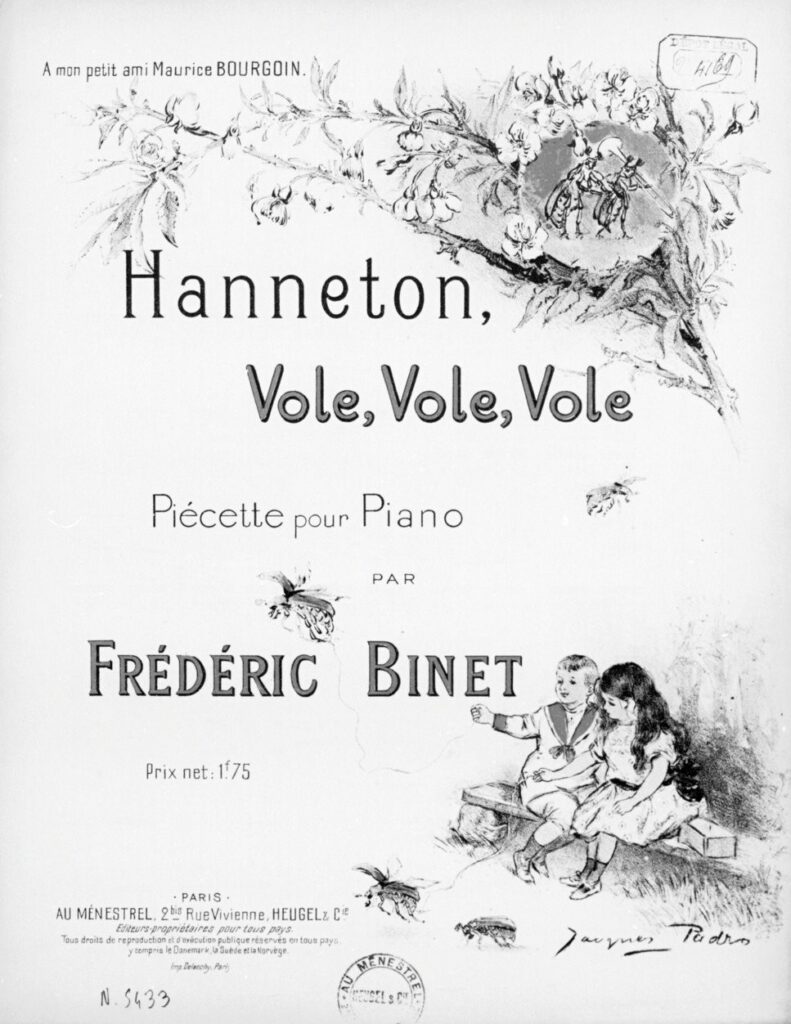
In fact, most of these witnesses recall playing with cockchafers, as kids had done since Antiquity. In ancient Greece, children tied a thread to one of the insect’s legs and set it free to watch it fly in circles.xl Children across Europe continued to play similar games until the mid-twentieth century, making maybugs fly on a string or pull tiny paper carts. These amusements were so popular that, in large cities, destitute boys collected the insects on the outskirts of town and sold them in the streets as living kites.xli In 1880, one could read: “The cockchafer! Who doesn’t know it? What child hasn’t spent hours chasing it, and having fun tormenting it in a thousand ways?”xlii Thirty years later, another writer assumed that nearly every reader had, at some point, played with one:
Cockchafer fly, fly! Who among you, dear readers, has not sung this ancient refrain to the unfortunate cockchafer that you held captive at the end of a thread that tied it by the leg? This insect is found in such great abundance, at certain seasons, and it is so easy to catch, that surely few of you have never had one in your possession.xliii
By the late twentieth century, however, this was no longer true. In 1992, horticultural engineer Jack Goix observed that the common cockchafer was now “absent from the memory of children,”xliv adding that its populations had been reduced to such an extent that the general public was beginning to wonder whether the insect still existed at all. In that light, physiologist Paul Bert’s early-twentieth-century warning to schoolchildren not to indulge in the cruel amusement of tying a cockchafer by the leg now reads almost ironically: today, the difficult game, in many regions, would be finding the insect in the first place…xlv
https://artuk.org/discover/artworks/a-dragon-fly-two-moths-a-spider-and-some-beetles-with-wild-strawberries-142223/search/2026–keyword:cockchafer–referrer:global-search
Literature as Sensory Archive
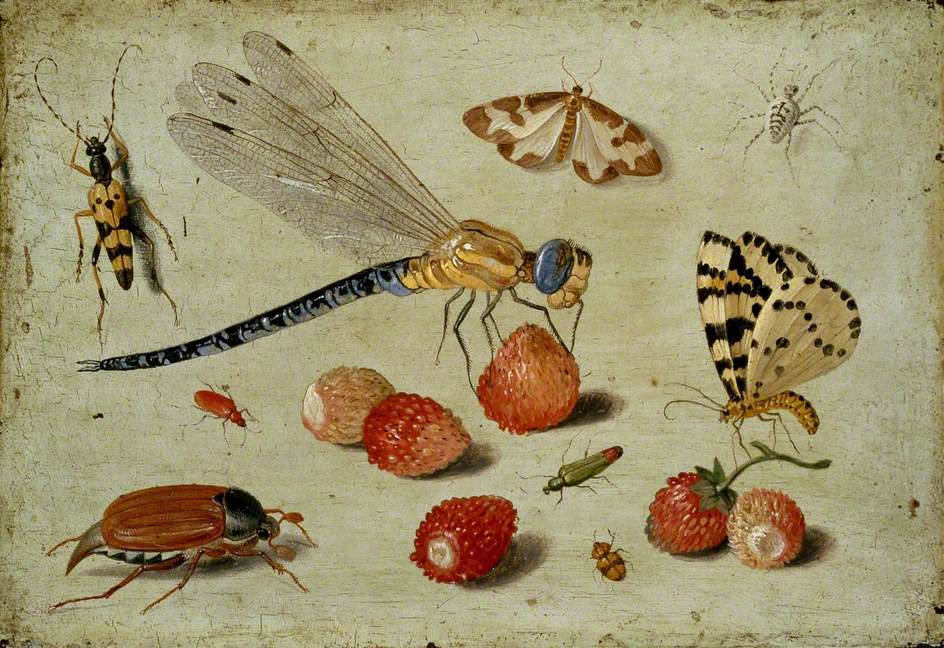
The cultural history of maybugs stretches back to Antiquity. Up through the twentieth century, especially in Central and Western Europe, they were everywhere: not only in nature, but in poems, folktales, and nursery rhymes; in children’s games, schoolrooms, and kitchens; in medicine, agriculture, and industry.xlvi Loved and loathed in equal measure, Melolontha melolontha belonged fully to collective life and imagination. Today, though they are not critically endangered, they belong mostly to memory, and I fear their peculiar smell may soon be known almost exclusively through the words of writers from a time richer in cockchafers.xlvii
How many other natural smells, sounds, textures, and living beings, not yet extinct, have already slipped from common perception, from language, from metaphor, from collective imagination? And if they no longer exist for us in that way, how are we to care for them, or even fully grasp what their disappearance means? This is why literature matters. It preserves traces of worlds already slipping away. When writers evoke beings and sensations we no longer know, they allow us to measure the distance between their former familiarity and our present estrangement. In that sense, literature acts as both a biodiversity archive and a sensory archive: a repository of past realities, helping to counter, however imperfectly, environmental amnesia.xlviii
In the end, it was literature that made me realize I miss cockchafers. Even their smell—however unpleasant it was made to sound.
Clara Muller is a French art historian and art critic conducting research on olfaction in art, design, and literature. She has been a writer for the olfactory magazine and publishing house Nezsince 2016. She contributes to the collection “The Naturals Notebooks” for which she studies the place of aromatic plants in the history of visual and decorative arts. She has curated several exhibitions dedicated to olfactory art and design. https://www.claramuller.fr/
Reinhard Mey
Il n’y a plus de hannetons
This French song from 1975 by Frederik Mey titled There’s no more maybugs mourns the vanishing of maybugs (cockchafers) that were once abundant spring insects across Europe. These beetles were so common that they shaped seasonal memory. Children collected them, farmers battled them, and they even entered cuisine and folklore. But, by the 1970s, their numbers had dramatically declined in many regions due to pesticide use, agricultural intensification, and habitat loss. The song captures that moment of realization when something once taken for granted is suddenly gone.
The song has cultural resonance today because it is not only about extinction. It is about our relationship to noticing life. It speaks to the insect decline now widely documented globally, the erosion of everyday ecological encounters, and the emotional dimension of environmental change. The maybug has become a symbol for all the unnoticed life that underpins ecosystems.
It’s a song of small loss that foreshadowed the large ecological rupture currently underway.
iBirgit Müller and Susanne Schmitt, “Fifty Years Ago, Cockchafers Belonged to Spring…,” Seeing the Woods, 27 July 2018. Retrieved from: https://seeingthewoods.org/2018/07/27/reflections-on-insect-loss/.
iiColette, Pour un Herbier, in Œuvres complètes de Colette, t. XIV, Paris, Flammarion (Le Fleuron), 1950, p. 157. In an earlier book, Colette mentions a visit to a naturalist in the midst of taxidermizing a beetle and notes: “I can smell its rotten cockchafer odor from afar.” (Colette, La Paix chez les bêtes, Paris, Georges Crès et Cie, 1916, p. 139).
iiiPerfumer Jean-Claude Ellena also mentions the smell of rose chafers in one of his books: “‘Can you smell the cockchafer?’ my grandmother would ask me when we were picking roses for the perfume houses. The smell of the cockchafer was the indicator of a good scent.” (Jean-Claude Ellena, Le Parfum, Paris, PUF, coll. « Que sais-je ? », 2007, p. 41). According to him, they smelled like cumin, or, more precisely, cuminic aldehyde. (Personal communication with Jean-Claude Ellena by email, 28 March 2026).
ivThe males’ larger antennae allow them to track pheromones released by females easily, as well as volatiles emitted by damaged leaves. (Joachim Ruther, et al., “Mate finding in the forest cockchafer, Melolontha hippocastani, mediated by volatiles from plants and females,” Physiological Entomology, Vol. 25, 2000, pp. 172-179).
vWilliam Dollard, General and Medical topography of Kalee Kemaoon and Shore Valley, with sketches of the cantonments of Lohooghaut and Petoragurh, Calcutta, 1840, n.p.
viVictor Meunier, Les Animaux à métamorphoses, Tours, A. Mame, 1876, p. 257.
viiMarc Anfossi, “Madame Torpille. Troisième Partie : Pris au piège !,” L’Indépendant de Seine-et-Oise, 30 March 1890, p.1.
viiiAnonym, “Séance du 16 août 1864,” Annales de l’agriculture française, 1st July 1864, p. 338.
ixMathieu W. Williams, The Chemistry of Cookery, London, Chatto & Windus, 1906, p. 34.
xFemales in particular, especially while feeding, release various volatiles that act as pheromonal cues for males, including phenol, toluquinone, and 1,4-benzoquinone. (H.F. Huiting, et al., “Biology, control and luring of the cockchafer, Melolontha melolontha,” Literature report on biology, life cycle and pest incidence, current control possibilities and pheromones, Praktijkonderzoek Plant & Omgeving BV, Wageningen, 2006).
xiAlain Fraval, “Les insectes qui sentent,” Insectes, n° 178, 2015, p. 15.
xiiIn 1934, French poet René Char even wrote that poetry can “become intoxicated by anything, even the smell of cockchafers.” (René Char Le Marteau sans maître, Paris, Editions surréalistes, 1934, p. 76). The smell of maybugs also entered social language as a metaphor. In late 19th and early 20th-century France, it was used metaphorically to describe the smell of the poor, of vagabonds, or of crowds. This discriminating association shows how widely recognized the unpleasant smell of these insects once was.
xiiiA. L., “Pau et Département,” Le Mémorial des Pyrénées, 20 April 1880, p. 3.
xivCarlos Larronde, Cristaux, Paris, Albert Messein, 1931, n.p.
xvSociété nationale de protection de la nature, Revue des sciences naturelles appliquées : bulletin bimensuel de la Société nationale d’acclimatation de France, 1892, p. 38; Paul Souriau, “Le Symbolisme des couleurs,” La Revue de Paris, 1st March 1895, p. 857; J. Saint-Romain, “Le mariage de Sabine,” Les Veillées des chaumières, 6 September 1919, p. 709.
xviL. B., “Lille. Çà et là. Le Bois Joli,” L’Echo du Nord, 13 mars 1903, p.
xviiThe presence of TMA could also explain why roasted cockchafers or cockchafer soup, consumed in Ireland, France, Luxembourg and Germany between the 17th and 19th century, were usually said to taste like shellfish.
xviiiFabien Zunino, “Plantes odorantes,” Tela Botanica, April 2011; Dr. Colomb, “Voluptés Spectaculaires,” La Cigale uzégeoise, 1st March 1926, p. 114.
xixParadoxically, in France in particular, some regional sayings, like “Year of cockchafers, year of abundance,” associate cockchafers with good harvests.
xxThe larvae actually find roots in the soil through their olfactory system thanks to the biogenic volatile organic compounds they release. (Sonja Weissteiner, et al., “Cockchafer larvae smell host root scents in soil,” PloS One, Vol. 7, no. 10, 2012). While adults, male in particular, are attracted by green leaf alcohols such as (Z)-3-hexen-1-ol, (E)-2-hexen-1-ol, 1-hexanol, and by volatiles from mechanically damaged leaves of the common beech, of the English oak and of the common hornbeam. (Andreas Reinecke, et al., “Alcoholism in cockchafers: orientation of the male Melolontha melolontha towards green leaf alcohols,” Naturwissenschaften, Vol. 89, 2002, pp. 265-269).
xxiIn the Middle Ages, when effective pest control scarcely existed, the fight against cockchafers gave rise to bizarre episodes from a modern perspective. In 1320, for instance, cockchafers were brought before court in Avignon, France, and ordered to withdraw within three days; when they failed to comply, they were ultimately condemned the the death penalty. In 1479, in Switzerland, another trial was brought against them: the insects were excommunicated and ordered, along with their descendants, to forever leave the Lausanne diocese. (William Jones, “Legal Prosecutions of animals,” Popular Science Monthly, Vol. 17, September 1880, p. 624).
xxiiThere are reports of fines being received by people who didn’t bring in enough cockchafers in the season.
xxiiiLouis Figuier & Peter Martin Duncan, The Insect World: being a popular account of the orders of insects, together with a description of the habits and economy of some of the most interesting species, London, Cassel, 1892, p. 455.
xxivLucien Rousseau, “Chronique Agricole. Destruction des hannetons,” Journal d’agriculture pratique, de jardinage et d’économie domestique, 1st January 1869, p. 614.
xxvFrançois Rozier, Cours complet d’agriculture, t. V, Hôtel Serpente, 1784.
xxvi Anselme Payen, “Animaux nuisibles à l’agriculture,” Revue des Deux Mondes, t. 76, 1868, pp. 652-667.
xxviiJean-Henri Fabre, Les ravageurs : récits de l’oncle Paul sur les insectes nuisibles à l’agriculture, Paris, C. Delagrave, 1870, p. 96.
xxviiiWe should also note the attempts to biological pest control by pioneer engineer Léopold Le Moult who, in 1891, proposed to fight white grubs infestations with an entomopathogenic fungi, Botrytis tenella. The technique proved quite successful until 1939 before being superseded by chemical pesticides. (André Gougeroux, “Le Hanneton et la Lemoultine,” Insectes, no. 217, June 2025, pp. 11-12).
xxixGerd Crüger, Pflanzenschutz im Gemüsebau, Stuttgart, E. Ulmer, 1972. Three years after this article, German composer Frederik Mey relased a song called Es gibt keine Maikäfer mehr, in German, with a French version titled Il n’y a plus de hannetons (“There are no more maybugs”).
xxxAlthough this recovery may not just reflect more restrained pesticide use but also declines in the populations of the cockchafer’s natural predators, the return of cockchafers is, in many ways, good news. It may not please farmers or foresters but it offers hope for the remaining species for which cockchafers are prized prey: insect-eating birds, amphibians, bats, and mammals including bats, hedgehogs, weasels, martens, moles, badgers, and even foxes. Several 18th-century books on trapping wolves and foxes indeed claimed that the bait was to be coated with cockchafer oil, the smell of which exerts an almost irresistible attraction on these animals. (Louis de Loménie, Les Mirabeau : nouvelles études sur la société française au XVIIIe siècle, t. II, Paris, E. Dentu, 1879, p. 236). One might also recall the remark attributed to the Marquis de Mirabeau by his biographer Edmond Rousse: “Men will always rally to honesty like foxes to the scent of a cockchafers.”(Edmond Rousse, Mirabeau, Paris, Hachette, 1891, p. 32).
xxxiJean-Henri Fabre, op. cit., p. 91.
xxxiiAnonym, “Où sont passés les hannetons du canton?,” Museum d’Histoire Naturelle de Fribourg, 21 October 2022. Retrieved from: https://www.fr.ch/mhnf/actualites/ou-sont-passes-les-hannetons-du-canton
xxxiiiPeter H. Kahn, “Children’s affiliations with nature: Structure, development, and the problem of environmental generational amnesia,” in P. H. Kahn, Jr. & S. R. Kellert (Eds.), Children and nature: Psychological, sociocultural, and evolutionary investigations, Cambridge, MA, MIT Press, 2002, p. 113.
xxxivDaniel Pauly, “Anecdotes and the Shifting Baseline Syndrome of Fisheries,” Trends in Ecology & Evolution, Vol. 10,no. 10, October 1995, p. 430.
xxxvRobert Pyle, The Thunder Tree. Lessons from an Urban Wildland, New York, Houghton Mifflin, 1993.
xxxviMasashi Soga and Kevin J. Gaston, “Extinction of experience: the loss of human-nature interactions,” Frontiers in Ecology and Environment, Vol. 14, no. 2, March 2015, pp. 94-101.
xxxviiRecent work has reinforced this intuition, showing that reduced contact with nature can weaken both nature-relatedness and the desire to protect it. (Victor Cazalis, Michel Loreau, and Gladys Barragan-Jason, “A global synthesis of trends in human experience of nature,” Frontiers in Ecology and the Environment, Vol. 21, no. 2, March 2023, pp. 85-93).
xxxviiiSachi Sekimoto, “Reading the air: toward multisensory literacy for the Anthropocene,” The Senses of Society, Vol. 20, no. 3, 2025, pp. 281-297.
xxxixAlain Livory, “Premiers témoignages sur le hanneton commun,” Argiope, no. 49, 2005, pp. 9-16; “Témoignages sur le hanneton commun (suite),” no. 50, 2005, pp. 17-20.
xlAristotle tells us that Cetonia aurata shared with Melolontha melolontha the “privilege” of amusing children. Aristophanes, in his comedy The Clouds: “Let your spirit soar, let it fly whither it lists, like the Melolontha tied with a thread by the leg.” (Louis Figuier and Peter Martin Duncan, op. cit., p. 445).
xliAlphonse Karr, “Les Hannetons,” Le Figaro : supplément littéraire, 22 March 1890, p. 1.
xliiMarie Maugeret, La Science à travers les champs, Tours, A. Mame, 1880, p. 62.
xliiiPaul Maryllis, Les Vacances du petit naturaliste : à travers le monde des plantes, la chasse aux papillons, le collectionneur d’insectes, les vacances à la mer, Paris, Hachette, p. 97.
xlivJack Goix, “Ces insectes ! Que sont-ils devenus ?,” Insectes, n° 85, 1992, pp. 25-27.
xlvPaul Bert, L’année préparatoire d’enseignement scientifique (sciences naturelles et physiques) : l’homme, les animaux, les végétaux, les minéraux, phénomènes usuels, 27e édition, Paris, A. Colin, 1910.
xlviIn Germany, particularly, Maybugs became fixtures of popular song, Pentecost imagery, and springtime confectionery. (Gisbert Zimmermann, “The European cockchafer in Germany: Beloved and hated. A contribution to its role in cultural history and the history of control,” Journal fur Kulturpflanzen, Vol. 62, no. 5, pp. 157-172). They were also occasionally eaten—in soup, sweets, and even raw—, used in folk medicine, and put to practical uses in agriculture and industry, whether for burning oil, fertilizer, or animal feed.
xlviiSwiss chemist Roman Kaiser once remarked: “In order to conserve an olfactant for the future, if that is your goal, one must first and foremost describe it—verbally describe it with all the adjectives one has at one’s disposal.” (Roman Kaiser, “Headscape: An Interview with Roman Kaiser,” Future Anterior, Vol. 13, no. 2, 2016, p. 5). Yet literature preserves not only “an olfactant” but the density of meanings once attached to its perception. In the case of the smell of maybugs: revulsion, seasonality, childhood play, botanical knowledge, etc.
xlviiiOn the power of literary and creative works to counteract environmental generational amnesia, see: Stef Craps, “Remembering Earth: Countering Planetary Amnesia through the Creative Arts”, in A. Erll, S. Knittel, and J. Wüstenberg (Eds.), Dynamics, Mediation, Mobilization: Doing Memory Studies with Ann Rigney, Berlin/Boston, De Gruyter, 2024, pp. 313-424.
Plantings
Issue 59 – May 2026
Also in this issue:

The Green Bloom: Chlorophyll, Light, and Renewal
By WS/C
Edward Steichen: Delphiniums on Umpawaug Farm
By Gayil Nalls
Elizabeth Blackwell: The Courage of Attention
By John Steele

The Importance of Embodied Joy
By Gayil Nalls

Seeds, Time, and the Human Psyche
By Margherita Gandolfi
Eat More Plants Recipes:
Spring Dandelion & Burdock Broth
By Gayil Nalls

As Ireland transitions from the rich, smoky scent of peat-burning to a more sustainable future, its olfactory heritage is evolving. What will become the next iconic aromatic symbol of Ireland?
Click to watch the documentary trailer.
As Ireland transitions from the rich, smoky scent of peat-burning to a more sustainable future, its olfactory heritage is evolving. What will become the next iconic aromatic symbol of Ireland?