

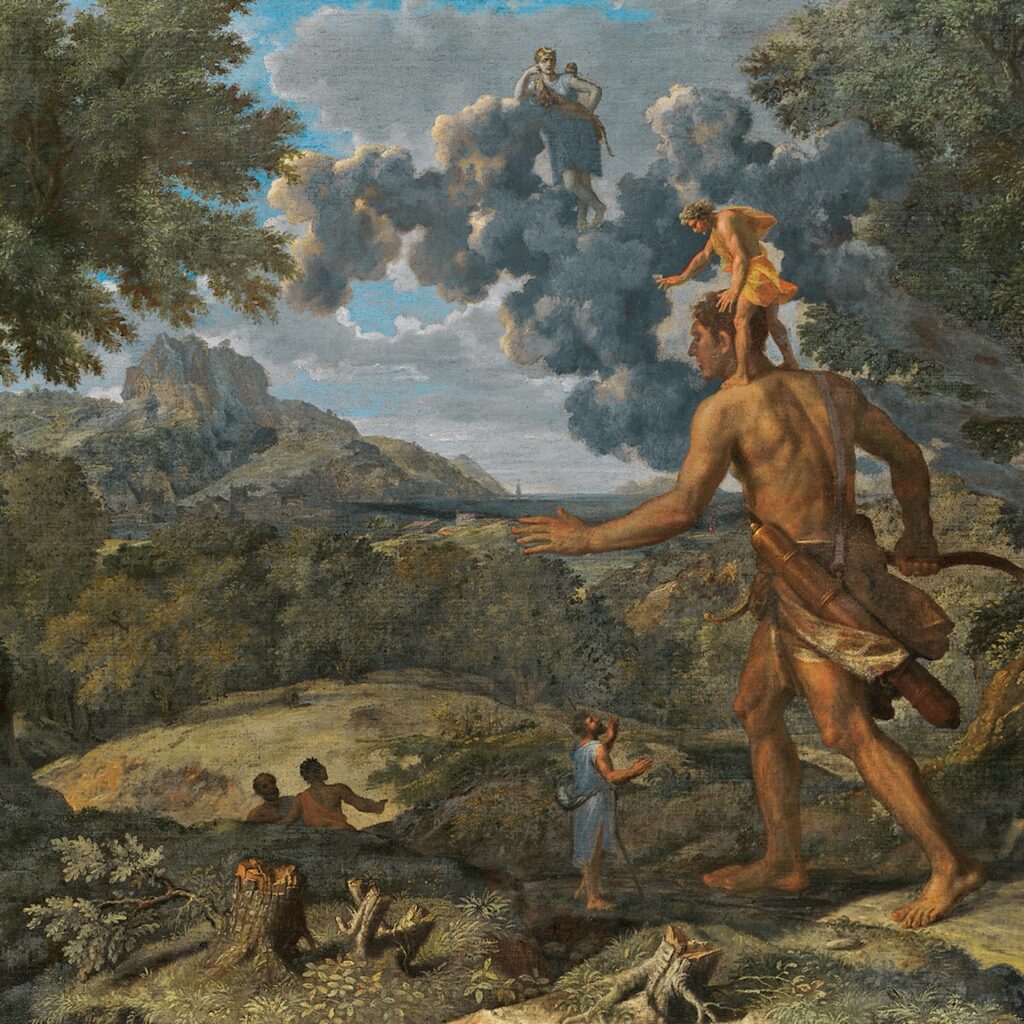
Blind Orion Searching for the Rising Sun, by Nicolas Poussin, Oil on Canvas, 1658, Collection of The Metropolitan Museum of Art
The Living World Inside the Frame
At The Met, “Ecologies of Painting” asks us to look again at European art and at the relationships between people, plants, labor, and land.
By Gayil Nalls
Sign up for our monthly newsletter!
A field of wheat glows in the summer heat. Workers cut the grain, gather apples, and pause for a meal beneath a tree. In Pieter Bruegel the Elder’s The Harvesters, painted in 1565, human life seems inseparable from the season. The land provides food, but only through the work of those moving across it.
This painting is one of ten works in Ecologies of Painting, a special installation at The Metropolitan Museum of Art that considers how European artists pictured the natural world between roughly 1525 and 1775. Its premise is simple and far-reaching: people have never existed outside nature, even when their art has encouraged them to imagine otherwise. Human and nonhuman histories are fundamentally intertwined.
Look longer at Bruegel’s harvest, and the apparent harmony becomes more complicated. The Met notes that the scene was commissioned by a wealthy Antwerp merchant for his country home. Its laborers receive a sympathetic portrayal, yet the painting softens the physical difficulty of their work. The abundance belongs to the field; the pleasing vision of that abundance belongs, in part, to the patron. What looks like a portrait of seasonal life is also a record of who worked the land and who could afford to contemplate it.
Other paintings draw us closer to forms of life that a grand landscape can make easy to overlook. In Otto Marseus van Schrieck’s Still Life with Poppy, Insects, and Reptiles, a poppy grows amid the activity of lizards, a snake, snails, and butterflies. The artist was known for exploring the forest undergrowth and studying natural specimens, including with a microscope. His painting invites the eye toward a crowded, interacting world at ground level. The flower is beautiful, but it does not stand alone. It requires the ecosystem.
Nicolas Poussin’s Blind Orion Searching for the Rising Sun opens that sense of connection to a larger scale. Orion, a figure from Greek myth, moves through a landscape shaped by sunlight, water, clouds, and rain. The Met’s interpretation draws attention to the water cycle within the scene: the sun lifts moisture, clouds gather, and rain returns to nourish the soil. Myth becomes a way to picture forces that move through bodies and landscapes alike.
Yet looking carefully at nature is not the same as seeing a place clearly. Frans Post’s A Brazilian Landscape includes observed plants and animals, including an iguana, but was painted after the Dutch artist returned from colonial Brazil. The Met asks viewers to consider what its tranquil view leaves out: Indigenous dispossession and the enslavement of Africans whose labor underpinned Dutch colonial wealth. The painting offers a landscape that could be admired and, for a European buyer, possessed as an image, while concealing the violence connected to its resources.
These works remind us that a landscape painting is never a neutral window. The artist decides where we stand, what we see, and whose presence matters. A harvest can appear effortless from a distance. A flower can become decoration when its surrounding lives disappear from view. A colonized landscape can be made to look empty of conflict.
The paintings themselves also come from the natural world. Bruegel painted on oak; Post painted on wood; other works in the installation use canvas. The Met asks visitors to think about flax, timber, ground minerals, and linseed and walnut oil, as materials with histories beyond the images they helped create. Even an artwork hanging inside a museum remains connected to fields, forests, and the earth, reacting to light and humidity.
That may be the exhibition’s most enduring invitation. To see ecologically, and to see relationships between a poppy and the creatures around it, between rainfall and harvest, between beauty and labor, between a painting and the materials from which it was made. Ecologies of Painting gives familiar works another life by asking us to look beyond the frame, and then back into it with greater care.
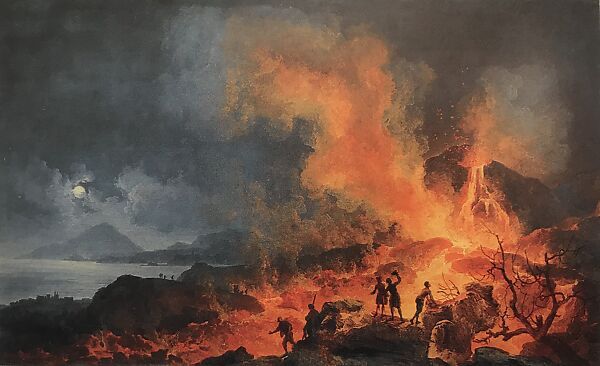
At the Edge of Vesuvius
In Pierre Jacques Volaire’s The Eruption of Vesuvius, A View of Naples Beyond (ca. 1776), the mountain commands the scene. Lava lights the darkness while small human figures stand before it, some drawn toward the spectacle, others seemingly overcome by fear. Volaire carefully arranged their gestures to evoke the sublimeandthe idea that nature’s immense power could inspire wonder and terror at once.
Vesuvius attracted travelers from across Europe, and Volaire found a market for paintings they could take home as luxurious reminders of what they had seen. Yet the eruption exceeds the boundaries of a souvenir. The view he painted is so compelling. The land is being remade and the lives upon it threatened. Nearby excavations at Pompeii, begun in 1748, sharpened the era’s fascination with volcanic destruction, the Earth’s past, and what Vesuvius famously destroyed within minutes.
Within Ecologies of Painting, Volaire’s work offers a forceful counterpoint to cultivated fields and carefully observed flowers. People may shape landscapes and turn them into images, but the earth remains active beneath their feet. His tiny spectators confront a truth the exhibition returns to again and again: human life is bound to natural forces it can observe, represent, and study, but never fully command.
Ecologies of Painting is on view through January 17, 2027, in Gallery 638 at The Met Fifth Avenue. The installation is free with museum admission.
Gayil Nalls, PhD, is an interdisciplinary artist, theorist, conservationist, and the founder of the World Sensorium / Conservancy.

Plantings
Issue 66 – December 2026
Also in this issue:
Plants as Life’s Painkillers
Gayil Nalls
Plants are Important: The Part About Drugs
Lewis H. Ziska
What Trees Let Go: Lessons from Flora on Rest and Renewal
Willow Gatewood
Humans Are Killing Helpful Insects in Hundreds of Ways––Simple Steps Can Reduce the Harm
Christopher Halsch and Eliza Grames
Why are there so many plants?
Kale Sniderman, Chris Mays, and Greg Jordan
Eat More Plants Recipes:
Black Bean Brookies
Skye Gatewood
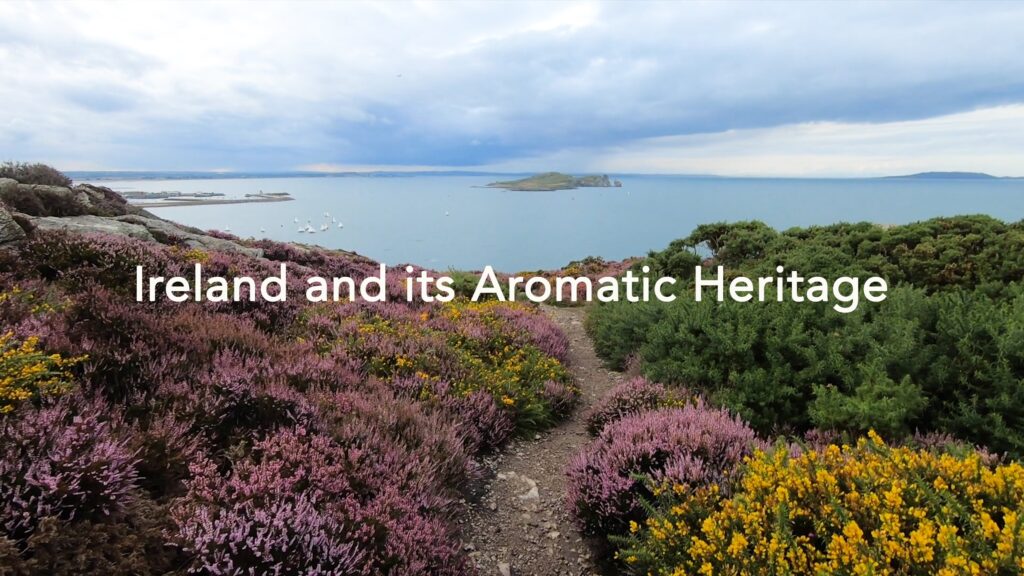
As Ireland transitions from the rich, smoky scent of peat-burning to a more sustainable future, its olfactory heritage is evolving. What will become the next iconic aromatic symbol of Ireland?
Click to watch the documentary trailer.
As Ireland transitions from the rich, smoky scent of peat-burning to a more sustainable future, its olfactory heritage is evolving. What will become the next iconic aromatic symbol of Ireland?